Table of Contents
Gothic anime occupies a unique corner of the medium—one where beauty and dread are inseparable, and every shadow feels alive. Unlike straightforward horror, these series draw from centuries of literary gothic tradition, mixing Victorian decay, existential terror, and voluptuous melancholy into something that lingers long after the screen goes dark. For viewers who crave atmosphere over jump scares and moral complexity over tidy resolutions, gothic anime offers a visual and narrative feast.
At its core, gothic storytelling is about transgression and the weight of the past. Crumbling architecture mirrors fractured psyches; cursed bloodlines echo the inescapability of fate; supernatural entities become externalizations of inner torment. Anime, with its ability to fuse detailed background art with stylized character designs, amplifies these themes. A single rain-slicked alley in Tokyo Ghoul can convey more despair than pages of exposition. The genre isn’t a formal category like shonen or shojo but a mood—a shared sensibility that runs through horror, dark fantasy, psychological thriller, and even romance.
What follows is a deep dive into the visual language, narrative obsessions, and cultural footprint of gothic anime. You’ll find classics that established the template, modern series that push boundaries, and the archetypes that make these tortured protagonists so compelling. Along the way, we’ll explore how gothic anime has influenced fashion, fan art, and even literature beyond the screen.
Key Elements of Gothic Aesthetics in Anime
Gothic anime is immediately recognizable. Its world feels heavy with history, sorrow, and the uncanny. Three elements define the aesthetic: a meticulously constructed visual atmosphere, a deep engagement with gothic horror traditions, and a dense network of symbols that reward repeated viewing.
Visual Style and Atmosphere
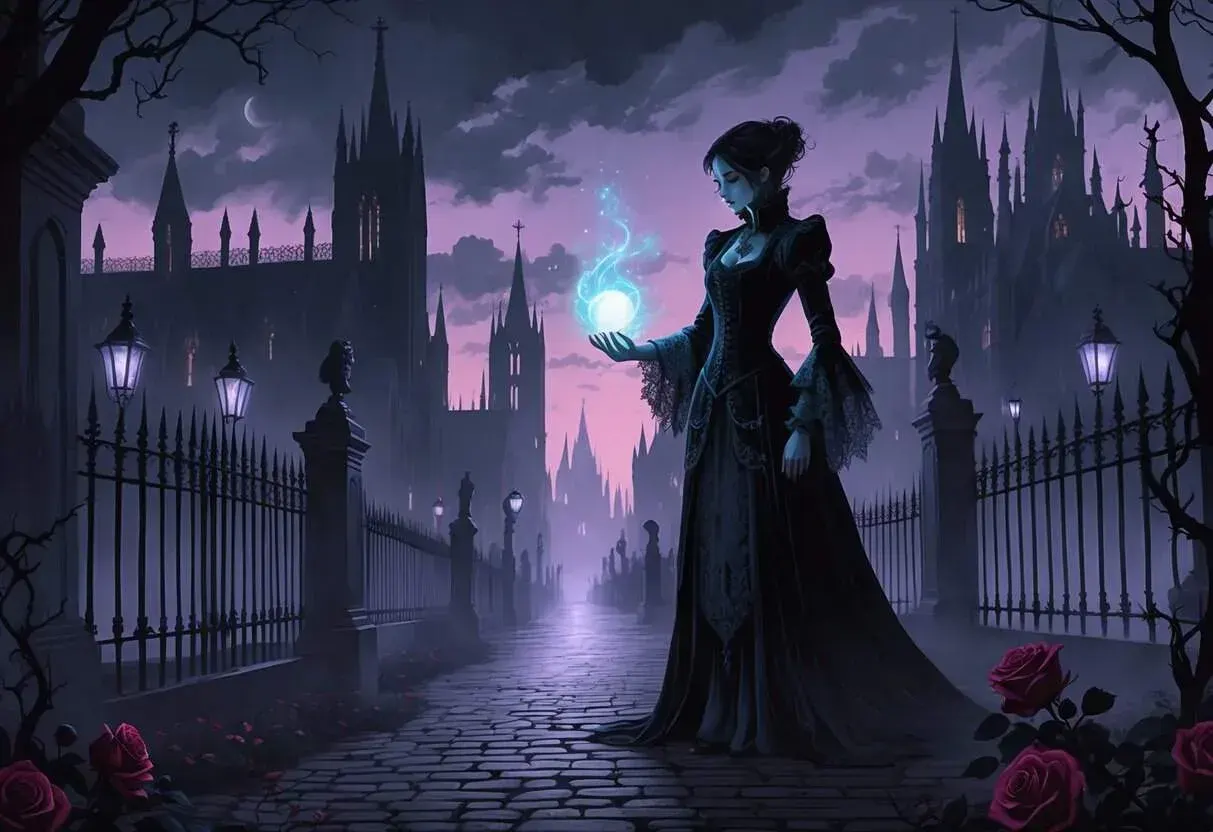
If sunshine is rare in gothic anime, it’s by design. The color palette tends toward charcoal grays, bruised purples, arterial crimsons, and bone whites. High-contrast lighting is essential—characters are often half-consumed by shadow, their faces split between illumination and obscurity, reflecting divided loyalties or hidden natures. Backgrounds are just as important as foreground action. You’ll see cathedrals whose spires seem to pierce a perpetually overcast sky, manor houses choked with ivy and dust, and cityscapes where gas lamps flicker against an encroaching industrial gloom.
Weather plays a narrative role. Rain is a cleansing that never comes; fog obscures truth; snow falls on fresh graves. In Claymore, the warriors move through medieval hamlets permanently cloaked in mist, their silver eyes the only points of brightness. In Another, a sleepy town’s overcast skies mirror a curse that tightens with each death. These environments aren’t just backdrops—they are expressions of the characters’ internal states.
When Ken Kaneki wanders through Tokyo’s rain-drenched wards in Tokyo Ghoul, the city becomes a labyrinth of hunger and alienation.
Costuming further anchors the aesthetic. Victorian-era silhouettes—tailcoats, corsets, lace gloves, high collars—blend with punk and gothic lolita influences. Ciel Phantomhive’s meticulously tailored shorts and top hat in Black Butler are as much a mask as his emotional detachment. The flowing black coats of Alucard in Hellsing turn him into a walking shadow. Even series set closer to the present day, like Death Note, use costume to signal otherness: Light Yagami’s descent into godhood is paralleled by the increasingly severe, almost clerical lines of his clothing.
Influence of Gothic Horror Traditions
Anime didn’t invent the gothic—it inherited and transformed it. The genre’s literary roots stretch from Horace Walpole’s The Castle of Otranto through the Brontë sisters, Edgar Allan Poe, and Bram Stoker. Anime creators internalize these tropes and refract them through distinctly Japanese anxieties. Haunted mansions become isolated schools or hospitals. The sin of the father becomes a corporate conspiracy or a scientific experiment gone wrong.
The vampire evolves into a half-human monster struggling with identity.
Supernatural entities abound, but they’re rarely simple antagonists. Ghouls in Tokyo Ghoul are victims of biological tragedy. Demons in Black Butler are bound by contract and a twisted code of etiquette. The vengeful spirits summoned by Ai Enma in Hell Girl are tools of a cosmic justice system that devours both the sinner and the one who pulls the cord. This ambiguity is pure gothic: the line between monster and victim is permeable, and salvation is never guaranteed.
Violence in gothic anime is often operatic rather than gratuitous. It erupts suddenly, a reminder of the fragility of the body and the chaos beneath social order. Elfen Lied, with its limb-severing telekinetic Diclonius, uses extreme gore to explore trauma and the failure of institutional care. Hellsing Ultimate orchestrates bloodshed like a dark symphony, each death a note in Alucard’s nihilistic hymn. The horror is never just about fear—it’s about the recognition that civilization is a thin veneer over unspeakable appetites.
Symbolism and Recurring Motifs
Gothic anime is a language of symbols. Learning to read them deepens every rewatch. Portraits and mirrors are among the most potent. A portrait ages while its owner remains youthful, as in The Picture of Dorian Gray—a motif twisted into the ghoul aging process in Tokyo Ghoul. Mirrors reflect not just faces but fractured souls; shattering glass often accompanies a psychological break.
In Revolutionary Girl Utena (a series soaked in gothic romanticism despite its shojo package), the mirrored lifts and dueling ground transform every encounter into a confrontation with the self.
Decay pervades the scenery. Wilting flowers, cracked porcelain, collapsed staircases—these are memento mori, reminders that all things crumble. Shadows House, a recent standout, centers on a mansion of living dolls and shadow nobles where soot and crumbling masks signal the erosion of identity. Crosses and religious iconography appear frequently, but often in corrupted forms: inverted crosses, desecrated altars, or crucifixes worn by characters who have abandoned faith. They signify a struggle with the divine that ends in despair, not redemption.
Cages, chains, and bindings recur as visual shorthand for entrapment. Whether literal prisons or metaphysical bonds—a contract with a demon, a prophecy, a biological imperative—gothic protagonists are rarely free. Their arcs are not about escape but about understanding the shape of their cage. This symbolism connects deeply with the audience, inviting introspection about our own invisible constraints.
Classic Anime That Defined the Gothic Genre
Several series established the visual and thematic vocabulary that later shows would build upon. These are the titles that proved anime could do gothic with intelligence and style, not just shock value.
Black Butler (Kuroshitsuji) transports viewers to a meticulously researched Victorian England where a 13-year-old earl, Ciel Phantomhive, has sold his soul to a demon butler, Sebastian Michaelis. The opulent aesthetic—from the Phantomhive manor to the cobbled streets of London—is a love letter to the era. But beneath the polished surface lie child murder, cult conspiracies, and the festering wound of empire. The series explores what it means to be monstrous while remaining exquisitely composed, a tension that defines gothic tragedy.
Claymore, based on the manga by Norihiro Yagi, transplants gothic horror to a medieval dark fantasy world threatened by shape-shifting Yoma. The silver-eyed Claymore warriors, half-human and half-Yoma themselves, are doomed to either die in battle or lose control and become the monsters they hunt. The desaturated palette, crumbling villages, and pervasive sense of fatalism channel the essence of gothic romance. Claire’s quest for vengeance is undercut by the knowledge that her power is a ticking clock.
Death Note may seem an outlier without castles or corsets, but its gothic credentials are impeccable. The Shinigami realm is a desolate wasteland; Ryuk’s skeletal form and black wings evoke medieval danse macabre imagery. Light Yagami’s god complex plays out in a world of perpetual twilight, where moral absolutes dissolve. The cat-and-mouse game with L is a gothic double, a duel of intellects that ends only in mutual annihilation. The series’ influence on the visual language of later gothic anime—extreme close-ups, chiaroscuro lighting, symbolic apple motifs—is enormous.
Modern Dark Anime with a Gothic Soul
Recent anime have expanded the gothic palette, incorporating psychological depth, fluid animation, and a willingness to question traditional power dynamics. These series are not just revisiting old tropes but reinventing them for a new generation.
Tokyo Ghoul became a phenomenon for its fusion of body horror and existential anguish. Ken Kaneki’s transformation into a half-ghoul is framed as a monstrous puberty, complete with unbearable hunger and physical mutation. Tokyo itself is a gothic landscape: neon-drenched but riddled with hidden alleys, a city where predators and prey wear human faces. The kagune—organic weapons that erupt from the back—are both beautiful and horrific, a visual metaphor for the repressed self clawing its way out. The series’ meditations on identity, otherness, and the cycle of violence resonate deeply with viewers who feel trapped between worlds.
The Case Study of Vanitas (Vanitas no Carte) brings vampires, steampunk, and Parisian decadence together in a story that is equal parts romantic comedy and existential dread. The vampire Noé Archiviste and the human doctor Vanitas navigate a world where cursed vampires lose their true names and become rampaging beasts. The art design is sumptuous: ornate chandeliers, flowing ball gowns, and the sparkle of blue moonlight on blood. Beneath the banter lies a meditation on memory, salvation, and the right to choose one’s own ending.
Shadows House is a masterclass in slow-burn gothic unease. In a vast, windowless mansion, living dolls serve shadowy nobles whose bodies emit soot that must be cleaned constantly. The dolls mimic their masters’ emotions until they are granted a “face” and become something like a person—or lose themselves entirely. The series uses its limited setting to explore class, identity, and the horror of being a mirror without a self. Its muted color palette, punctuated by the deep black of the shadows, feels like a Victorian engraving come to life.
Ergo Proxy and Hell Girl remain essential viewing for those who prefer their gothic with a heavy dose of philosophy. The former constructs a post-apocalyptic domed city where auto-reivs contract the Cogito virus and gain self-awareness, triggering a journey through a desolate wasteland that confronts the nature of the soul. The latter offers a modern-day Faustian bargain: at midnight, you can access a website and condemn someone to hell, but you will also go to hell when you die. Each episode is a mournful vignette of human cruelty and desperate justice, all told in a palette of muted earth tones and stark reds.
Character Archetypes and Moral Ambiguity
Gothic anime populates its worlds with figures who refuse to fit into neat moral boxes. Understanding these archetypes is key to appreciating what makes the genre tick.
The Byronic anti-hero is perhaps the most iconic: a brooding, intelligent figure driven by a dark past and a personal code that conflicts with society. Sebastian Michaelis is the ultimate expression—immaculate, lethal, and utterly beyond human morality—but he is bound by a contract that gives Ciel the illusion of control. Alucard of Hellsing is another variation: a vampire who serves a human master not out of loyalty but because he seeks a worthy death. These characters compel because they embody power without ethical constraint, yet they are themselves shackled.
The tragic monster is a gothic staple. Ken Kaneki learns that becoming a ghoul does not erase his humanity; it splits him in two. Clare from Claymore knows that her power is the very thing that will destroy her. These characters force us to ask where the monster ends and the person begins. Their suffering is not merely physical but psychological—a constant negotiation with the abyss within.
Vengeful spirits and oracles add a supernatural dimension to justice. Ai Enma of Hell Girl is both executioner and prisoner, delivering damnation while eternally burning for her own sins. Shigofumi’s Fumika delivers letters from the dead, each message a haunting reminder of unfinished business. These figures act as moral punctuation marks, but their existence also questions the value of retribution. They are liminal beings, neither alive nor truly dead, and their presence reminds us that the past can never be fully buried.
What makes these archetypes work is their refusal of easy redemption. Gothic anime rarely offers a clean happy ending. Instead, it grants catharsis through recognition: the villain’s pain is not so different from the hero’s, and the world’s cruelty is systemic, not individual. This moral complexity feels true, which is why fans return to these stories again and again.
Cultural Ripple Effects: Fashion, Art, and Beyond
Gothic anime’s influence extends far beyond the screen. It has shaped how fans dress, create, and even furnish their personal spaces.
Anime gothic fashion is a thriving subculture. At conventions worldwide, cosplayers replicate the intricate lace, corsetry, and military jackets of Black Butler’s Ciel or the draped, tattered elegance of Tokyo Ghoul’s Kaneki. Brands have taken notice, with collaborations that produce official gothic lolita lines inspired by series like Rozen Maiden or Vampire Knight. The aesthetics of anime gothic have also bled into everyday wear: dark lipstick, velvet chokers, and platform boots owe as much to Soul Eater’s Maka Albarn or Death Note’s Misa Amane as they do to Western goth bands.
Fan art communities have built entire visual languages around gothic anime. Platforms like Pixiv and DeviantArt are dense with reinterpretations that emphasize chiaroscuro contrasts, intricate detail on weapons and attire, and moody color grading. Artists often expand on moments only hinted at in the shows—Sebastian’s true form, Kaneki’s internal world, the full glory of a Claymore awakening. This participatory culture keeps the aesthetic alive and mutating. If you want to decorate your devices, gothic anime wallpapers remain hugely popular, with high-resolution edits available for almost every series mentioned here.
Anime gothic also crosses into literature. Light novels and manga have long explored gothic themes—Vampire Hunter D, Trinity Blood, and The Saga of Tanya the Evil all carry gothic DNA. More surprisingly, the anime aesthetic has influenced contemporary gothic fiction outside Japan. Authors cite Death Note as an inspiration for morally gray protagonists, while the visual storytelling of Paranoia Agent echoes in surreal horror novels. For readers who finish these anime and crave more, art books like The Art of Black Butler or Tokyo Ghoul Illustrations: zakki offer deep dives into the design philosophy behind the gloom.
Where to Start: A Curated Watchlist
With so many series available, choosing a starting point can feel overwhelming. Here’s a quick guide based on the emotional and aesthetic experience you’re seeking.
If you want opulent atmosphere and dark wit, begin with Black Butler. Its episodic mysteries build into a richer, more disturbing narrative about trauma and agency. For those who prefer psychological horror with a body-horror edge, Tokyo Ghoul remains a visceral entry point, though the manga is recommended for the full story. Fans of slow, unsettling mystery will find Shadows House mesmerizing; its patience rewards careful attention to visual cues.
If you crave action with a tragic core, Claymore and Hellsing Ultimate deliver stylized violence anchored by characters who long for something they can never have. For those drawn to moral ambiguity and intellectual battles, Death Note is foundational, and Ergo Proxy offers a more philosophical, deliberately paced alternative. Finally, if you want to sample gothic anthology storytelling, Hell Girl and Kino’s Journey (particularly the darker episodes) provide bite-sized tragedies that linger like smoke.
All these series can be streamed on major platforms, and community resources like MyAnimeList provide synopses, user reviews, and recommendations for similar titles. Academic analysis of gothic anime can be found in journals like Mechademia, and fan discourse thrives on Reddit’s anime communities. For stunning fan art and wallpapers, communities on DeviantArt and pixiv are treasure troves, and creator interviews often appear on Anime News Network.
The Enduring Pull of Gothic Anime
Why does gothic anime persist? Because it looks at the things most entertainment avoids: grief that never heals, power that corrupts absolutely, and the beauty in decay. It refuses to comfort with simple answers. Instead, it offers the solace of recognition—the understanding that loneliness, rage, and longing are shared human experiences, even when they wear a demon’s face.
The visual opulence of these series is not mere decoration; it is a form of storytelling that bypasses logic and speaks directly to emotion. A crumbling tower, a blood-red moon, a tear runneling through ash—these images bypass rational critique and lodge in memory. As anime continues to evolve globally, the gothic strain will inevitably shape new generations of creators. Whether you’re a longtime fan or a newcomer peering into the shadows for the first time, there has never been a richer moment to explore the dark, gorgeous, and sorrowful world of gothic anime.