Table of Contents
Understanding Multiple Perspective Storytelling in Anime
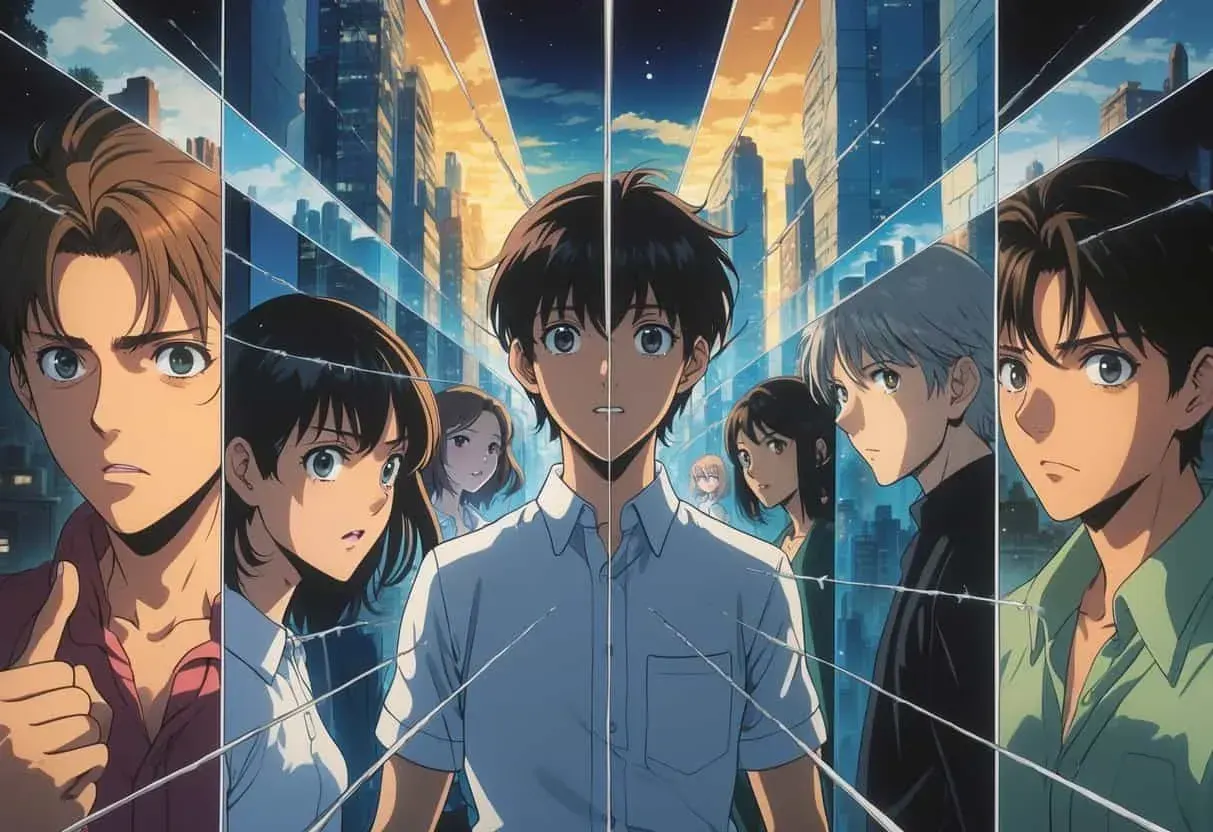
Anime that unfold through multiple points of view do more than simply switch camera angles; they fracture a single reality into a series of subjective truths, each character a prism reflecting a distinct shade of the same event. When a narrative abandons the safety of a lone protagonist, it invites you into a mosaic of motivations, biases, and incomplete knowledge. This technique transforms passive viewing into active detective work, where every episode or scene might recontextualize what you thought you knew. Shows built on this foundation often weave anachronistic timelines, overlapping actions, and ensemble casts into tapestries that feel more like lived experience than plotted story. The result is a world that breathes on its own terms, populated by individuals whose internal conflicts carry as much weight as any external threat.
Unlike linear storytelling that depends on a single hero’s journey, the multiple-perspective format disperses narrative authority. You may begin with one character’s version of a fateful encounter, only to discover later that a second observer noticed a detail the first missed, or that a third party had entirely different stakes in the outcome. This fragmentation mirrors real-life perception, where no two people recall the same incident identically. In anime, directors leverage this by dividing arcs among characters, sometimes dedicating entire episodes to side figures who appear minor at first glance. The technique also allows for rich dramatic irony: you as the viewer piece together the full picture long before any single character does, heightening tension and empathy.
How Shifting POVs Deepen Emotional and Psychological Engagement
Watching the same tragedy through several pairs of eyes multiplies its emotional resonance. In a traditional story, you might mourn a character’s death once; in a perspective-driven anime, you might relive that loss from the viewpoint of a sibling, a rival, and an unsuspecting bystander, each iteration adding a new layer of grief or guilt. This layering transforms emotion from a simple reaction into a complex understanding of consequence. You begin to grasp why decisions that seem cruel from one angle can feel unavoidable from another, and how love and resentment often stem from the same root, depending on whose memory you inhabit.
Psychologically, these narratives train you to question your own allegiances. A character painted as a villain in the first episode may become the most sympathetic figure by the sixth because you finally understand the pressures that shaped them. Anime such as Fate/Zero demonstrate this exquisitely by dedicating substantial screen time to every Master and Servant, forcing you to weigh their philosophies without a clear moral compass. Empathy, then, becomes a deliberate byproduct of the structure. Instead of handing you a hero to root for, the story asks you to hold multiple, often contradictory, emotional truths at once.
The aesthetic choices reinforce this: visual palettes may shift subtly depending on whose mind you are inside, and background music might echo a character’s internal rhythm, making each perspective feel sensorially unique.
Unreliable narration thrives in this environment. When you only see fragments, you must decide whom to trust. A character might omit shameful details or misremember events due to trauma, and you learn to read between the lines. This uncertainty makes the narrative feel alive because it refuses to hand you objective reality. The psychological depth becomes the story itself, not just a vehicle for plot.
Landmark Anime That Master the Multi-Perspective Format
Durarara!! – Ikebukuro’s Web of Connected Lives
Set in the bustling urban labyrinth of Ikebukuro, Durarara!! thrives on the sheer number of viewpoints it juggles. A headless rider, an underground doctor, a high school student caught up in gang wars, a violent bartender—each character enters the narrative with their own agenda and a private set of secrets. The story rarely lets one voice dominate for long, instead threading together street rumors, online chat logs, and personal monologues. This structure turns the city itself into a protagonist, a living organism where every individual’s actions send ripples across the whole. You discover that seemingly random encounters were always connected, and that a throwaway line from a side character might unravel a major mystery five episodes later.
The genius of Durarara!! lies in its refusal to moralize. No faction is wholly righteous; even the most menacing figures reveal vulnerabilities that complicate your judgment. As perspectives shift, you come to understand why someone would join a color gang, fall in love with a supernatural being, or manipulate others from the shadows. The series rewards patience and attention, and the emotional payoff often comes not from a climactic battle but from the quiet moment when two perspectives finally align and a character is truly seen by another.
Baccano! – Anachronistic Chaos and Immortal Tales
Baccano! weaponizes its timeline with gleeful abandon. Set primarily during the Prohibition era in America, the story leaps between 1930, 1931, and 1932, often within the same episode, following alchemists, gangsters, immortals, and petty thieves. Each character’s experience of the same violent, absurd chain of events is cut up and scattered, challenging you to assemble the chronology. The multi-perspective approach isn’t a gimmick; it’s the engine that drives the mystery. A journalist and his young assistant attempt to reconstruct the tale for a book, and their process mirrors yours as a viewer.
With so many unreliable voices—some eccentric, some outright insane—the “truth” becomes a collage rather than a single line.
By denying you a stable narrator, Baccano! turns narrative fragmentation into pure entertainment. You laugh at the chaos one moment and flinch at the brutality the next, but always with the awareness that someone else in the story experienced the same event entirely differently. The show’s love for its sprawling cast means even the goofiest comic-relief character gets a moment of genuine poignancy, reminding you that a life seen from the inside is never a joke.
Higurashi no Naku Koro ni – Questioning Reality Through Repetition
Few anime weaponize perspective as unsettlingly as Higurashi: When They Cry. The series resets its timeline again and again, each arc centered on a different character’s viewpoint of the same summer in the cursed village of Hinamizawa. Because you retain memories from previous arcs, you watch helplessly as relationships sour, paranoia escalates, and violence erupts in ways that the current point-of-view character cannot anticipate. The horror stems not just from gore but from the realization that perception is fragile and easily twisted by fear. A friend’s innocent gesture can look like a sinister threat when seen through the eyes of someone spiraling into distrust.
This structure makes Higurashi a masterclass in empathy. By the final chapters, you have inhabited the minds of nearly every major character, understanding the specific trauma or misunderstanding that fuels their descent. The solution to the mystery depends entirely on synthesizing these fragmented viewpoints into a cohesive whole—something no single character could have achieved alone. The series illustrates that violence is rarely born of pure evil; more often, it’s the tragic result of isolated perspectives unable to bridge their gaps.
The Toaru Series – Intersecting Rails of Science and Magic
The Toaru universe splits its narrative between Academy City’s scientific esper programs and the global occult struggles of the magic side. A Certain Magical Index and A Certain Scientific Railgun frequently cover the same periods from radically different angles. An event portrayed as catastrophic in one series might appear as a distant news item in the other, only for later arcs to reveal that the two protganists were passing each other on the same street, oblivious to each other’s battles. This dual-track storytelling rewards committed viewers with a sense of lateral continuity that most single-protagonist anime never achieve.
What makes the Toaru approach compelling is its respect for side characters. A girl who seems like a minor ally in Index becomes the brilliant, emotionally complex hero of her own arc in Railgun. You realize that every “background” figure has a full inner life and a personal stake in events. The perspective shifts tear down the illusion that the world revolves around one chosen one; instead, the fictional universe becomes a place where many heroes coexist, each blind to the others’ dramas.
Monogatari Series – Fragmentary Narratives and Subjective Truth
The Monogatari series builds its identity on the idea that no story is ever complete. Arcs are narrated by different characters, each coloring the events with their own biases, obsessions, and emotional wounds. Visual cues—rapid text flashes, surreal backgrounds, and abrupt stylistic shifts—externalize the narrator’s mental state, so a conversation that feels menacing from one perspective may appear comedic from another. The protagonist Koyomi Araragi may seem heroic or deeply flawed depending on who is telling the tale, and the series slyly questions whether he even perceives himself accurately.
The fragmented narrative forces you to hold contradictions comfortably. A character’s dialogue might contradict something you saw earlier, but instead of a plot hole, you recognize it as a deliberate clue about that character’s self-deception. This technique turns the whole series into a psychological labyrinth where relationships are the true plot, and every confession or retraction deepens your understanding of how people construct their own truths.
Fate/Zero – The Holy Grail War from Every Participant’s Eyes
In Fate/Zero, a battle royale among seven mages and their summoned Heroic Spirits could easily have devolved into a simplistic clash of power levels. Instead, the narrative distributes its compassion evenly across the entire roster. Each Master and Servant pair receives dedicated episodes that explore their philosophies, regrets, and ambitions. Kiritsugu Emiya’s ruthless pragmatism stands in sharp contrast to Saber’s chivalric code, and you understand both because you have walked alongside them. Even antagonistic figures like Caster and Ryuunosuke, horrific as their deeds are, are not treated as monsters but as individuals whose twisted perspectives make a horrifying internal sense.
By the time the war reaches its devastating conclusion, you are not simply rooting for a winner; you are mourning the inevitable destruction of ideals that each character holds dear. The multiple-POV structure ensures that no victory feels truly triumphant and no death feels meaningless. It elevates the Grail War from a tournament arc into a meditation on the limits of conviction and the cost of pursuing a single-minded vision of justice.
Boogiepop and Others – Interlocking Stories of Urban Legends
Boogiepop and Others tells its story through a series of interconnected vignettes, each focusing on a different student or faculty member at Shinyo Academy. The titular Boogiepop, an enigmatic figure who appears when danger threatens, is seen in wildly different ways: as an angel of death, a protector, a myth, or a real person. The narrative deliberately withholds a central explanation, forcing you to piece together the truth from the contradictory accounts of those who have encountered this entity. One chapter might be a psychological horror, the next a quiet character study about loneliness, but every story adds a new tile to the mosaic.
The refusal to codify a single reality is the series’ greatest strength. It captures the way urban legends spread and mutate, each retelling shaped by the teller’s fears and desires. Boogiepop itself becomes a mirror, reflecting back whatever the observer most needs to see. The fragmented narrative suggests that some truths are too large or too strange to be held by one person and can only exist in the spaces between multiple experiences.
The Craft Behind the Kaleidoscope: Techniques and Visual Storytelling
Directors who specialize in multi-perspective anime employ a toolkit of visual and auditory techniques to keep narrative threads distinct. Color grading often shifts to match a character’s emotional temperature: cool blues for a depressive loner, warm ambers for a nostalgic romantic. Camera placement mimics a character’s psychological state—claustrophobic close-ups when someone feels trapped, wide and distant shots when they are emotionally detached. In Durarara!!, the cityscape itself becomes a character map, with certain intersections or iconic buildings triggering instant recognition of whose territory the story has entered.
Sound design, too, plays a crucial role. A recurring musical motif might appear in a minor key for one character and a major key for another, subtly signaling how the same event is processed differently. Voice acting leans into contrast: a boisterous narrator may describe a scene with manic energy, only for a later episode to revisit the same moment from a subdued, sorrowful whisper. These techniques do not merely decorate the narrative—they structure it, teaching you to associate specific sensory signatures with specific viewpoints so that a single frame or chord can instantly reorient you.
Time manipulation is another essential tool. Non-linear editing, flashbacks within flashbacks, and parallel cut sequences allow the anime to juxtapose multiple reactions to the same moment. A character’s death might be shown once, but the aftermath is explored through five different grieving processes, each revealing a new facet of the deceased’s life. The result is a narrative that feels sculptural rather than flat, with depth created by the accumulation of overlapping angles.
Beyond the Screen: Expanded Universes in Manga, Light Novels, and OVAs
Multi-perspective storytelling often extends well beyond the broadcast episode. Original light novels frequently alternate chapter-by-chapter between protagonists, giving readers direct access to internal monologues that the anime may only imply. Manga adaptations and spin-offs zoom in on supporting characters, depicting their versions of pivotal events and fleshing out backstories that the main series can only hint at. For example, the Baccano! light novels introduce centuries of immortal history and interlocking criminal networks that deepen every character’s motivations. OVAs, too, serve as orphaned perspectives, focusing on a single character’s downtime or a lost episode that reshapes your understanding of the canonical plot.
This expanded universe model rewards the dedicated consumer without punishing the casual viewer. You can enjoy the anime’s kaleidoscopic structure on its own merits, but engaging with the supplementary material transforms it into a three-dimensional puzzle. A minor smirk in a background scene becomes a devastating revelation when you know the manga chapter devoted to that smirk’s origin. The narrative becomes a collaborative construction between author, adaptation studio, and audience—a living story that refuses to stay still.
Cultural Reflections and the Nuance of Japanese Settings
Anime that thrive on multiple perspectives often embed their narratives in distinctly Japanese environments, from the neon-soaked streets of Ikebukuro to the claustrophobic humidity of a rural Showa-era village. These settings do more than provide aesthetic flavor; they enforce social codes that shape character behavior. A teenage boy in a Tokyo suburb navigates different expectations than a shrine maiden in a remote hamlet, and those differences become visible only when you see the story through their respective eyes. Hierarchies, group identity, and the tension between public face and private self—concepts deeply rooted in Japanese culture—are exaggerated and examined through perspective shifts.
Regional identity also comes into play. Dialects, local festivals, and traditional customs ground the supernatural or violent events in a recognizable reality, making the psychological toll feel more immediate. When a character in Higurashi violates a village taboo, you experience the fear from both the transgressor’s and the community’s perspectives, understanding that the tragedy springs as much from social structures as from individual madness. This cultural grounding anchors abstract themes of identity and truth in something tangible, turning the perspective format into a tool for cultural commentary as much as character study.
The Future of Multi-POV Narratives in Anime
As streaming platforms encourage binge-watching and audiences grow more comfortable with non-traditional structures, multi-perspective anime are poised to evolve further. Interactive storytelling experiments, such as branching narratives or supplementary shorts that unlock alternative viewpoints, hint at a future where the viewer’s own choices determine which fragments they see first. Already, discussion forums and analytical essays turn every multi-POV series into a collective decoding project, with fans mapping timelines, cross-referencing visual clues, and debating which narrator is most reliable.
Production technology also enables more subtle perspective markers. Advances in compositing and 3D integration allow directors to embed subliminal cues—a slight flicker in a character’s eye, a peripheral distortion—that signal a shift in perceived reality. The core appeal, however, remains unchanged: multi-perspective anime trust you to handle complexity. They respect your intelligence and emotional bandwidth, offering stories that grow richer the more you invest. In an age of algorithmically simplified content, these narratives stand out as demanding, human-centric works that celebrate the messiness of truth.
Conclusion
Anime told from multiple perspectives reinterpret the very act of watching. They turn you into a collector of insights, a confidant to many minds, and a weaver of fragmented truths. By refusing to settle for a single hero or a linear timeline, these series mirror the layered way we actually experience life—through overlapping memories, competing interpretations, and the constant negotiation of our own unreliable perceptions. Whether you are drawn to the immortal chaos of Baccano!, the psychological horror of Higurashi, or the urban web of Durarara!!, you will find stories that reward patience and empathy. The best of them do not hand you answers; they teach you to ask better questions, and they remind you that every person you meet is living a story as complex as your own.
In that sense, the multiple-perspective anime is not just a narrative technique—it is an invitation to understand the world through eyes other than your own.