Table of Contents
Introduction: How Anime Can Teach Politics and Economics
Anime is often perceived purely as entertainment — colorful characters, imaginative worlds, and fast-paced action. But beneath the surface, many series offer something far more substantial: a window into the mechanisms that drive real societies. Political maneuvering, economic survival, and civic duty are not just abstract textbook concepts when they are woven into a story where the stakes feel personal and immediate. Watching a well-crafted anime can help you understand governance, market forces, and social structures in a way that traditional education sometimes struggles to deliver.
Rather than memorizing dry definitions, you follow protagonists who must balance a kingdom’s budget, negotiate fragile alliances, or challenge oppressive systems. The emotional weight of their choices makes the underlying principles stick. If you want to learn about politics and economics through engaging stories, anime provides some of the most accessible and memorable lessons available, using narratives that mirror real-world dilemmas.
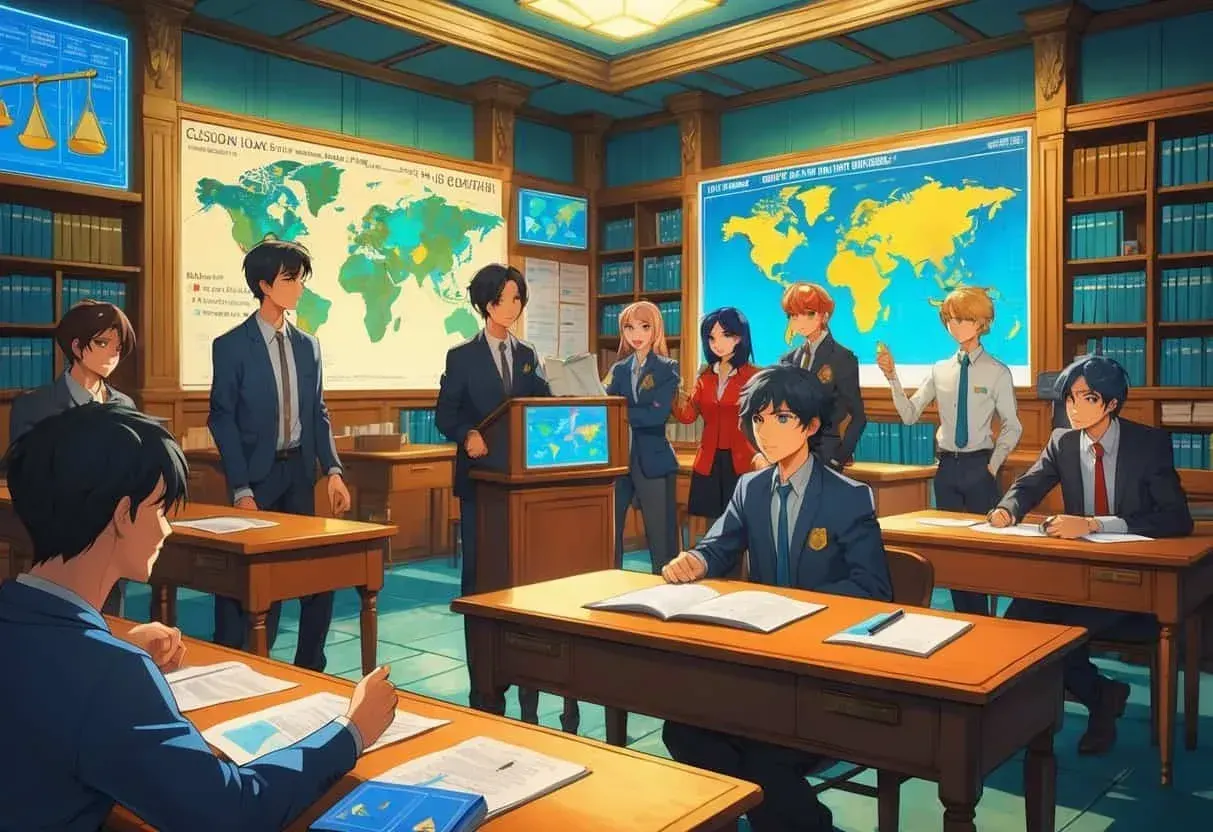
From medieval trade routes to futuristic parliaments, these shows distill complex ideas into clear, visual narratives. Whether you are a student looking for a fresh perspective on political science, a curious viewer interested in how economies function, or someone who wants to grasp civic responsibility through storytelling, the right anime can turn abstract theory into a tangible, human experience. This article explores a range of series that excel at teaching political, economic, and civic thinking — and explains why the medium itself is so uniquely suited to the task.
Key Takeaways
- Anime translates political and economic theories into relatable, character-driven narratives that deepen understanding.
- Visual storytelling, emotional arcs, and detailed worldbuilding help viewers see the consequences of governance and economic decisions.
- Many academically recognized titles provide functional lessons about leadership, trade, diplomacy, and social activism.
Anime as a Medium for Political, Economic, and Civic Education
At its core, anime is a narrative art form that excels at externalizing internal conflicts and societal pressures. This makes it a powerful tool for explaining how governments operate, how markets behave, and how citizens can influence both. Unlike a textbook that lists definitions, anime constructs living, breathing worlds where political ideologies clash, economic theories are tested, and civic values are questioned — all through the eyes of characters you come to care about.
Storytelling and Emotional Engagement
One reason anime works so well for political education is that it ties abstract systems to concrete human stakes. When a protagonist must decide between austerity and investment to save a starving village, you feel the weight of fiscal policy. When a coup threatens a kingdom’s stability, you witness the fragility of institutions. The emotional investment helps learners retain information longer and encourages them to think critically about cause and effect. Series like Maoyuu Maou Yuusha (“Maoyu: Archenemy & Hero”) turn economics into a central plot device: the Demon Queen uses agricultural reform, crop rotation, and trade alliances rather than warfare to end conflict between humans and demons.
Through her negotiations, you absorb lessons about supply and demand, labor specialization, and the political barriers to economic progress without ever feeling like you’re in a lecture hall.
Visual Explanations of Abstract Systems
Anime’s visual language can make invisible structures visible. Graphs, maps, or even stylized representations of trade flows appear in shows like Spice and Wolf, where the protagonist, a traveling merchant, literally draws diagrams of currency exchange rates and arbitrage to explain his plans to his companion. The medium also uses symbolism and setting to convey power dynamics: a towering castle overlooking a squalid town instantly communicates inequality, while scenes of parliamentary debate in Legend of the Galactic Heroes illustrate the tension between democracy and autocracy with clear, allegorical clarity. By showing rather than just telling, anime reduces cognitive load and makes sophisticated ideas accessible to a broad audience.
Academic and Media Studies Perspectives
Educators and researchers have taken note of anime’s potential. Studies in media pedagogy suggest that narrative formats can enhance engagement with social sciences, particularly when viewers are guided to analyze the themes critically. A growing number of university courses use clips from politically themed anime to spark discussions on comparative politics or international relations. The medium’s ability to simulate historical and hypothetical scenarios gives learners a sandbox in which to test concepts like economics, diplomacy, and civic duty — making it a legitimate complement to conventional learning tools.
Anime That Explore Politics and Governance
Many series place the workings of government and the struggle for power at the center of their plots. By following leaders, rebels, and reformers, these anime dissect political theory and reveal the practical difficulties of ruling.
Political Strategy and Empire Building
Code Geass: Lelouch of the Rebellion remains a standout example. The exiled prince Lelouch vi Britannia uses tactical genius and a supernatural power to orchestrate a rebellion against a global empire. The series is a masterclass in political strategy, showing how propaganda, public opinion, and strategic alliances can shift the balance of power. It also poses uncomfortable questions about authoritarianism, utilitarianism, and whether ethical compromises are ever justified in the pursuit of a greater good.
For a more grounded approach, The Apothecary Diaries offers a detailed look at court politics in a setting inspired by imperial China. The protagonist, Maomao, is a sharp-witted apothecary who becomes embroiled in the intrigues of the royal palace. Through her investigations, the series illuminates how governance in a historical monarchy relied on advisors, information networks, and the precarious balance between emperor and bureaucracy. Watching it, you gain insight into the informal power structures that often drive formal institutions.
In Arslan Senki (“The Heroic Legend of Arslan”), a young prince must reclaim his kingdom after a devastating military defeat. The narrative is a crash course in statecraft, covering the importance of a loyal retinue, the need to earn the trust of the populace, and the careful construction of a multi-ethnic coalition. These anime show that empires are not built solely on force, but also on policy, public perception, and institutional design.
Economic Systems and Trade
Anime are equally adept at unpacking economic principles through storytelling. Spice and Wolf follows the merchant Kraft Lawrence and the harvest deity Holo as they travel through a medieval trading landscape. Each episode tackles a different economic concept — from currency speculation and market bubbles to the power of guilds and the risks of overproduction. The show’s strength lies in its patient, detailed explanations, making it feel like a lively economics seminar set against a charming road trip.
Maoyuu Maou Yuusha builds an entire narrative around economic development as an alternative to war. The Demon Queen introduces fertilizer, crop rotation, and the potato to a struggling human world, demonstrating how technological innovation and trade can reshape geopolitics. The series explicitly teaches the principle of comparative advantage and the way economic interdependence can foster peace. Similarly, Log Horizon applies modern economic theory to a fantasy video game world where players are trapped. The protagonist, Shiroe, must manage resources, negotiate trade contracts, and even design a tax system to stabilize a fledgling society.
The series explores the social contract, public goods, and the unintended consequences of monetary policy — all without ever leaving its game-inspired setting.
Diplomacy and International Relations
Understanding how nations interact is a core component of political education, and several anime treat diplomacy as a high-stakes art. Legend of the Galactic Heroes contrasts a corrupt democratic state with a meritocratic autocracy, exploring the philosophical strengths and weaknesses of each system through decades of interstellar conflict. Peace negotiations, military treaties, and the fragile nature of détente are recurring themes, illustrating the difficulty of maintaining international order.
GATE: Thus the JSDF Fought There! imagines a modern military force entering a fantasy realm. The series focuses heavily on how diplomacy is conducted between radically different cultures, the role of international law, and the necessity of negotiation even in asymmetric power dynamics. In a lighter register, Hetalia: Axis Powers personifies nations as quirky characters, using humor to address historical alliances, cultural misunderstandings, and the roots of global conflict. While comedic, it prompts viewers to think about why nations cooperate or clash and how national identity shapes international behavior.
These series highlight that diplomacy is not merely about avoiding war — it is a continuous process of balancing interests, building trust, and communicating across cultural divides.
Social Justice and Civic Responsibility
Anime also serve as a platform for exploring civic engagement and social justice. Zankyou no Terror (“Terror in Resonance”) follows two teenage terrorists who challenge the Japanese government through enigmatic attacks. While the plot is a thriller, it raises profound questions about state surveillance, the ethics of dissent, and the responsibilities of citizenship in a democratic society. It encourages viewers to think about where the line between legitimate protest and destructive action lies.
In Psycho-Pass, a futuristic system measures citizens’ mental states to predict criminal behavior. The narrative examines the trade-off between security and liberty, the dangers of an unaccountable bureaucracy, and the role that individual conscience must play in a just society. The series is a powerful thought experiment about civic education and the moral obligations of those who enforce the law. Meanwhile, Yona of the Dawn transforms a sheltered princess into a leader who learns firsthand about famine, corruption, and the needs of ordinary people. Her journey is a lesson in empathy-driven governance and the importance of civic participation at every level of society.
Broader Influences: Civic Themes in Anime and Society
Beyond individual series, anime as a medium reflects and shapes cultural attitudes toward rights, ethics, and public life. By examining how these works handle sensitive themes and how they circulate in public discourse, you can better understand their educational power.
Human Rights and Ethical Dilemmas
Many politically charged anime embed human rights issues directly into their conflicts. Characters may resist unjust labor practices, fight against discriminatory laws, or grapple with the ethics of using force to achieve freedom. Series like Planetes, set among space debris collectors, explore the socioeconomic divides between wealthy spacefaring nations and impoverished terrestrial workers, raising questions about equity and labor rights in a high-tech future. These narratives help viewers connect historical struggles for justice — such as civil rights movements or anti-colonial resistance — with contemporary conversations about fairness and dignity. By personalizing the debate, anime can foster ethical reasoning and a deeper appreciation for constitutional protections and international human rights standards.
Media, Marketing, and Public Discourse
Themes of governance and economics in anime do not exist in a vacuum — they are amplified by marketing campaigns, social media discussions, and journalistic analysis. When a politically dense series like Legend of the Galactic Heroes receives a modern adaptation, think pieces emerge comparing its fictional political decay to real-world democratic backsliding. Fans dissect episodes in forums, linking plot points to actual historical events. This informal discourse turns viewing into a participatory learning experience. Journalism that reviews anime through a political lens further elevates the medium, demonstrating how pop culture can serve as a gateway to informed civic conversation.
Marketing strategies that highlight a show’s intellectual depth encourage audiences to engage critically, shifting anime from pure escapism to a tool for public deliberation.
Opportunities for Further Learning Through Anime
The curiosity sparked by politically themed anime can translate into tangible educational and career opportunities. These series open doors to deeper study and real-world application.
Comparative Politics and Economic Models
Watching how different anime depict political structures — feudal monarchies, parliamentary democracies, corporate oligarchies — naturally encourages comparative thinking. You begin to ask why certain systems succeed or fail under pressure, and how cultural context influences institutional design. This skill is foundational in political science and international relations programs. Pairing a viewing of Grancrest Senki, which deals with fractious noble alliances, with reading on the Treaty of Westphalia can make the historical material more vivid. Similarly, charting the economic collapse depicted in Rising of the Shield Hero against real cases of hyperinflation can reinforce macroeconomic concepts.
Anime becomes a springboard for rigorous academic inquiry.
Cultural Exchange and Study Abroad
Political and economic themes in anime are often interwoven with East Asian history and philosophy. If a series piques your interest in Chinese court bureaucracy, Japanese feudal politics, or the Silk Road, it can inspire formal study of those cultures. Student organizations focused on Asian studies, international affairs, or media analysis provide structured environments to explore these interests. Study abroad programs in Japan, South Korea, or China allow you to witness firsthand the cultural and political landscapes that informed the shows. Internships with NGOs or think tanks that work on East-West relations can transform a casual anime-inspired curiosity into cross-cultural expertise.
Career Pathways Inspired by Political Anime
The themes explored in these anime align with a wide range of careers: policy analyst, diplomat, economic consultant, civic educator, journalist, or international business strategist. Many universities offer courses and student clubs that bridge media studies and social sciences, helping you connect fictional narratives to professional competencies. The problem-solving, negotiation, and strategic thinking skills you develop by dissecting an anime’s political plot are directly transferable to real-world roles. By illustrating the human impact of policy and economics, these series can sustain your motivation through long academic and career paths, reminding you why the work matters.
Conclusion
Anime is far more than a pastime; it is a vast, diverse medium capable of teaching politics, economics, and civic responsibility with depth and emotional resonance. From the merchant routes of Spice and Wolf to the grand strategic halls of Legend of the Galactic Heroes, these stories translate complex systems into human-scale dramas that stick with the viewer. They encourage critical thinking, foster global awareness, and often inspire lifelong learning. Whether you are a seasoned student of political theory or someone simply looking for a more engaging way to understand the world, the anime highlighted here offer an education that feels less like instruction and more like a compelling journey through the mechanisms that shape our lives.