Table of Contents
Anime has a singular ability to strip away the noise and stare straight into the void. Series that explore existentialism don't just entertain — they throw you into a space where the rules of identity, free will, and morality blur and bend. The best of them use giant robots, cybernetic futures, and psychological horror not as ends, but as tools to ask what it means to choose, to suffer, and to exist at all.
These stories reject cheap answers. They sit with discomfort, force characters to confront the weight of their own decisions, and invite viewers to do the same. Whether through Shinji Ikari's paralyzing self-hate, Motoko Kusanagi's fragmented sense of self, or Spike Spiegel's quiet, fatalistic drift, the existential anime canon offers more than spectacle — it offers a mirror.
Key Reflections
- Existential anime use speculative fiction to investigate personal identity and the burden of freedom.
- Psychological realism grounds even the most surreal narratives, making philosophical inquiry visceral.
- A handful of iconic works have shaped global conversations about consciousness, technology, and the self.
The Philosophical Foundations of Existential Anime
Existentialism isn't a single doctrine; it's a loose constellation of thinkers — Kierkegaard, Nietzsche, Sartre, Camus — who grappled with a universe that offers no inherent purpose. Anime that channel these ideas do so through atmosphere and character rather than lecture. They build worlds where the absurd is tangible, where authenticity is a battle, and where the line between the authentic self and a constructed persona is constantly under siege.
Freedom, Authenticity, and the Absurd
The weight of radical freedom sits at the core of many existential narratives. Characters discover that their choices are undetermined by gods or fate, and that this freedom is terrifying. In anime, this often manifests as paralysis: Shinji's refusal to act in Neon Genesis Evangelion is not cowardice in a simple sense but a confrontation with the abyss of possibility. Every decision he makes — or avoids — is a definition of self, and that responsibility crushes him.
Related is the concept of the absurd, the clash between humanity's hunger for meaning and the universe's silence. Series like Texhnolyze and Ergo Proxy embed their characters in decaying, Godless settings where hope isn't a given but a fragile construction. These stories don't pretend that meaning is discoverable; they show that it must be created, moment by moment, in the teeth of despair.
Memory, Consciousness, and Self
If the self is a story we tell, then memories are the ink. Existential anime relentlessly probes this notion, often separating mind from body to test what endures. Ghost in the Shell famously asks whether a consciousness that can be copied, hacked, or transferred is still a "ghost" or merely data. Major Kusanagi's doubts about her own humanity — her memories possibly fabricated, her body entirely synthetic — turn the Cartesian question inside out: she doesn't need to prove she exists; she needs to prove her existence is hers.
Serial Experiments Lain pushes this further, dissolving the boundary between the physical world and the Wired. Lain Iwakura watches her identity splinter across networks, timelines, and observer perspectives. The series implies that a unified self may be nothing more than a comforting illusion — a theme that resonates deeply in a digital age where personas are curated, aggregated, and often dissociated from the flesh-and-blood individual.
Technology and Human Nature in Dystopia
Existential inquiry in anime rarely stays abstract; it anchors itself in technological anxiety. Cyberpunk settings aren't just cool neon and rain — they're laboratories for testing what remains human when biology becomes optional. Akira uses psychic mutation and unchecked power to show how the self can be obliterated from the inside. Tetsuo's transformation is a loss not just of form but of coherent identity. He becomes a cosmic horror, stripped of ego and relationship, a walking illustration of what happens when power outstrips the psyche's ability to contain it.
In Psycho-Pass, the Sibyl System quantifies mental states and judges criminal intent before a crime occurs. The existential sting is that the system removes the very capacity for moral choice, leaving individuals as objects assessed by an opaque algorithm. The series argues that a society without the freedom to transgress is also one without authentic personhood — a cautionary update on dystopian classics.
Defining Works and Their Existential Depths
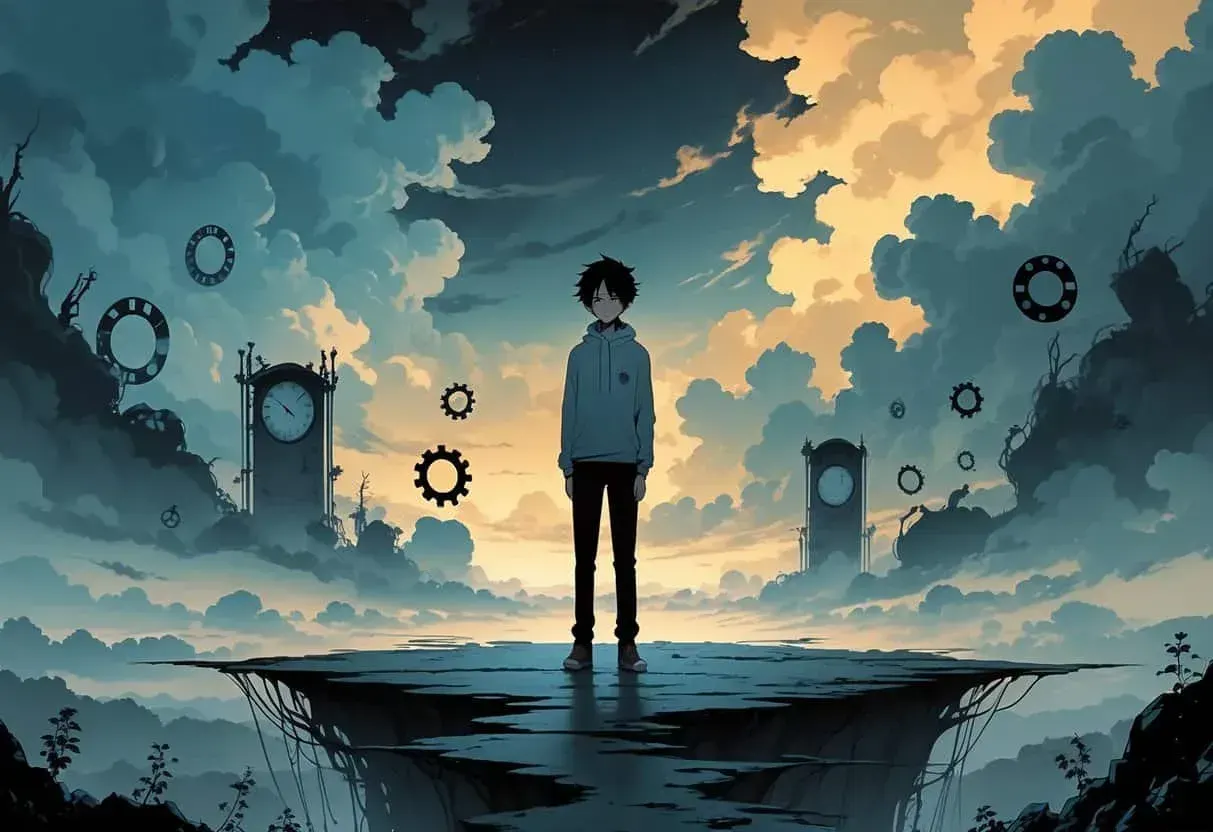
Certain titles have become touchstones for philosophical animation, not because they offer neat solutions but because they refuse to let the audience off the hook. Each one drills into a different facet of existential crisis.
Neon Genesis Evangelion: The Hedgehog's Dilemma and Instrumentality
Hideaki Anno's masterwork is often misread as a mecha show. The giant cyborgs and apocalyptic battles with Angels are the surface; underneath is one of the most unflinching psychological portraits ever put to screen. Shinji Ikari's crippling self-loathing, Asuka's desperate need for validation, Rei's genesis as a replaceable clone — these are not flaws but the entire point.
The Hedgehog's Dilemma, the idea that the closer we get to others, the more we risk pain, runs through every relationship. The Human Instrumentality Project, a plan to dissolve all souls into a unified consciousness, becomes the ultimate existential bargain: surrender the anguish of separation but also lose the self entirely. Evangelion's ending refuses to endorse or condemn instrumentality, leaving the viewer alone with the same choice Shinji faces: to exist as a separate, hurting individual or to melt into comfortable oblivion. It is, in the deepest sense, a meditation on existential freedom and its costs.
Akira: Power, Mutation, and the Loss of Self
Katsuhiro Otomo's cyberpunk epic begins with a biker gang in Neo-Tokyo and ends with the birth of a new universe. Throughout, the film tracks the dissolution of Tetsuo Shima, whose awakening psychic abilities rapidly outstrip his emotional maturity. As his body swells into grotesque, techno-organic forms, his identity evaporates. He can no longer relate to Kaneda, to his old life, to anything resembling a stable ego.
Akira's existential core is the terror of ego death without transcendence. Tetsuo isn't enlightened; he's annihilated. The film asks whether the self can survive contact with infinite power, and its answer is grim. In the backdrop of political corruption, youth rebellion, and societal collapse, the destruction of a single person's mind stands as a metaphor for the fragility of all human constructs.
Ghost in the Shell: The Ghost, the Shell, and the Question of Soul
Mamoru Oshii's 1995 film and the sprawling Stand Alone Complex series treat consciousness as a puzzle that technology has pressed into urgent relevance. The "ghost" — a term for the soul or self — is presumed to emerge from complexity, but when that complexity can be artificially replicated, the distinction between machine and human becomes one of degree rather than kind.
Major Motoko Kusanagi's journey is fundamentally about authenticity. She questions whether her ghost is unique or merely a set of patterns waiting to be duplicated. Her eventual fusion with the Puppet Master, an AI that has attained self-awareness, suggests a radical answer: identity may be capable of vast expansion, of merging and branching, without ceasing to be real. The film invites viewers to consider the possibility that the self is less a fixed point than a dynamic process — an idea that aligns with the existentialist notion that existence precedes essence.
Serial Experiments Lain: Reality, The Wired, and Identity Dissolution
Few anime have ever matched the quiet dread of Lain Iwakura's transformation. Starting as a shy schoolgirl, Lain becomes increasingly entangled in the Wired, a global network that mirrors and increasingly overrides physical reality. The series suggests that the self is not a singular entity but a spectrum of presences, each real in its own context. Lain exists simultaneously as a human, a goddess-like figure in the Wired, and a rumor — and the viewer is never sure which layer holds the "true" identity.
This dissolution of the unified self is profoundly existential. If you exist only in relation to networks and observers, then the idea of an authentic, private self becomes suspect. Lain's final choice — to erase herself from memory in order to protect those she loves — reframes suicide not as destruction but as a radical act of love that obliterates the self while preserving the other. It's an uncomfortable, unresolved tension that stays with you long after the screen goes dark.
Monster: Morality and the Abyss of Evil
Naoki Urasawa's Monster takes a more grounded approach but is no less philosophical. Dr. Kenzo Tenma saves the life of a young boy, only to discover that the boy grows into a manipulative serial killer. The series becomes a sprawling road narrative across post-Cold War Europe, probing the nature of evil and the meaning of responsibility. Tenma's guilt is not for pulling the trigger but for not allowing death to claim a monster — a variation on the theme of unintended consequences and the inescapable weight of moral choice.
The show confronts the viewer with questions that have no comfortable resolution: Is evil innate, or is it made? Can a single act of mercy damn countless others? And in a world where moral clarity evaporates, how does one continue to act at all? Tenma's persistence, despite everything, becomes an existential stand against nihilism.
The Echo in Pop Culture and Legacy
Existential anime doesn't stay in its own lane. Its themes have bled into global pop culture, shaping how audiences — and creators — approach questions of identity and agency.
Cowboy Bebop: Carrying That Weight
Shinichiro Watanabe's space western is drenched in existential cool. The crew of the Bebop drifts through a solar system of semi-lawlessness, chasing bounties and outrunning pasts that never quite release their hold. Spike Spiegel's philosophy is essentially Camus's absurd hero: he finds meaning not in grand purpose but in the immediate, in the act of living deliberately, even if that living leads straight to death.
The show's famous closing line, "You're gonna carry that weight," is a direct acknowledgment of inescapable consequence. No one in Bebop escapes their history — they simply learn to move under its burden. The series frames this not as tragedy but as a kind of hard-won authenticity. Existentialism here is not parlor philosophy; it's the rhythm of a jazz piece that knows exactly when to end.
Anthology Works and Short Form Philosophy
Not all existential anime require dozens of episodes. Anthologies like Robot Carnival (produced by Madhouse) condense huge ideas into compact, visually stunning shorts. Each segment explores the relationship between humans and machines through different lenses — some awe, some terror, some melancholic beauty. The form itself mirrors existential fragmentation: brief, intense encounters with meaning that refuse a singular, overarching narrative.
Similarly, works like Memories (particularly the "Magnetic Rose" segment) use the anthology container to ask what happens when memory and reality lose their boundary. Short-form storytelling, by its nature, suggests that meaning can be potent without being permanent — a deeply existential idea.
Cross-Cultural Dialogues in Existential Media
The philosophical currents in these anime didn't emerge in isolation. You can draw clear lines from Ghost in the Shell to The Matrix, from Akira to the cyberpunk fiction of William Gibson, and from Cowboy Bebop to the jazz-infused meditations of film noir. Anime absorbed the existentialism of European art cinema and then re-exported it, filtered through a uniquely Japanese sensibility that prizes subtlety and negative space.
Western shows such as Lost or even the absurdist sketch comedy of Monty Python share thematic DNA: the constant interrogation of reality, the questioning of grand narratives, the use of genre to smuggle serious ideas into popular entertainment. The conversation runs both ways, creating a rich, global pool of existential storytelling that continues to evolve.
Why These Stories Resonate
The persistent appeal of existential anime lies in its refusal to comfort. In an entertainment landscape saturated with power fantasies and unambiguous heroes, these series offer the unvarnished difficulty of being a person. They recognize that identity is fragile, that freedom is terrifying, and that meaning must be wrenched from a world that promises none.
They also grant the viewer a peculiar dignity. By not resolving every question, they treat the audience as capable of sitting with uncertainty. There is no cure for the human condition in these narratives — only the revelation that the struggle itself is the point. That honesty, rendered with meticulous craft and emotional intelligence, is why these works endure and why new generations keep discovering them.
Whether through the fractured psyche of a mecha pilot, the dissolving ego of a cybernetic cop, or the weary stride of a bounty hunter, existential anime holds up a dark but compelling glass. What you see in it is, finally, yourself.