Table of Contents
Working as a Japanese animator means long hours, tight deadlines, and a stubborn dedication to detail. You’re constantly balancing intense workloads and the need for creativity just to bring stories and characters to life.
It’s demanding, yeah, but you get to be part of creating some of the world’s most beloved and visually stunning animations. Being an animator in Japan isn’t just a job—it’s a lifestyle defined by passion, resilience, and a community bonded by a shared love of the craft.
Key Takeaways
- Your workday as a Japanese animator is busy and relies heavily on teamwork, discipline, and clear communication.
- You must be skilled in many animation methods—from hand-drawn cels to digital pipelines—to meet the industry’s high standards.
- The animation process combines art and precision under extreme time pressure, often forcing you to adapt fast.
- Entry-level pay is notoriously low, and advancement depends as much on endurance as on raw talent.
- Despite the hardships, the opportunity to contribute to iconic stories and visuals keeps many artists in the field.
Inside the Studio: Daily Life and Work Rhythms
Life as a Japanese animator? Expect long hours, detailed tasks, and a lot of collaboration. You’re always balancing creativity with deadlines in a studio that rarely slows down. Understanding your routine and how you fit into the team is essential if you want to survive the breakneck pace—and even then, many burn out quickly.
Typical Workday Responsibilities
Most days start early—sometimes before the studio officially opens. Your exact tasks depend on your role: junior animators often handle in-between frames (douga), while senior or key animators (genga) draw the critical poses that define a scene’s motion. You might also be assigned corrective retakes, background line art, or simple compositing if you’re on a digital team.
Deadlines are relentless. You’ll spend hours on precise, sometimes repetitive work, checking each drawing for consistency with model sheets and previous cuts. At elite studios like Studio Ghibli, the bar for quality is legendary—every hair, every subtle expression is scrutinized. Overtime is so normal it’s rarely even discussed; 12‑hour days are common during crunch periods.
Your daily rhythm includes reviewing sketches with supervising animators, fixing proportions or line work, and prepping cleaned‑up frames for the digital ink‑and‑paint department. You’re constantly checking in with supervisors to make sure your work aligns with the episode or film’s overarching vision. It’s a mix of creative problem‑solving and technical endurance, and you’ve got to maintain speed without sacrificing quality.
The Studio Atmosphere and Physical Setup
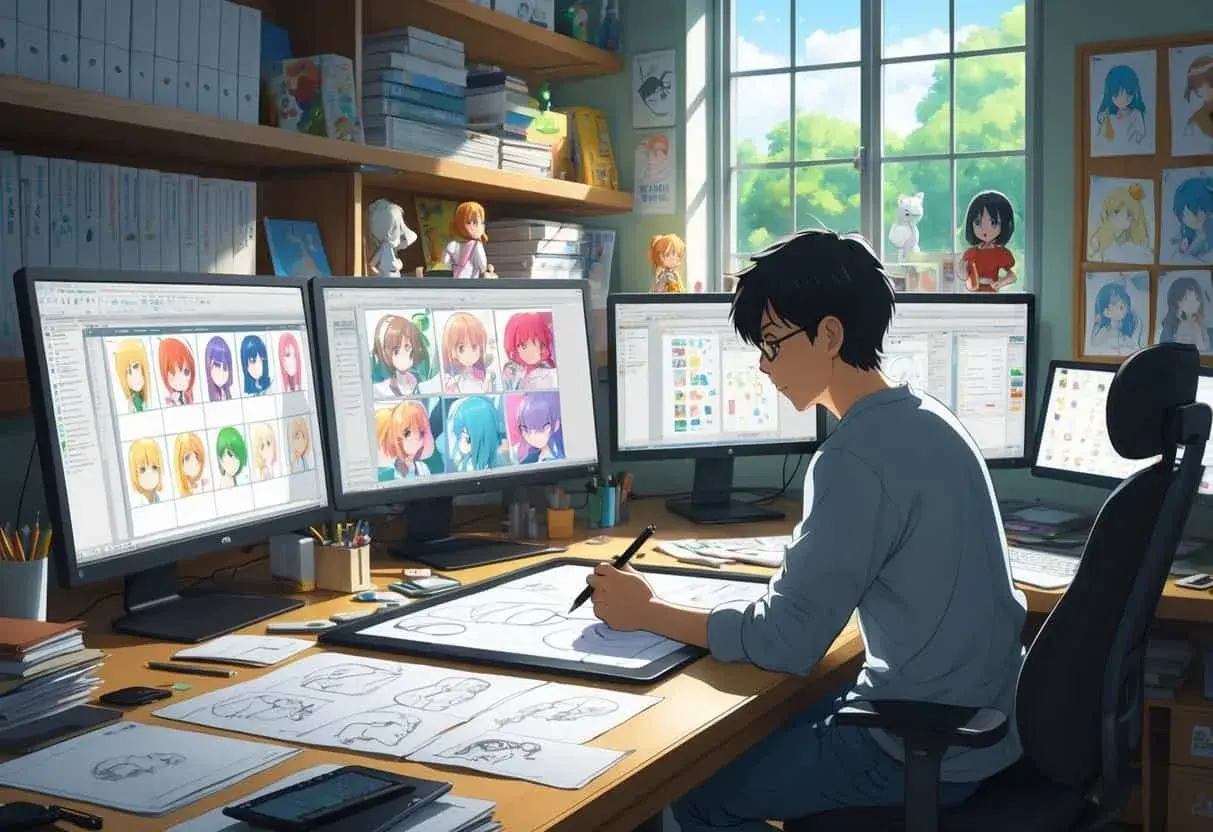
Animation studios are rarely quiet havens. They’re usually crowded, compartmentalized spaces buzzing with the hum of Toon Boom, Photoshop, and custom software. In smaller, outsourced studios, you might be squeezed into a tiny desk surrounded by stacks of layout paper and reference books. The tools of the trade vary: some veterans still insist on pencil and paper, while younger animators rely on Wacom tablets and monitors.
Studios range from revered powerhouses like Ghibli or Kyoto Animation to tiny subcontracting firms that handle only one stage of the pipeline. Regardless of size, the atmosphere hums with quiet intensity. Breaks are short and often skipped when a deadline looms. Despite the noise and pressure, a strange camaraderie develops. You bond with coworkers over shared exhaustion and the small victories of nailing a difficult running sequence or receiving a rare nod from the director.
Collaboration and Creative Hierarchy
Teamwork isn’t just encouraged—it’s the only way a production gets finished. Directors, episode directors, writers, key animators, in‑betweeners, colorists, compositors—everyone’s got a specific, tightly interlocked role. You need to communicate clearly so your frames match the established style and continuity. Regular dailies and production meetings keep the entire pipeline aligned, but the hierarchy is steep: junior staff have almost no creative say, and feedback often arrives as direct, non‑negotiable corrections.
Revisions are constant. A senior animator or animation director might reject a cut for the smallest deviation from the model sheet, and you’ll re‑draw the same handful of frames multiple times before they’re accepted. In large studios, specialisation is extreme—you might work exclusively on hair movement or background crowds for an entire season. Being flexible and willing to discard work you’ve laboured over is a survival skill. It’s this relentless team effort, layer by layer, that finally brings a massive anime project to life.
From Script to Screen: The Animation Pipeline
Japanese animation follows a clear, multi‑stage process where every layer—story, design, movement, and final polish—has its own dedicated moment. Understanding how an idea becomes a finished cut demystifies why even a 20‑minute episode can take months of collective effort.
Storyboarding and Pre‑Production
Storyboard artists (often the episode director themselves) start by sketching rough panels that map out the entire story flow. These boards read like a comic strip, dictating camera angles, shot composition, timing, and the emotional cadence of each scene. This stage is critical—it sets the visual language before anyone dives into detailed drawing. Many studios now use digital storyboarding tools like Toon Boom Storyboard Pro to speed up revisions and share boards instantly.
The completed storyboard serves as the team’s master guide. It includes not just character placement but also notes on lighting, sound effects, and dialogue pacing. Because so many people rely on it, inconsistencies caught at this stage save hundreds of hours later. Directors usually present the board to the entire production staff with a recorded scratch track, letting everyone internalise the rhythm before a single keyframe is drawn.
Character Design and Visual Development
Character design is where personalities first take physical form. Designers create turnaround sheets, expression charts, and colour palettes—often producing dozens of variations before the production committee approves a final look. This phase shapes the emotional tone of the entire animation, and every subsequent artist will cling to these reference sheets like gospel.
Final designs must be exceptionally clear and consistent because they’ll be replicated by animators working across different time zones and subcontractors. Any ambiguity in a model sheet leads to costly retakes. Concept art for backgrounds, props, and special effects runs in parallel, ensuring the world feels cohesive before animation even begins.
Cel and Digital: The Evolution of Techniques
Hand‑drawn animation remains the soul of Japanese anime. For decades, artists painted characters and backgrounds on transparent cels, layering them under rostrum cameras to create motion. This labour‑intensive method produced lush texture and depth—think of the rain‑slicked streets in Akira (1988) or the floating forests in Miyazaki’s works.
Today, most production has shifted to digital. Key frames are still drawn by hand—either on paper or directly onto tablets—but in‑betweening, coloring, and compositing happen inside software. Tools like RETAS, Clip Studio Paint, and OpenToonz streamline the assembly line, but the fundamental craft of drawing each expressive frame hasn’t vanished. CGI is increasingly used for complex mechanical objects, crowd scenes, or camera‑mapped backgrounds, often blended with 2D line art to preserve the organic feel audiences expect. The tension between maintaining hand‑drawn warmth and embracing digital efficiency defines modern anime production.
Short‑Form Projects and Film Festival Circuits
Music videos, promotional clips, and independent shorts offer animators a rare chance to break out of repetitive commercial work. Deadlines on these projects are even tighter, but because you’re not bound by a long‑running series’ formula, there’s more room to experiment with bold colour choices, wild editing, or heightened abstraction.
Film festivals like Annecy provide a platform where visual impact matters more than mass appeal. A short created for a J‑pop music video might lean heavily on graphic design and kinetic typography, while a festival piece could explore themes through textured stop‑motion. These side projects let studios and individual artists stretch their creative muscles and often act as a calling card for future, larger‑scale work.
Mastering the Craft: Techniques and Influences
Japanese animators draw from a deep well of techniques that have evolved over nearly a century. Familiarity with these methods—and the iconic works they produced—explains why anime carries such a distinct visual signature.
Traditional Hand‑Drawn and Cel Animation Methods
Traditional hand‑drawn animation means sketching every single frame that appears on screen. Cel animation specifically involves transferring those drawings onto transparent acetate sheets and painting the reverse side with opaque gouache. Multiple cels are then stacked against painted backgrounds, frame by frame, to create a layered scene with convincing depth.
Hayao Miyazaki built his reputation on this exact method. Films like Nausicaä of the Valley of the Wind, My Neighbor Totoro, and Princess Mononoke are monuments to cel animation—each blade of grass, each swirl of wind rendered by hand. Even as digital tools took over, Miyazaki’s attention to organic movement (the way a child runs, how hair floats underwater) became a textbook reference for animators worldwide. The discipline required—drawing 24 frames per second of film, often without the safety net of undo buttons—cultivated an almost obsessive precision that still defines top‑tier anime.
Stop Motion and Experimental Approaches
Stop motion is a niche but respected avenue in Japanese animation. Instead of drawing, you manipulate physical puppets, clay figures, or cut‑paper elements, photographing one tiny adjustment at a time. When the sequence runs, inanimate objects appear to move independently. It’s painstaking, with mere seconds of footage often consuming entire days of work.
Although not as commercially dominant as 2D or 3D, stop motion has produced cult classics and festival darlings. Some directors blend stop‑motion textures with hand‑drawn characters, creating a hybrid look that feels tactile and strange. Experimental animators also explore pinscreen, paint‑on‑glass, and sand animation—anything to break away from the clean vector lines of modern digital production. These outsider techniques influence mainstream anime by introducing new ways of thinking about texture and light.
Iconic Works and the Masters Behind Them
Hayao Miyazaki remains one of the most revered figures globally. His ability to weave ecological parables, pacifist themes, and deeply human moments into fantasy landscapes has set a benchmark few can reach. Under his lead, Studio Ghibli became synonymous with quality—Spirited Away even claimed an Academy Award, a feat unmatched by most non‑English animations.
Yet the influence spreads wider. Katsuhiro Otomo’s Akira revolutionised both domestic and international perceptions of anime, flaunting hyper‑detailed backgrounds and fluid action at a scale never seen before. Satoshi Kon’s editing techniques and psychological narratives in Perfect Blue and Paprika still echo in live‑action films. Each master left not just a body of work but a set of principles—for timing, weight, and emotional framing—that animators study like scripture.
The Harsh Realities: Challenges, Pay, and Burnout
For all the romantic images of drawing desks and beautifully realised worlds, the working life of an animator in Japan is riddled with structural problems that have persisted for decades.
Low Pay and Unstable Employment
The entry‑level salary for a junior animator shocks many newcomers. According to surveys conducted by the Japan Animation Creators Association (JAniCA), young in‑betweeners often earn less than ¥1.1 million (roughly $7,000 USD) per year—well below the national poverty line. Pay is frequently based on a per‑frame piecework system, so if you’re assigned a slow, complex scene, your effective hourly rate plummets.
Most animators are classified as freelancers or on fixed‑term contracts, receiving no health insurance, pension contributions, or paid leave through the studio. A shocking number of artists rely on parental support or second jobs just to afford rent. This financial fragility has driven many talented creators out of the industry entirely, leaving a vacuum that studios fill by outsourcing to lower‑cost countries. A detailed report on these conditions was covered by Anime News Network, highlighting how even after global hits, labor conditions barely trickle down.
Health Implications and the Crunch Cycle
The physical toll is just as severe. Prolonged sitting, poor ergonomics, and constant deadline pressure lead to chronic back pain, eye strain, and repetitive stress injuries. Mental health struggles—anxiety, depression, and burnout—are widespread but seldom discussed openly, partly because of cultural stigmas around vulnerability.
During the final weeks before an episode’s broadcast (a period known as “the death march”), sleep deprivation becomes routine. It’s not uncommon for key animators to work 30 hours straight, napping under their desks while the next batch of corrections prints out. Some studios have taken steps to improve conditions—limiting overtime, offering on‑site health checkups—but change remains patchy and often voluntary.
Is the Dream Worth It?
Despite all this, many animators stay. The allure of seeing your drawings become part of a cultural phenomenon, the rush of hearing a packed theatre react to a scene you poured a week into, the quiet pride of a sequence that perfectly captures a character’s emotion—these intangible rewards keep the industry alive. For some, it’s a stepping stone to becoming a director or character designer; for others, it’s a calling they can’t ignore, even when the numbers don’t add up.
Support networks among animators are growing. Online communities, crowdfunding platforms, and union‑like initiatives are slowly building a safety net that didn’t exist a generation ago. While the dream remains fragile, the conversation around fair pay and sustainable working schedules gets louder each year, pushed by veterans who remember what it cost them.
Where Japanese Animation Is Heading Next
The industry stands at a crossroads. International demand for anime has exploded, with streaming platforms pouring billions into production. Yet the labour pool is shrinking, and the pressure to produce more content faster is at an all‑time high. This tension is reshaping how animation gets made.
AI‑assisted in‑betweening, real‑time rendering, and procedural background generation are no longer speculative—they’re being tested in studios right now. While purists worry that automation will erode the craft, others see it as the only way to relieve animators of the most gruelling grunt work. Similarly, remote collaboration tools accelerated during the pandemic, enabling smaller studios to connect with global talent and bypass some of the insular, Tokyo‑centric bottlenecks.
Experimental formats like interactive anime, VR experiences, and vertical‑screen shorts are pushing visual storytelling into new territories without abandoning the core appeal of strong characters and emotive timing. As the tools evolve, the fundamental challenge remains: preserving the human touch that makes Japanese animation so recognisable while building a system that doesn’t burn out the very people creating it.
The life of a Japanese animator has never been easy, and it may never be fully comfortable. But for those who endure, the chance to shape the visual dreams of millions remains one of the most compelling—and grueling—creative paths on earth.