Table of Contents
Gameplay Philosophy: Strategy, Art, and Raw Speed
The world of anime gaming has entered a golden age, where licensed adaptations no longer settle for being shallow cash-ins. Instead, they strive to translate the core fantasy of their source material into interactive systems that players can feel. Among the most celebrated examples are those born from Attack on Titan, Demon Slayer, and Jujutsu Kaisen. Each franchise brings a distinct flavor to the table, forcing players to decide what they value most in a game: cerebral combat that rewards planning, cinematic spectacle that tugs at the heart, or chaotic brawling that lets you unleash power without restraint. The choice is rarely objective—your preference often mirrors the kind of experience you seek from interactive entertainment.
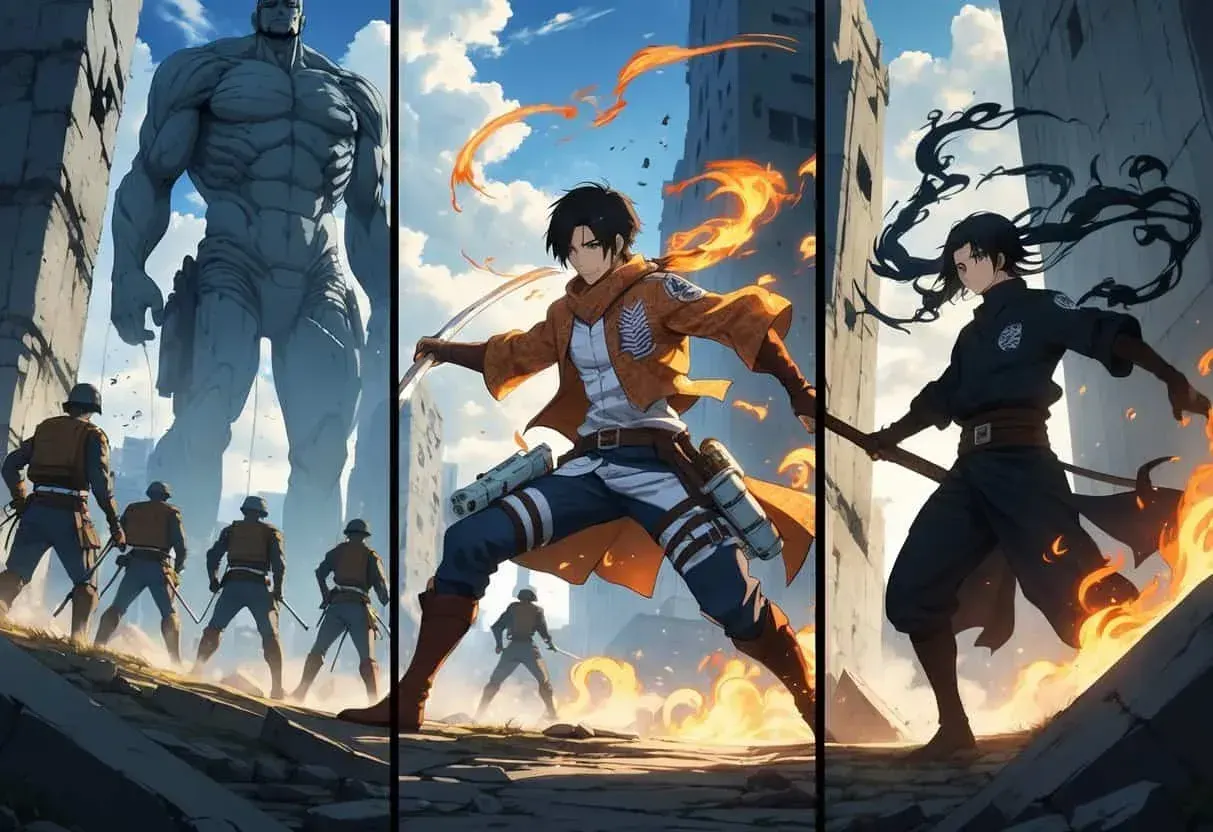
While Demon Slayer: Kimetsu no Yaiba – The Hinokami Chronicles garnered acclaim for its impeccable visual fidelity and emotional arc, IGN’s review noted how faithfully it replicates the anime’s breathing techniques. Similarly, Jujutsu Kaisen: Cursed Clash leans into the frenetic energy of cursed technique battles, though some critics argue it sacrifices narrative depth for speed. On the other end of the spectrum, the Attack on Titan games—particularly A.O.T. 2 and the more experimental Attack on Titan VR: Unbreakable—craft an adrenaline-fueled loop out of precision strikes and Omni-Directional Mobility Gear. Each game stands out not for trying to be everything to everyone, but for doubling down on what makes its anime source material unique.
Attack on Titan: Vertical Precision and Environmental Mastery
In the Attack on Titan games, especially the A.O.T. series from Koei Tecmo, combat is a high-stakes dance of momentum and geometry. The Omni-Directional Mobility Gear turns every battlefield into a 3D puzzle where angles, speed, and distance define survival. You don’t just fight Titans—you outmaneuver them, threading through narrow city streets and forests at breakneck speed. The learning curve is steep. Mastering the lock-on system, managing gas and blade durability, and timing the final strike to a Titan’s nape creates a cerebral loop that rewards patience over button mashing.
The official site for A.O.T. 2 emphasizes the game’s focus on tactical squad commands, where you can order allies to create diversions or target specific limbs—a layer of strategy that mimics the anime’s emphasis on coordinated assaults.
Attack on Titan VR: Unbreakable takes this further by immersing you in a first-person perspective where the scale of a Titan’s lunge feels genuinely terrifying. The mechanical depth—juggling anchor points, avoiding grabs, and coordinating with squadmates in certain modes—reflects the anime’s emphasis on tactical teamwork. This is not a game that forgives carelessness; one misjudged swing can end a mission. The result is a combat system that satisfies the part of the brain that loves planning and execution, much like a flight simulator wrapped in a horror-survival skin. The VR iteration even includes a stamina-based grappling mechanic that requires careful management of your anchor points, making each encounter a test of spatial awareness.
Demon Slayer: Cinematic Flourish and Reactive Combat
CyberConnect2’s Demon Slayer: Kimetsu no Yaiba – The Hinokami Chronicles takes the opposite approach. This is an arena fighter at its core, but one that prioritizes the theatricality of every clash. Stringing together light and heavy attacks with Breath of Water or Flame Breathing techniques triggers gorgeous, canned animations that mirror iconic scenes from the anime. Timing a successful parry or landing a special move feels less about deep mechanical innovation and more about recreating the emotional high of Tanjiro’s final strike against Rui. The combat is accessible—a deliberate choice that invites fans who might not typically play action games to experience the story.
The inclusion of a “Ultimate Art” system, where building a combo meter allows you to unleash a cinematic finisher, further reinforces the game’s focus on spectacle over complexity.
While some players note a lack of long-term complexity compared to traditional fighting games, the sheer style of the visually staggering specials keeps the loop satisfying. The Hinokami Kagura, for instance, transforms a standard combo finisher into a blazing dance that feels directly lifted from the ufotable anime. This is a game that understands its target audience; it’s less about labbing frame data and more about feeling like a Demon Slayer. The versus mode expands the roster with playable Hashira and demons, each with unique breathing styles that add variety without overwhelming new players. The single-player campaign also includes side missions that explore character backstories, fleshing out the world beyond the main battles.
Jujutsu Kaisen: Unleashing Chaos with Cursed Energy
Jujutsu Kaisen: Cursed Clash (Byking and Gemdrops) serves up a different beast entirely—a 2v2 brawler that emphasizes character-swapping synergy and screen-filling Domain Expansions. Where Attack on Titan is methodical and Demon Slayer is dramatic, Jujutsu Kaisen games are about letting loose. Flashy cursed techniques from Yuji Itadori’s Divergent Fist to Gojo’s Hollow Purple fill the screen with particle effects and rapid movement. The combat is chaotic by design, encouraging players to switch between partners mid-combo and layer attacks in ways that overwhelm opponents. The “Cursed Clash” mechanic, where both players simultaneously activate a special move to create a dramatic struggle, adds a rock-paper-scissors element that keeps matches unpredictable.
This design choice aligns with the anime’s focus on team battles and improvisation. However, the trade-off is a reliance on quick instinct over deep strategic planning. Some critics have pointed out that Cursed Clash lacks the single-player narrative weight of its peers, but for fans seeking high-octane multiplayer matches, it delivers a uniquely satisfying power trip. The roster diversity—brawlers, zone-controlling sorcerers, and technical fighters—ensures that mastery involves not just learning your favorite character but understanding how they complement a partner’s kit. Post-launch updates have added new characters like Toji Fushiguro and Yuta Okkotsu, expanding the strategic possibilities.
The online matchmaking, while occasionally plagued by latency issues, supports ranked and casual modes that foster a dedicated competitive community.
Visual Storytelling: From Cel-Shading to Grim Atmosphere
Anime games live and die by their ability to capture the art style of their source material. All three franchises achieve this, but through distinct artistic lenses that speak to their narrative tones.
Demon Slayer’s Water-Color Brushwork
The Hinokami Chronicles is a benchmark for cel-shaded animation in games. CyberConnect2 painstakingly recreated ufotable’s hybrid 2D-3D aesthetic, resulting in character models that look as though they were hand-painted. Environmental effects like the flowing ribbons of Water Breathing or the shimmering heat of Hinokami Kagura feel alive. The stark contrast between the taisho-era settings and the demonic realms creates a visual language that constantly reinforces the story’s emotional beats—light and shadow, hope and despair. The camera dynamically shifts during special moves to frame the action as if it were from the anime, including quick cuts and dramatic zooms that heighten the impact.
Even the menus and character select screens are designed with the same attention to period-appropriate typography and woodblock-print textures.
Attack on Titan’s Bleak Realism
By contrast, the Attack on Titan games adopt a rougher, more grounded visual palette. Character models carry the grit of a world on the brink of extinction, and the Titans themselves are rendered with unsettling anatomical detail. The animation prioritizes weight and impact: when Eren’s Titan form crashes into a building, debris flies with a physicality that sells the scale. The HUD is minimalistic, the camera often shaky, and the color grading leans into muddied greens and browns—all intentional choices that pull you into a world devoid of romance. Even the VR title maintains this oppressive tone, where looking up at a 15-meter Titan in first-person induces genuine dread.
The sound design complements the visuals: the creak of ODM gear, the whoosh of air as you swing, and the thunderous footsteps of approaching Titans build an immersive auditory landscape that reinforces the tension.
Jujutsu Kaisen’s Urban Fantasy Edge
Cursed Clash pursues a sleeker, modern look. Character models are sharp and highly expressive, carrying the swagger of Jujutsu sorcerers in contemporary Tokyo. The visual effects for cursed energy are distinct: Gojo’s Infinity Void warps the screen into a cosmic abyss, while Megumi’s shadows twist with a fluid, ink-like motion. The game’s UI is loud and energetic, reflecting the fast pace of combat. Where Demon Slayer aims for painterly beauty and Attack on Titan for rugged immersion, JJK goes for pure visual adrenaline, matching the manga’s bold linework and chaotic fight choreography.
The stages draw from iconic locations—Shibuya crossing, the school rooftop, the cursed womb—and dynamically shift during Domain Expansions, adding a layer of environmental storytelling that rewards familiarity with the series.
Narrative Integration and Storytelling Approach
How these games handle storytelling reflects their design priorities. Demon Slayer structures its adventure mode as a linear retelling, framing battles with anime cutscenes and optional dialogue moments. This approach deepens the player’s connection to Tanjiro’s journey, even if mission structure feels repetitive at times. The inclusion of Versus Mode bosses that recount iconic duels keeps the narrative threads alive outside the story campaign. Additionally, the game includes a “Character Library” that unlocks lore entries for each fighter, providing context for their motivations and relationships.
Attack on Titan games often weave narrative directly into the chaos of gameplay. In A.O.T. 2, you inhabit a custom cadet whose story runs parallel to the main cast, allowing you to experience key events—like the Battle of Trost—from a soldier’s on-the-ground perspective. The tension of watching allies die while you struggle to retreat feels more immediate than a standard cutscene. This emergent storytelling, where failure has narrative weight, sets it apart. The game also features an “Another Mode” that lets you replay pivotal moments from the perspectives of different characters, such as Levi’s squad during the Female Titan arc, offering new insights into the story.
Jujutsu Kaisen: Cursed Clash takes a lighter approach, using brief pre-fight dialogues and character-specific interactions to flavor its arcade-style framework. The story mode is more of a highlight reel than an immersive retelling, suitable for players who already know the plot. For those seeking deep lore integration, this might feel shallow, but it aligns with the game’s competitive, replay-driven philosophy. The inclusion of “Cursed Technique” cutscenes for each character, triggered by specific conditions in battle, adds a layer of fan service that rewards series knowledge. Still, the lack of an original narrative arc means players expecting a new story may be disappointed.
Roster Depth and Long-Term Engagement
A game’s longevity often rests on its character variety and the depth of its systems. Demon Slayer offers a respectable roster of the Hashira and key demons, with post-launch DLC adding characters like Rui and Akaza. Each fighter plays differently—Shinobu’s poison-based combos, for instance, feel radically distinct from Rengoku’s explosive offense. Yet the core combo system remains relatively uniform, which can lead to fatigue for competitive players. The game mitigates this with a “Ultimate Battle” mode that introduces modifiers like infinite special gauge or reduced cooldowns, encouraging experimentation.
However, the lack of a robust ranked online mode limits its long-term appeal for fighting game enthusiasts.
Attack on Titan diversifies playthrough via its gear customization and character-specific skills in story mode. Playing as Levi unlocks unique spin-attacks, while Mikasa’s boosted speed changes your approach to engagements. The multiplayer raid modes in A.O.T. 2: Final Battle push players to experiment with loadouts and roles, extending replayability. The game also features a “Survey Corps” mode where you lead a squad through procedurally generated missions, adding variety beyond the main campaign. Player-created loadouts can be shared online, fostering a community of theorycrafters who optimize gas usage and blade sharpness for different Titan types.
Cursed Clash arguably offers the most varied roster from a mechanical standpoint. Categorizing fighters into zones—attack, support, disruption—makes team composition a strategic puzzle. Discovering how Inumaki’s Cursed Speech setups enable Nobara’s resonance combos creates a meta that evolves with player knowledge. The game’s focus on online 2v2 battles gives it a competitive framework that can sustain interest long after the story is finished. Regular balance patches and seasonal events, such as limited-time character swaps or cursed item modifiers, keep the meta fresh.
The inclusion of a spectator mode and replay sharing further supports the tournament scene, with events like the “Jujutsu Kaisen Cup” attracting hundreds of participants.
Critical and Commercial Reception
Sales figures and awards provide a window into each title’s impact. The Hinokami Chronicles topped 3 million units shipped worldwide, buoyed by the anime’s global popularity and glowing reviews for its presentation. At the Crunchyroll Anime Awards, Demon Slayer has repeatedly claimed prizes for its animation and storytelling—recognition that carries into its gaming adaptation. Critics praised its visual fidelity and faithful recreation of the anime’s emotional beats, though some noted that the combat lacked depth for hardcore fighting game fans. The game’s accessibility, however, made it a gateway title for anime fans new to action games, expanding the audience for the genre.
A.O.T. 2 found a loyal, though smaller, audience. Its steep learning curve and repetitive mission structure drew mixed critic scores, but fans of the property treasure its faithful recreation of Titan combat. The VR title has opened a niche but passionate discussion about what immersive anime experiences can look like. Commercial performance was modest compared to its peers, but the game’s cult status ensured continued support through patches and DLC. Koei Tecmo’s decision to release a “Final Battle” edition, which bundled the base game with the second season’s content and new gameplay modes, helped bolster sales and show commitment to the franchise.
Cursed Clash launched to more polarized reactions. While its 2v2 system and faithfulness to the anime’s combat won praise from dedicated JJK fans, limited single-player content drew criticism. Still, with the Jujutsu Kaisen brand at an all-time high, its cultural footprint remains significant, reflected in active online communities and tournament scenes. The game’s initial technical issues, including dropped connections and character balancing problems, were addressed through updates, but the mixed critical reception has led some to view it as a missed opportunity. However, its status as the first AAA JJK game ensures it will remain a reference point for future adaptations.
Shaping the Next Generation of Anime Games
The lesson from these three franchises is that there is no single formula for success. Attack on Titan proves that faithful mechanical depth—making players truly master the ODM gear—can build lasting engagement even without flashy cinematics. Demon Slayer demonstrates that prioritizing visual splendor and emotional accessibility can propel a game into the mainstream and attract casual anime fans. Jujutsu Kaisen shows that competitive multiplayer and character-swapping chaos can breathe new life into the arena fighter genre if the IP’s identity is preserved. The best-selling anime games of recent years—like Dragon Ball FighterZ and Naruto Shippuden: Ultimate Ninja Storm 4—each found their own balance of these elements, proving that versatility within a niche is more valuable than trying to cater to every audience.
Future adaptations can take cues: don’t dilute the source material’s unique fantasy to fit a generic mold. Instead, isolate what makes the anime feel special—whether it’s the grappling freedom of Attack on Titan, the artistry of Demon Slayer’s breathing techniques, or the unchained sorcery of Jujutsu Kaisen—and build the entire game around that pillar. The best anime games are not the ones that try to include everything; they are the ones that let you step into the world and feel exactly what you hoped you would. For players, this means that choosing between these three titles is less about finding the “best” game and more about discovering which fantasy fits your personal taste—be it the strategic thrill of taking down a Titan, the emotional catharsis of a demon slayer’s final form, or the chaotic joy of launching a Domain Expansion with a partner.