Table of Contents
The Dueling Universe: Two Distinct Worlds
Any fan who has cheered for Yugi Muto while watching the anime and then sat down with a physical deck has experienced a moment of confusion. The game on screen feels familiar, but the moment you shuffle up, it becomes clear that the rules aren’t quite the same. The animated series bends, breaks, and occasionally invents mechanics to serve drama, pacing, and character moments. Meanwhile, the official Yu‑Gi‑Oh! Trading Card Game (TCG) operates under a meticulously maintained and globally enforced rulebook.
Understanding the divide is essential for anyone moving from spectator to player, and it makes both watching and dueling far more rewarding.
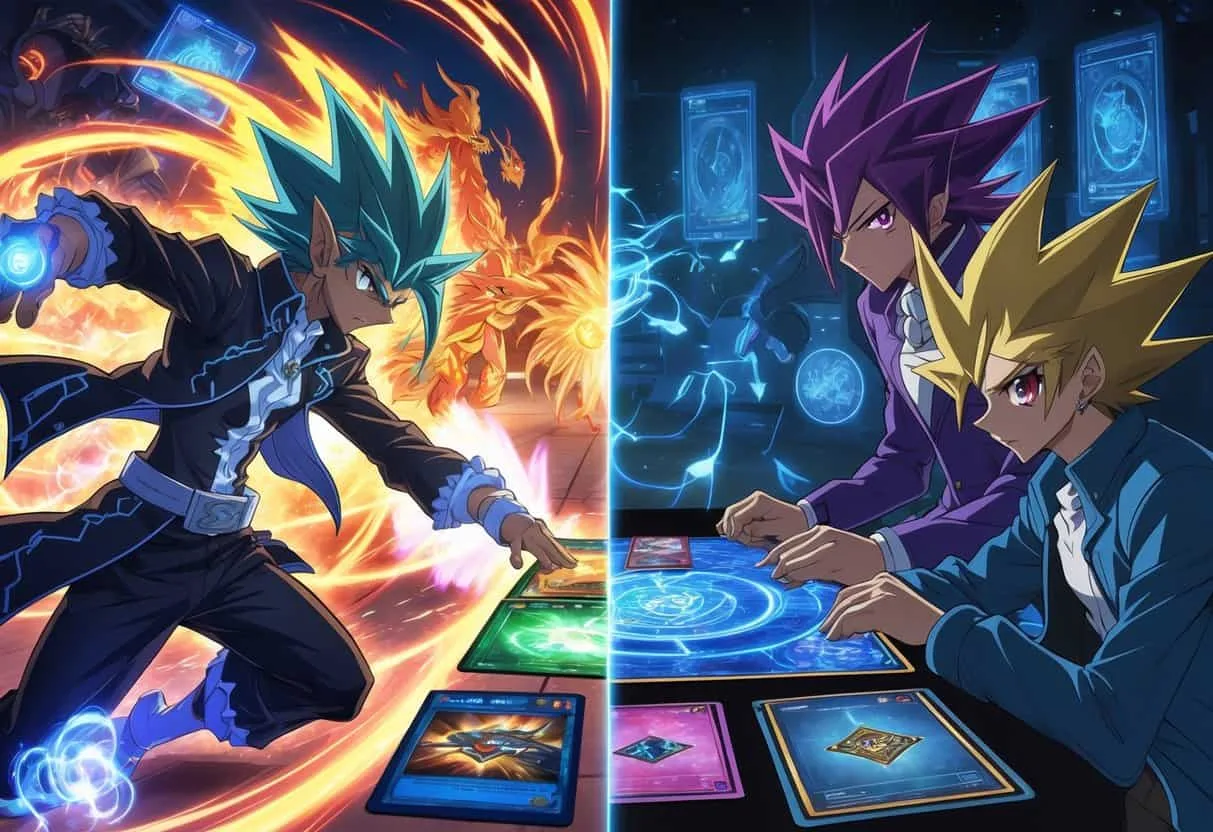
The anime is a spectacle of holograms, shadow games, and life‑or‑death stakes where a single draw can alter destiny. The real TCG is a tactical grind of resource management, chain resolution, and forensic card text reading. Neither is superior; they simply serve entirely different masters. As we dissect both systems, you’ll see exactly where the show takes creative liberties and how the official game enforces consistency across thousands of cards and an international competitive scene.
The Anime’s Dynamic Rulebook
Narrative Over Mechanics
In the world of the anime, a card’s text is more of a suggestion than a binding contract. Duels are crafted to heighten tension, spotlight a character’s growth, or deliver a cathartic comeback. Complex interaction chains and precise timing—the lifeblood of competitive play—are routinely glossed over or ignored. During Duelist Kingdom, the very first story arc, the rules were practically a prototype: monsters had types that granted innate advantages, life points started at 4000, and tribute summoning was entirely optional. This was because the real‑world card game was still in its infancy, and the writers prioritized cinematic flow over mechanical rigor.
The show’s technology reinforces this spectacle. Solid vision systems project towering monsters that roar and clash, and duel disks on every arm make the action feel immediate and visceral. These visual flourishes are wonderful for storytelling but give no indication of how actual priority, spell speed, or missed timing works. A viewer might see a player summon three massive creatures in a single turn without a single tribute or activating a card from the hand during the opponent’s turn with no clear trigger. In a local tournament, that would draw an immediate judge call.
Summoning Shenanigans and Hollywood Effects
Anime characters rarely pay full tribute costs unless it’s specifically highlighted for dramatic effect. Powerful monsters like Blue‑Eyes White Dragon or Dark Magician can appear with minimal setup. Even extra‑deck monsters like fusions were often summoned without the Fusion spell, simply by willing the materials together. Special summoning from the graveyard is absurdly common, with cards like “Monster Reborn” treated as a narrative reset button rather than a limited resource. The show also invents unique summons for climactic moments—rituals that require no ritual spell, or god cards that ignore the rulebook entirely.
This narrative liberty extends to card effects that change on the fly. A trap card might do one thing in a filler duel and something completely different against the rival. The infamous Egyptian God Cards exemplify this: they possess convoluted, often untranslatable abilities in the anime that were sharply simplified for their real‑world printings. For a comprehensive look at how these cards function in the actual TCG, check the official card database.
Duel Structure and High Stakes
Anime duels rarely adhere to the rigid six‑phase structure of the TCG. Characters banter, flash back, and strategize mid‑turn, compressing or expanding phases to suit the scene. The primary win condition remains reducing life points to zero, but the series frequently layers on alternative goals: collect all five pieces of Exodia, survive a set number of turns against a final boss, or destroy a specific card like the “Pyramid of Light.” Sometimes, losing a duel means forfeiting your soul, your freedom, or a loved one’s memory. This emotional weight focuses the audience on character stakes rather than the nuts and bolts of game mechanics.
The table below highlights the stark contrasts between the two formats, showing just how far the anime leans into entertainment over simulation.
| Feature | Anime Version | Real Card Game |
|---|---|---|
| Summoning Limits | Often ignored for dramatic effect | Strict tribute and summoning rules |
| Duel Tools | Duel disks, holograms, solid vision | Physical cards and field zones |
| Stakes | Bets, death, castles, star chips | Life points only |
| Duel Phases | Flexible, story-driven | Fixed sequence |
The Official TCG: A Game of Precision
The Yu‑Gi‑Oh! TCG is a completely different beast. Governed by an extensive rulebook and regularly updated tournament policy documents, it demands that players master a sequence of phases, understand cost versus effect, and build decks within strict constraints. If the anime is an improvised jazz solo, the real game is a symphony orchestra with every instrument strictly notated. You can read the foundational mechanics in the official rulebook and keep up with the Forbidden & Limited List to ensure your deck is legal.
Turn Phases and the Rhythm of Play
Every turn follows an unchangeable order: Draw Phase, Standby Phase, Main Phase 1, Battle Phase, Main Phase 2, and End Phase. This structure determines when monsters can be summoned, when effects trigger, and when attacks happen. You are entitled to one Normal Summon per turn; anything beyond that requires a card effect or game mechanic that performs a Special Summon. The Battle Phase itself is layered—declaration, damage calculation, and end of battle—and missing a step can lead to illegal plays. Precision is not optional; it is the core of the game.
Skipping phases or performing actions out of sequence disrupts the delicate timing that many cards depend on. Mastery of the turn cadence allows players to bait out disruptions, sequence their combos optimally, and understand exactly when a “once per turn” effect can be activated again. These nuances are invisible to the anime viewer but are the dividing line between a casual player and a competitive duelist.
Deck Building and the Forbidden & Limited List
The TCG imposes firm rules on deck construction. Your Main Deck must contain between 40 and 60 cards. You can include up to three copies of any Forbidden & Limited list‑legal card. Cards that are deemed too powerful—either because they enable unstoppable combos or single‑handedly warp the meta—are placed on the list. Some become Limited (one copy), others Semi‑Limited (two copies), and the truly broken get Forbidden entirely.
Skill Drain, Torrential Tribute, and Bottomless Trap Hole have all seen restrictions at various points, and the list shifts every few months based on tournament data.
Beyond the Main Deck, the Extra Deck holds up to 15 Fusion, Synchro, Xyz, and Link monsters. Each summoning method has a rigid set of requirements, and you cannot simply slap a monster into your Extra Deck without the means to bring it out. Regional legality also matters; cards released in the OCG (Asia) may not be tournament‑legal in TCG territories until formally imported. Always verify a card's status on the official database before sleeving it up.
Card Effects, Traps, and Field Spells
Every card’s text is authoritative. Effects are classified by spell speed, activation conditions, and resolution mechanics. When you activate a trap like Bottomless Trap Hole, you follow a precise chain: declare the activation, pay any cost, place it on the chain link, and resolve in reverse order. Missing the timing is a real consequence; an effect that includes “When… you can” requires the trigger to be the very last thing to occur, or you lose the window.
Field Spells add a strategic layer by altering the battlefield for both players. Cards like Skyscraper boost “Winged Dragon” monsters during attack declaration, while others like Mystic Mine have been so oppressive they earned a place on the Forbidden list. Only one Field Spell can be active on each side, and playing a new one sends the old to the graveyard, opening up timing nuances that skilled players exploit. Understanding the difference between a continuous effect and an activated one is critical—the anime rarely bothers to explain these distinctions.
Extra Deck Summoning Mechanics
The Extra Deck is the home of the most powerful monsters in the game, but each summoning method follows strict rules. Fusion Summoning requires a card like Polymerization (or another effect that performs a Fusion Summon) and the listed materials. Synchro Summoning demands a Tuner monster and one or more non‑Tuners whose total Levels exactly equal the Synchro monster’s Level. Xyz Summoning overlays two or more monsters of the same Level, using the materials as resources for activated effects. Link Summoning uses a certain number of monsters as materials and must follow the Link Arrows and Link Rating printed on the card.
These mechanics are entirely absent from the original Duelist Kingdom arc and only gradually introduced later in the anime, often with simplified rules. In the actual TCG, missing the nuance of how a negated summon interacts with materials or how a Link monster’s arrows unlock Extra Monster Zones can cost you a game. For a deeper dive into these mechanics, many players consult community hubs like this fan resource which details the gaps between source material and card game.
Diverging Paths: Anime vs. Reality
Life Points and Pacing
The anime standard of 4000 Life Points creates much shorter, more volatile duels. A single direct attack from a strong monster can end the game in a few turns, which works perfectly for a 22‑minute episode. Real duels begin at 8000 Life Points, roughly doubling the attack survival threshold and forcing players to manage resources over a longer horizon. This difference alone dramatically shifts deck‑building priorities; burn decks and one‑turn‑kill strategies that seem effortless on screen often fizzle against 8000 LP and a prepared opponent.
Effect Interpretations and Flexibility
Anime characters frequently use cards in ways that would be illegal in the TCG. A monster like Catapult Turtle was used to launch monsters at castle structures to destroy floatation rings, an entirely narrative‑driven interaction. In the real game, Catapult Turtle has a specific effect: tribute a monster, deal damage equal to half its ATK. There is no provision for destroying field obstacles. This pattern of contextual, almost improvisational card use is one of the biggest stumbling blocks for new players transitioning from the show.
Even the most iconic cards get reinterpreted. The Egyptian God Cards—Slifer the Sky Dragon, Obelisk the Tormentor, and The Winged Dragon of Ra—appear in the anime with an aura of invincibility and a host of abilities that change episode to episode. Their real‑world counterparts have fixed, printed effects that, while powerful, are bound by the standard rules of the game. Ra’s connection to LP payment and ATK gain, for example, is faithfully translated but without the cryptic hieratic chanting seen on screen.
Famous Duels Where Rules Bent
Yugi versus Kaiba in Duelist Kingdom is the quintessential example. The duel used a simplified rule set where monsters could destroy spell cards by attacking them, and a “type advantage” system overrode any semblance of ATK comparison at times. Kaiba’s Blue‑Eyes White Dragon was defeated by Yugi’s Mystical Elf powered up with Blue Medicine and a strategically placed Book of Secret Arts—a combination that, in the real game, wouldn’t work because equip spells have specific targets and timing restrictions. These moments are beloved for their cleverness, but they are pure anime logic, not TCG rules.
Similarly, the Battle City arc introduced the concept of “God Card” hierarchy, where a God could only be affected by another God’s effect. In reality, while God Cards have powerful protections, they can be removed by standard card effects unless specifically protected. The anime often forced players to resolve conflicts with dramatic intuition rather than chain links. Understanding these liberties helps fans appreciate the duels as storytelling devices rather than rule demonstrations.
Adapting from Screen to Tabletop
If you are a fan of the anime looking to start playing the TCG, the first step is to unlearn the habits you’ve absorbed. Begin by reading the current official rulebook cover to cover, then practice with a starter deck that has clearly printed instructions. Pay attention to the cards themselves—every comma, every semicolon, every colon indicates a specific mechanic. Resources like the official card database can clarify individual card rulings, and the Forbidden & Limited List will prevent you from building an illegal deck.
Start with simple decks that focus on basic Normal Summons, a few trap cards, and straightforward effects. As you grow comfortable with the turn flow and the chain system, you can explore more complex Extra Deck mechanics. Watching tournament coverage on official streams is another excellent way to see the rules executed correctly and learn how timing and priority work in a real‑world context. The transition may feel like learning a new language, but it’s immensely rewarding to master the system behind the cards you’ve cheered for on screen.
Embracing Both Sides of the Duel
The chasm between the Yu‑Gi‑Oh! anime and the real‑world TCG is not a flaw—it’s a feature that allows each medium to excel in its own domain. The anime uses cards as vehicles for emotion, sacrifice, and character triumph, while the TCG offers a deeply strategic, ever‑evolving game that has kept a global community engaged for decades. By recognizing where the rules diverge, you can enjoy the show for its theatrical heart and still sit across from a friend with a properly constructed deck, ready to declare an attack with full knowledge of the ruleset.
Whether you’re reliving the shadow games of the original series or fine‑tuning a competitive deck for your next local tournament, knowing the distinct logic of each world only deepens your appreciation for the entire franchise. Keep your rulebook handy, your heart in the cards, and never forget: the next draw might change everything—just not in the way the anime would have you believe.