Table of Contents
The Silent Narrator: How Environmental Design Communicates Regret
Anime settings often transcend their role as mere backdrops, functioning instead as a silent narrator that externalizes a character’s psychological landscape. When a character is burdened with regret, the spaces they navigate become a visual lexicon of their inner suffering. A seemingly ordinary room, a rain-soaked street, or an overgrown garden can broadcast volumes about unresolved guilt, missed opportunities, and the weight of past decisions.
This technique hinges on the Japanese aesthetic of mono no aware, where the beauty of impermanence is tinged with sadness. Directors and background artists manipulate environmental details—color palettes, lighting, spatial composition—to evoke a specific emotional resonance. A faded photograph on a desk, the persistent sound of a leaking faucet in an empty apartment, or the visual motif of a bridge at twilight can all serve as silent confessions. These elements bypass intellectual interpretation, creating a direct, somatic connection to the character’s sorrow. You understand their regret before a single line of dialogue is spoken, because the world itself seems to be grieving.
This deep synergy between place and emotion elevates visual storytelling, transforming the setting into an active participant in the narrative rather than a passive container.
For a foundational understanding of how Japanese aesthetics influence modern visual media, resources like the Nippon.com cultural explainer offer valuable context on these enduring artistic principles.
The Psychology of Place: When Environments Become a Mind’s Prison
The connection between a character’s regret and their environment in anime is rarely accidental. It is a deliberate form of world-building rooted in environmental psychology, where physical space becomes a metaphor for mental states. When a hero is consumed by remorse, their world often mirrors that entropy. A formerly warm childhood home might appear permanently bathed in a cold, blue twilight. A once-bustling school hallway becomes an echoing, desolate corridor.
This externalization of internal decay is a powerful shorthand for depression, anxiety, and traumatic fixation.
Consider the use of negative space. In interior design, clutter can represent a chaotic mind, but in anime, emptiness is often the most potent symbol of regret. A spacious, minimalist room with a single chair facing a wall communicates a profound isolation and punitive self-reflection that dialogue cannot easily replicate. The character is physically and mentally trapped within a space stripped of distraction, forced to confront their own internal monologue. This is not a home; it is a cell of their own making.
Similarly, repeating environmental motifs—a broken clock, a chained gate, a circular path that leads nowhere—visually articulate a character’s inability to move forward. Their regret has frozen time and sealed off escape routes. To explore this concept further, academic discussions on environmental psychology and restorative environments in Sage Journals can deepen your understanding of how real-world place attachment informs these fictional narratives.
Color Palettes as Emotional Anchors
Animators carefully select color schemes to reinforce a character’s regret. Desaturated hues—muted grays, faded blues, ashen greens—dominate scenes where the protagonist is trapped in the past. A flashback sequence might use vibrant, warm colors to contrast with the present’s coldness, emphasizing what was lost. The deliberate use of monochrome or limited palettes within a single location, such as a perpetually overcast city or a room lit only by gray daylight, creates a visual consistency of grief. This technique ensures that every shot of the environment reinforces the emotional state without the need for exposition.
Symbolism in Decay: Abandoned Spaces and Lost Chances
Anime frequently employs the visual of the abandoned or decaying structure as a direct emblem of regret. A disused theme park, a crumbling factory, or a ghost town left to the elements are among the most evocative symbols in the medium. These places, once full of life and purpose, now stand as monuments to a failure that pains the central character. They represent a concrete, unshakeable past that the protagonist cannot escape, a physical manifestation of a promise broken or a mistake that festered into a disaster.
In a narrative about a fallen idol or a disbanded group, the team’s old clubroom, now dusty and silent, is not just a building; it is a mausoleum of shared dreams and personal guilt. The peeling paint and broken windows directly mirror the protagonist’s fragmented self-image. Nature’s reclamation of these human spaces—vines crawling over desks, water staining walls—symbolizes the slow, corrosive power of regret. It suggests a wound that has been left untreated for too long, complicating the character’s emotional landscape and making redemption feel geographically distant. The effort required to clean and restore such a space becomes a powerful, visual metaphor for the psychological work of healing and atonement.
This narrative device is a potent variation of the pathetic fallacy, with the setting not just reflecting a mood but actively decaying alongside the character’s hope.
The Weight of Objects in Haunted Spaces
Specific objects within decayed settings carry immense narrative weight. A child’s toy left in an abandoned playground, a half-finished letter on a desk, or a pair of shoes by a door that will never open again—all serve as tangible relics of a regretted past. These items create a sensory bridge between the character and their guilt, forcing them to physically interact with reminders of their failure. In Your Lie in April, the empty piano in the school music room becomes a constant reminder of Kousei Arima’s trauma and his mother’s lost dream. The object is not just a prop; it is an emotional vortex that drags the character back to the moment of shame.
Urban Desolation and Social Regret in Cyberpunk Worlds
The sprawling, oppressive cityscapes of cyberpunk and science fiction anime offer a distinct flavor of environmental regret, one rooted in societal and existential failure. These settings—often a blend of neon-lit commercialism and dark, labyrinthine slums—externalize a character’s regret over a lost sense of humanity, identity, or connection. In a world dominated by technology, a narrow, rain-slicked alley where a crucial, life-altering mistake was made can haunt a protagonist more than any ghost. The city itself becomes a database of personal traumas.
Ghost in the Shell provides a definitive case study. Major Motoko Kusanagi navigates a stunningly rendered city that is a visual paradox. Giant holographic advertisements and gleaming high-rises symbolize a seamless, attainable future, while the ground-level streets are awash in obscurity and old-town decay. This architectural clash is a direct reflection of her central regret and identity crisis: the uncertainty of whether her ghost (her soul) is genuine or merely a byproduct of her synthetic shell. The city’s vast, interconnected network mirrors her own digitally augmented mind, a space of both infinite possibility and profound loneliness.
Her environment does not simply mirror a simple sadness; it embodies the complex regret of a being questioning its own existence. The setting is her philosophical battleground, proving that regret in anime can be as much about a world lost as a personal failing.
Neon and Shadow: The Dual Language of Cyberpunk Regret
Cyberpunk anime often uses stark contrasts between artificial brightness and deep shadow to represent the split between public façade and private guilt. A character may smile under neon lights while their own shadow stretches into dark corners, hiding their true remorse. The rain that falls so frequently in these settings acts as a visual wash, suggesting tears that cannot be shed or a cleansing that remains out of reach. In Psycho-Pass, the Sibyl System’s constant surveillance and the clean, sterile interiors of the authorities contrast harshly with the grimy, chaotic underworld where criminals and hunted individuals harbor regrets about their choices. This environmental dichotomy forces characters to confront the gap between their public lives and their hidden shame.
Character Evolution Through Environmental Triggers
Settings do more than just portray regret; they act as catalysts for character evolution. A physical place, heavy with memory, often provides the uncomfortable shock necessary to break a cycle of avoidance and initiate change. The environment becomes a critical pivot point that transforms passive guilt into an active, if painful, journey toward growth. This mechanism shows how deeply culture and social structures influence the experience and expression of regret in anime.
In many narratives, the act of revisiting a specific location—a riverbank where a sibling disappeared, a schoolroom where a failed confession occurred—is the trigger for a profound emotional upheaval. The unchanged nature of the physical space creates a jarring contrast to the character’s internal turmoil, forcing a confrontation between who they were and who they have become. Cultural dynamics amplify this. The weight of societal expectation, a theme deeply rooted in Japanese concepts of on (debt) and giri (duty), can turn a family estate into a crucible of regret. The character must navigate not only their personal grief but also the silent judgment they perceive from the very walls around them.
This layered pressure forges a more profound and socially resonant character arc, where personal healing is inseparable from navigating a complex web of family and community obligations. To see how these cultural narratives have evolved, a retrospective on the changing landscape of anime by Anime News Network offers insightful context.
The Return Journey: Reclaiming Contaminated Spaces
A key narrative trope involves the character physically returning to a place of regret to reclaim it. This might mean cleaning an old workshop, repairing a ruined garden, or simply sitting in a empty room until the pain subsides. The physical action of restoration mirrors the emotional work of forgiving oneself. In March Comes in Like a Lion, Rei Kiriyama habitually retreats to a cramped, dimly lit apartment that reflects his social isolation and survivor’s guilt. His gradual willingness to open the curtains, invite others in, and eventually visit his childhood home serves as a visual barometer of his healing.
The environment is not static; it evolves as he does, from a prison of regret to a sanctuary of acceptance.
The Haunted Home: A Postmortem of Family Regret
Within the broader category of settings, the domestic space—the family home—holds a unique power in the language of regret. It is supposed to be a sanctuary, but when corrupted by trauma, it becomes a relentless, suffocating prison of memory. The empty chair at the dinner table, a child’s room preserved exactly as it was on the day of a tragedy, or a permanently flickering light in a hallway can be far more menacing than any monster. These environmental details act as a postmortem of family regret, where the house itself is paralyzed by the loss of a future that can never be.
Anime like Clannad uses this to devastating effect. The town itself, with its specific seasons, paths, and the iconic hill, becomes an externalization of Tomoya Okazaki’s frozen emotional state. His initial regret and resentment are mirrored in his dilapidated, intentionally disorganized apartment. It’s a space that shouts his refusal to engage with a world that has only caused him pain. As he connects with others and confronts his past, the representation of the home begins to shift, slowly transforming from a place of isolated dormancy to one of genuine, if fragile, belonging.
The environment’s gradual change is a silent meter of his emotional recovery. This use of the domestic sphere shows that regret’s most painful wounds are often inflicted in the quiet, everyday spaces where safety and love were expected but shattered.
Seasonal Cycles and the Persistence of Grief
Regret in domestic settings often follows seasonal patterns. A home that was once full of cherry blossoms in spring appears barren in winter, reflecting the character’s emotional state. The passing of seasons—autumn leaves piling up, snow covering old footsteps—visually captures the slow, relentless nature of unresolved regret. In Anohana: The Flower We Saw That Day, the old hideout where the group once played is surrounded by wildflowers that grow uncontrollably, symbolizing how the memory of their lost friend has overtaken their lives. The environment does not stay static; it ages and decays, but the regret remains anchored in the physical space, forcing the characters to return and face it year after year.
Mythical Landscapes and the Embodiment of Collective Guilt
The ambition of anime settings extends beyond the personal and into the mythic, where a landscape can embody a civilization’s collective regret. This is prevalent in fantasy and post-apocalyptic narratives, where the world itself is the scar of a past cataclysm—a great war, a magical experiment gone wrong, or a divine punishment. Here, the setting is not just a reflection of one character’s pain but the deep-seated, generational guilt of an entire people. A character’s personal journey of regret is thus amplified and given historical weight against this backdrop of ruin.
Attack on Titan provides a masterclass in this technique. The walls that protect the remnants of humanity are not merely a setting; they are the primary symbol of a deeply buried and horrific regret. The flat, pastoral land within the walls, bathed in an oppressive sunlight, represents the naïve peace of a population ignorant of its own sins. The narrative gradually reveals that the world itself is a graveyard, a global wasteland hiding an atrocity so profound that the entire environment functions as a monument to a shameful, unspoken past. Eren Yeager’s radicalizing regret is not just for his lost mother but becomes an inherited, poisonous outrage against this global cage.
The setting, from the cramped refugee districts to the titan-infested forests, physically manifests the cascading consequences of historical decisions, making the question of redemption not just personal but world-defining. Similarly, the law of equivalent exchange in Fullmetal Alchemist: Brotherhood is a setting’s natural law imbued with moral consequence, where the very landscape can be carved by the regret of those who tried to play god.
Cursed Geographies and the Weight of Legacy
In many fantasy anime, the land itself is cursed due to past sins. Deserts that were once oceans, forests filled with spectral remnants, or mountains that block passage—these are not random geographical features but direct consequences of regret. A character walking through such a landscape is literally treading on the bones of someone else’s mistakes. In Made in Abyss, the Abyss is a physical wound in the earth, created by a civilization that tried to ascend to divinity but instead fell into ruin. Each layer of the Abyss represents a deeper level of regret, and the characters must descend physically into the heart of this regret to understand the truth of their world.
This mythic scale forces the protagonist to grapple not only with personal guilt but with the inherited shame of an entire race.
Weather and Atmosphere: The Transient Mourning of Nature
Beyond static architecture, anime uses weather and atmospheric conditions to amplify the feeling of regret. Rain, in particular, is a near-universal symbol of sorrow, but anime directors treat it with precision. A sudden cloudburst during a confession, a persistent drizzle that lasts for days after a death, or a heavy fog that obscures a character’s path all externalize the emotional weight of regret. Snow can represent the numbing cold of a heart frozen by guilt, while a relentless sun beating down on a character forced to march through their past can evoke the inescapable heat of shame. The weather is not background noise; it is a dynamic participant in the storytelling, shifting as the character’s regret either deepens or begins to lift.
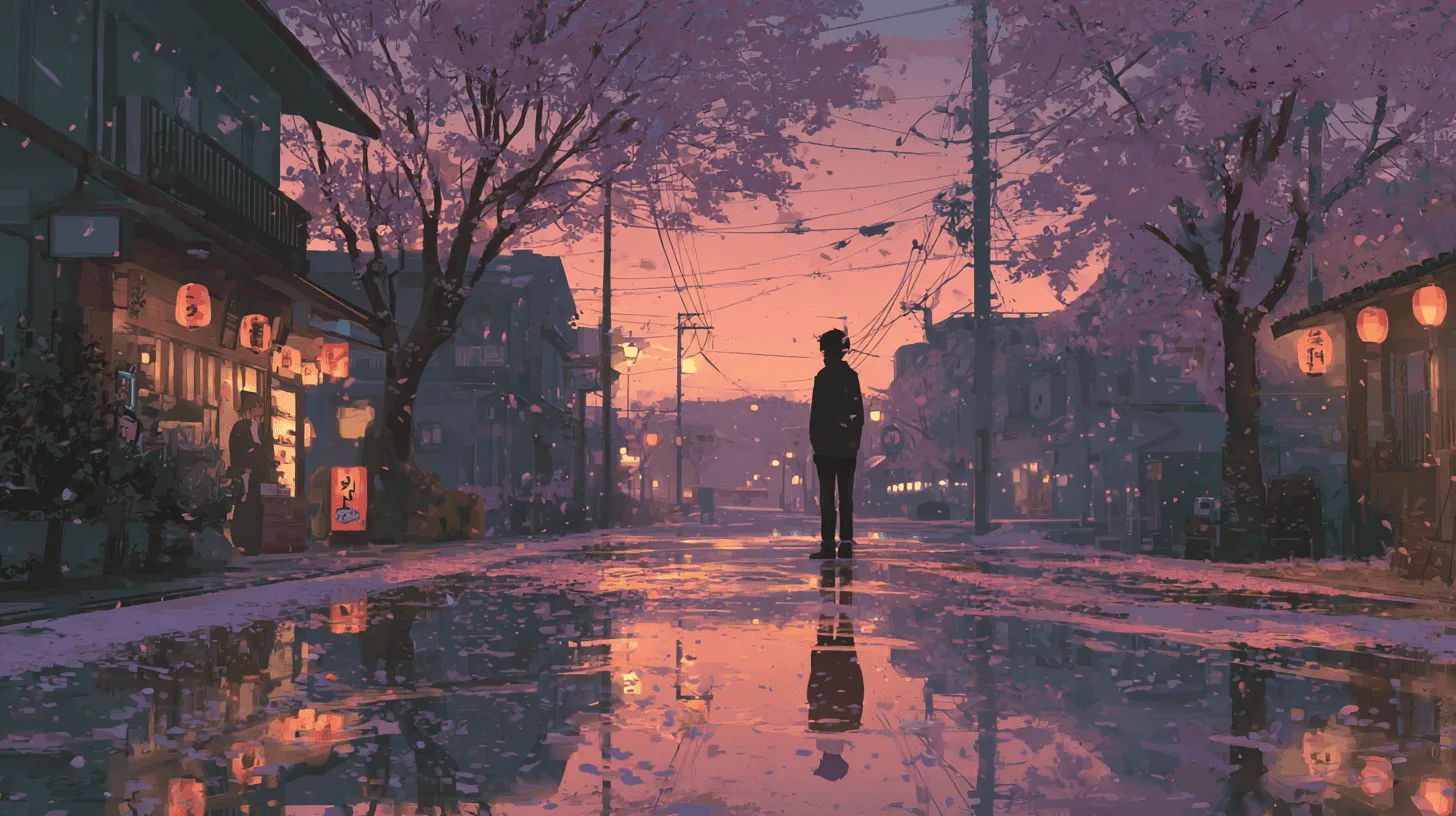
Lighting also plays a crucial role. Directors manipulate natural light to reflect the character’s emotional state. A sunset that casts long shadows can suggest an ending, while a sunrise that slowly breaks through clouds may hint at redemption. The use of golden hour versus twilight in a recurring location can chart the character’s journey from regret toward acceptance. In 5 Centimeters per Second, the fleeting cherry blossoms and the relentless rush of trains create an atmosphere of missed connections and lingering regret.
The beauty of the natural world is constantly tinted by the melancholy of what could have been, proving that even the most serene landscape can be a mirror for internal anguish.
The Legacy of Regret in Anime Storytelling and Audience Resonance
The masterful fusion of setting and regret leaves an indelible mark on anime as a storytelling medium, creating narratives that resonate long after the final credits. This technique transforms the audience from a passive observer into an empathetic participant. By visually encoding emotion into the environment, creators bypass the need for lengthy exposition, instead fostering a powerful, intuitive understanding of a character’s suffering. This is the legacy of regret in anime: a commitment to visual poetry that makes internal, invisible pain feel overwhelmingly concrete and universally understood.
You witness a character’s complete arc not just through their actions but through the silent evolution of their world. A train station that was once a place of despairing farewells might, in the story’s finale, become a place of hopeful departure, its meaning completely rewritten by the character’s growth. This symbolic continuity provides a deeply satisfying narrative closure. The practice has influenced a generation of storytellers, cementing a unique legacy where a city’s skyline or a classroom’s window seat is respected as a primary narrative tool. This enduring technique forges a profound connection between you and the story, proving that sometimes the greatest emotional truths are found not in what is said, but in the still, haunting beauty of where a story takes place.
The world-building thus becomes inseparable from soul-building, a testament to anime’s sophisticated capacity for emotional and psychological depth.