Table of Contents
Twenty years ago, the term “otaku” carried a weight of social judgment that made it nearly radioactive in polite conversation. It conjured images of shut-ins, obsessive collectors, and people whose entire emotional world revolved around drawings on a screen or pages of a manga. The word was rarely, if ever, used as a proud self-descriptor. In the mid-2000s, claiming the label could brand you as disconnected from reality, academically unmotivated, and socially inept — a stereotype amplified by sensationalist media and a few disastrous real-world events.
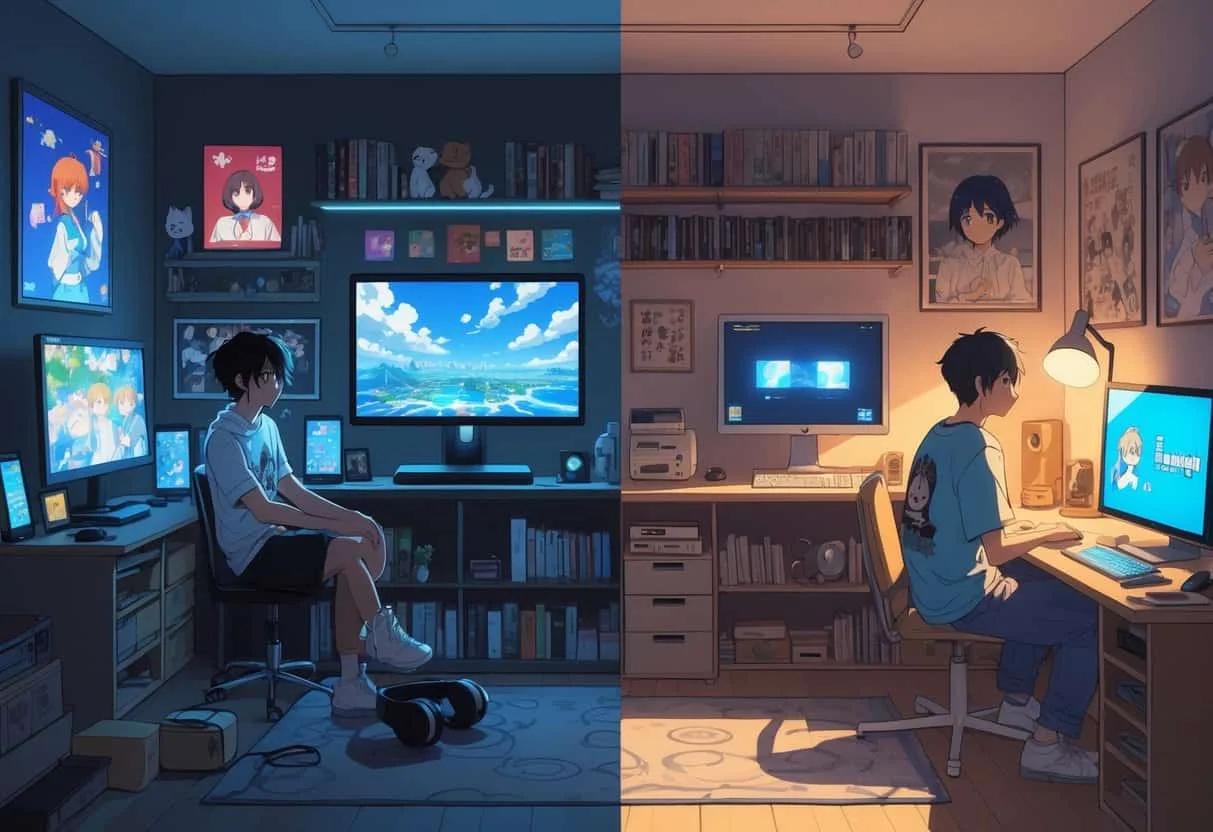
That version of “otaku” has not vanished, but it now represents only a narrow slice of a much broader, more vibrant identity. Today, millions of people around the globe use the word casually, even affectionately, to describe a genuine passion for Japanese pop culture, anime, video games, and the intricate fan works that surround them. The distance between the otaku of 2005 and the otaku of 2025 is not just one of time, but of technology, community norms, and a fundamental shift in who gets to define a subculture.
Defining Otaku: Then and Now
Origins and Early Stigma
The word itself began as an unusually formal second-person pronoun in Japanese, roughly meaning “your household” or “you” in a very polite register. In the 1970s and early 1980s, hardcore fans of anime, manga, and science fiction began using it among themselves as a quirky in-group address. The media caught on, and by the late 1980s, the term was being applied externally to a specific type of fan — one portrayed as socially withdrawn, obsessive, and even dangerous.
That perception calcified in 1989 with the arrest of Miyazaki Tsutomu, a serial killer whose apartment was filled with thousands of anime and horror videos. Japanese media immediately latched onto his fandom as an explanation for his crimes, unleashing a wave of “otaku panic” that painted an entire hobbyist community as potentially pathological. Some academics and commentators, like writer Toshio Okada, began defending otaku as knowledgeable specialists, but the stigma stuck. For well over a decade, being called an otaku meant being compared to a loner who could not function in normal society.
In the early 2000s, that stigma remained potent. Even as the global anime boom, fueled by shows like Dragon Ball Z, Sailor Moon, and Pokémon, created millions of international fans, the word “otaku” itself was rarely embraced. Western audiences preferred “anime fan,” while Japanese fans kept their hobby tightly compartmentalized. The cultural narrative was clear: otaku were people who had failed at mainstream adulthood.
Reclaiming the Label
A series of cultural and technological changes began eroding that narrative after 2005. Online communities like 4chan’s /a/ board, early anime forums, and dedicated fan sites let people connect over niche interests without geographic constraints, normalizing enthusiasm that once had to be hidden. When you could chat daily with hundreds of people who shared your love for a specific mecha series, the idea that your passion was a solitary pathology grew harder to sustain.
Creators themselves played a role. Hayao Miyazaki’s Studio Ghibli films won international acclaim and proved that animation could carry profound emotional weight, appealing to audiences far beyond the stereotypical male geek. Anime like Neon Genesis Evangelion and later Attack on Titan smashed into the mainstream, making it harder to dismiss fans as outcasts when half your classmates were wearing survey corps jackets. The emergence of “otaku” as a commercial identity, complete with dedicated shops, maid cafes in Akihabara, and massive conventions, turned a fringe label into a market segment — and eventually into a point of pride.
The 2010s saw a decisive shift: “otaku” morphed into a badge you could wear voluntarily. Influencers, YouTubers, and cosplayers started describing themselves as otaku in video titles and social media bios. The word came to signify not just consumption but expertise, creativity, and belonging. By 2025, calling yourself an otaku is more likely to start a conversation than to invite judgment.
Diverse Expressions in the 2020s
Today, no single archetype defines an otaku. The term accommodates the manga collector with floor-to-ceiling bookshelves, the competitive gamer who studies frame data in fighting games, the idol fan who follows every live stream, the cosplayer who sews their own outfits, and the historian who traces the evolution of 1980s OVA animation. These variations coexist under a large, loose canopy that values depth of knowledge and genuine passion over social conformity.
This diversity also means the old stereotype of the straight male otaku has been supplemented — though not entirely replaced — by highly visible communities of female fans, LGBTQ+ enthusiasts, and people who blend their fandom with fashion, music, and political commentary. The identity is no longer monolithic, and its many expressions make blanket judgments increasingly untenable.
Otaku Culture: 2005 vs. 2025
Media Consumption Trends
In 2005, watching anime typically meant buying expensive DVD box sets, catching late-night broadcasts on Adult Swim, or navigating frustrating peer-to-peer file sharing networks. Manga came almost exclusively as physical volumes, often scanned and translated by fan groups operating in a legal gray zone. A simulcast — a new episode arriving legally and subtitled within hours of its Japanese broadcast — was unthinkable. Fans had to be patient, resourceful, and willing to build entire libraries of physical media.
Two decades later, the landscape is unrecognizable. Services like Crunchyroll, Netflix, HIDIVE, and Amazon Prime have made anime a streaming-first medium. The moment a weekly episode airs in Japan, subtitled and often dubbed versions appear on platforms with millions of global subscribers — Crunchyroll alone surpassed 5 million paid subscribers in 2021 and has grown further since. Manga is consumed digitally through apps like Shonen Jump and Manga Plus, with official translations available day-and-date with Japan. This instant access has collapsed the former lag between Japanese and international audiences, making global fandom a simultaneous, shared experience.
The result is not just convenience but a transformation of fan behavior. Where once you might watch one or two series per season, a streaming subscriber can follow a dozen simulcasts, discuss them in real time on social media, and immediately dive into thousands of videos of analysis, reaction, and fan art. The volume and speed of consumption have reshaped what it means to be an enthusiast: you no longer need to hunt for content; you need to curate an overwhelming abundance.
Community, Fandom, and Social Stigma
Two decades ago, the community was physically scattered and largely online in text-based forums. Fan interactions happened through IRC channels, LiveJournal, and rudimentary social networks. Conventions like Anime Expo or Japan’s Comiket offered rare chances for face-to-face connection, and these events were often treated as temporary safe havens where you could express your passion without fear. Outside those spaces, many fans still felt the weight of stigma; “otaku” was a word you whispered, not declared.
Today, fandom is woven into the fabric of daily life. Discord servers, Twitter threads, TikTok edits, and Reddit communities keep the conversation permanent and public. The stigma that once forced fans into hiding has weakened dramatically, though research shows it has not vanished entirely. A 2021 survey by the Japan Times noted that while older generations may still associate otaku with negative traits, younger Japanese people are far more likely to view the term as neutral or even positive. Internationally, “otaku” has largely been absorbed into the broader spectrum of geek identity, alongside gamers, Trekkies, and comic book fans.
This shift has practical consequences. Fans now organize charity projects, academic conferences, and large-scale cosplay gatherings with corporate sponsorship. The idea that being an otaku is incompatible with social success has crumbled under the weight of evidence to the contrary: otaku are doctors, engineers, artists, teachers, and public figures who openly credit their passion as a driving force.
Key Influences and Milestones That Shaped Modern Otaku Identity
Creator-Driven Cultural Shifts
The evolution of otaku identity is inseparable from the artists, directors, and writers who refused to treat their medium as disposable entertainment. Hayao Miyazaki’s films, from My Neighbor Totoro to Spirited Away, demonstrated that animated stories could earn Academy Awards and speak to universal human experiences, pulling anime appreciation out of the subcultural basement. Toshio Okada, co-founder of Gainax and later a cultural commentator, tirelessly argued that otaku were not failures but “connoisseurs of database culture,” laying the intellectual groundwork for a more positive self-image.
Certain works became cultural flashpoints. Neon Genesis Evangelion (1995) shattered conventions with its psychological depth and ambiguous ending, spawning a generation of critical analysis and fan debate that mirrored academic discourse. Otaku no Video, a 1991 mockumentary produced by Gainax, mixed fictional narrative with real interviews to both lampoon and celebrate otaku life, showing fans that they could laugh at themselves while still taking their passion seriously. These titles, along with global juggernauts like Fullmetal Alchemist and One Piece, created entry points for millions and normalized the idea that deep investment in fictional worlds was not a flaw but a form of literacy.
From Akihabara to the World: Subcultural Spaces
Physical and digital spaces have played a decisive role in reshaping what otaku means. Akihabara, once an electronics district in Tokyo, transformed into a sprawling geek mecca where multi-story arcades, figure shops, themed cafes, and specialty bookstores catered to every niche. Here, being an otaku was not just tolerated but actively celebrated as an economic driver. The district’s influence radiated outward, inspiring similar hubs in Osaka’s Nipponbashi, Seoul’s Hongdae, and Los Angeles’s Little Tokyo.
Conventions amplified that sense of place. Comiket, the world’s largest self-published manga fair, grew from a small gathering of dedicated creators into a behemoth that draws half a million attendees twice a year. Events like Anime Expo in Los Angeles and Japan Expo in Paris showed that otaku culture had outgrown Japan entirely, becoming a global phenomenon sustained by cosplay parades, autograph sessions with voice actors, and late-night room parties. These gatherings proved that fandom could be a public, performative, and deeply social identity.
The Modern Otaku: Identity, Gender, and Global Belonging
Creativity, Knowledge, and the Blurring of Obsession
At the heart of the contemporary otaku identity lies a shift from passive consumption to active creation. The modern otaku is frequently a journalist of their own interests, whether they are cataloging anime background art on a blog, crafting elaborate cosplay armor, composing fan music, or producing video essays that dissect narrative themes with academic rigor. This output is not fringe; it feeds the culture back into itself, influencing creators and often being acknowledged officially by studios and publishers.
The boundary between dedication and obsession has become blurry not because the behavior changed, but because society’s threshold for passion has widened. When an entire subreddit devotes months to finding a single lost anime OVA, outsiders may see obsession; insiders see collective research and archival heroism. The difference between a healthy hobby and a consuming fixation is still real and debated, but the culture now tends to assess the outcome — creativity, community, knowledge — rather than the raw hours invested.
Gender, Fujoshi, and Inclusivity
The otaku landscape of twenty years ago was often imagined as a boys’ club, but that picture was always incomplete. Female readers and writers transformed the doujinshi (self-published comic) scene, particularly through the emergence of “fujoshi” — women who engage with and create male-male romance narratives. Far from being a marginal group, fujoshi have become a powerful economic and creative force, driving sales for certain anime and manga titles and shaping how online fandom platforms like Archive of Our Own operate.
This gender dynamic has forced a reevaluation of what an otaku looks like. Conventions now host panels on fujoshi history, and mainstream publishers openly court female fans with boy-love-adjacent titles. LGBTQ+ otaku have also carved out spaces where identity and fandom intersect, using anime and manga to explore their own experiences and build inclusive communities. The once-marginalized fans have become visible enough that the stereotype of the solitary male otaku feels increasingly outdated, even if it still exists in some corners.
Otaku in Global Pop Culture
Today’s otaku does not operate in a vacuum. The aesthetic of Japanese pop culture has bled into global fashion, music, and film. American rappers sample anime soundtracks, luxury brands collaborate with Nintendo, and Hollywood adaptations of anime — for better or worse — regularly make headlines. As media scholar Henry Jenkins has argued, fans are not passive recipients but active participants who spread, remix, and amplify media, effectively becoming unpaid distributors of culture. Otaku are central to that dynamic: their fan art floods social platforms, their fan translations pioneer new markets, and their convention culture influences mainstream event design.
This visibility has a dual effect. On one hand, it normalizes the otaku experience to the point where wearing an anime hoodie in a corporate office rarely raises an eyebrow. On the other, it opens the identity to charges of commercialization and dilution. When massive corporations use “otaku” as a marketing label, some long-time fans feel the term has lost its subcultural edge. Yet the core remains: an otaku is still someone who loves something so deeply that their identity reorganizes around it.
The Economic Power of Otaku Fandom
The transformation of otaku identity cannot be separated from the staggering economic growth of the anime and manga industry. According to a Grand View Research market report, the global anime market size was valued at over $26 billion in 2022 and is projected to continue expanding rapidly. This growth is fueled not only by streaming subscriptions and merchandise but by a fan culture that treats spending as a form of expression — whether through purchasing limited-edition figures, supporting Kickstarters for indie anime, or commissioning custom artwork.
The otaku wallet has become a recognized force, influencing production decisions, licensing negotiations, and even travel trends. Fans undertake “pilgrimages” to real-world locations featured in their favorite series, boosting local economies across Japan. The symbiotic relationship between creators and consumers has morphed into a full-fledged ecosystem where fan enthusiasm translates directly into commercial viability, further validating otaku tastes in the eyes of the business world and society at large.
This economic muscle also gives the community leverage. When a publisher mishandles a translation or a streaming platform cancels a beloved series, otaku can mount coordinated responses that genuinely shape corporate behavior. In a very material sense, being an otaku today means being part of a demographic whose preferences matter.
Looking Ahead: An Identity Still Under Construction
The distance between the otaku of 2005 and 2025 is vast, but the evolution is not complete. As virtual reality spaces emerge for anime-viewing parties, artificial intelligence tools enable instant fan art generation, and the line between original work and derivative creation blurs, the next decade will likely produce yet another iteration of what it means to be an otaku. The term may continue to broaden, or it may fracture into more specific tribal labels. What will not change is the fundamental engine: people finding profound meaning, community, and creative purpose in the art they love.
Whether you discovered anime on a grainy VHS tape two decades ago or downloaded a streaming app last week, the contemporary otaku experience is built on the same foundation — a refusal to treat passion as a guilty pleasure. That shift from shame to pride is the single biggest story of otaku culture over the past twenty years, and it’s a story that is still being written.