Table of Contents
The Emergence of Grassroots Anime Distribution
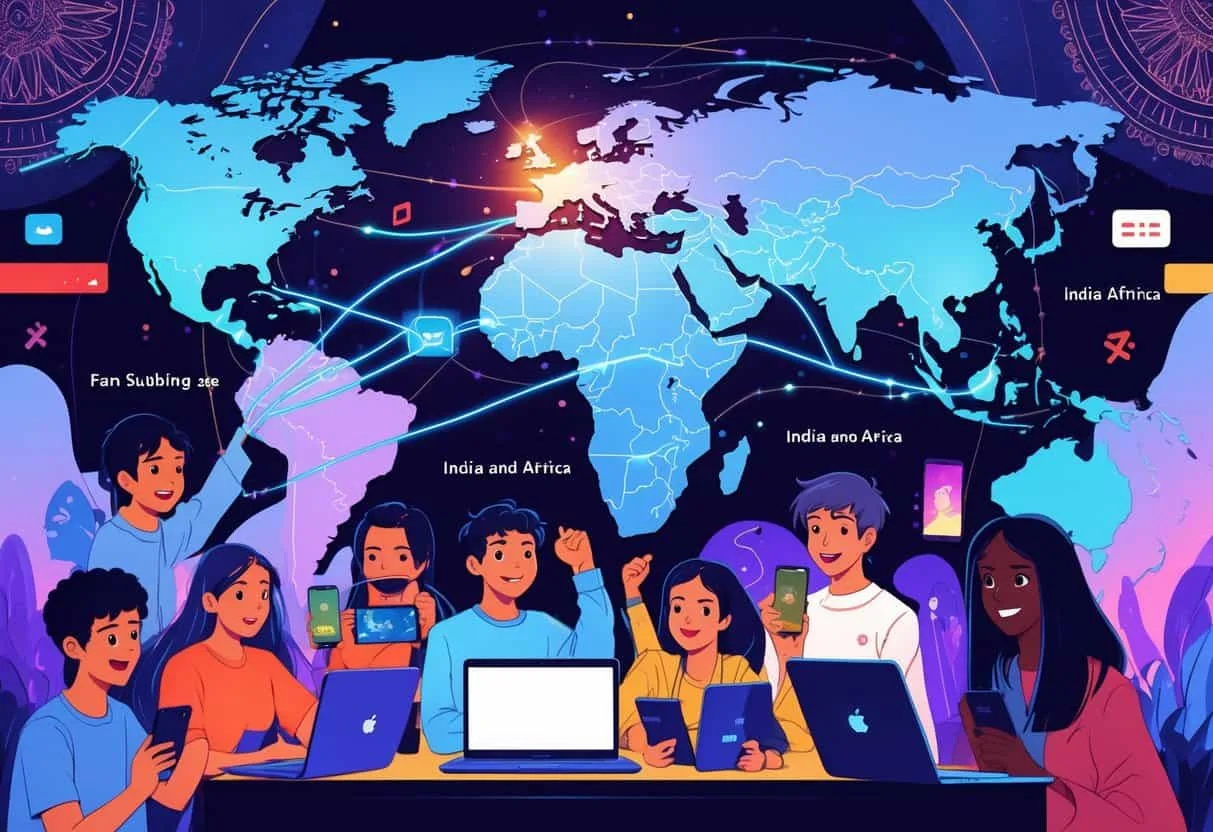
Anime’s meteoric rise across India and Africa is not a tale of carefully orchestrated marketing campaigns, but rather of fans seizing control of distribution when traditional channels failed to deliver. For millions of viewers from Lagos to New Delhi, the first encounter with a Studio Ghibli masterpiece or a shonen battle saga did not happen on a licensed streaming platform. It unfolded on a fan-run website, a peer-to-peer network, or a USB drive passed among friends, accompanied by subtitles crafted by passionate volunteers. This bottom-up circulation has fundamentally reshaped how Japanese animation penetrates emerging markets, creating a complex interplay between accessibility, cultural transmission, and the boundaries of copyright law.
Fansubbing—the practice of producing unauthorized subtitle translations—and broader media piracy function differently yet share a common outcome: they bridge the gap between a rich catalog of Japanese content and audiences underserved by commercial offerings. While copyright holders understandably view these activities as revenue leakage, the reality on the ground is far more nuanced. In regions where official localizations exist in only a handful of languages, where payment infrastructure is fragmented, and where disposable income dictates entertainment choices, fan-driven distribution often serves as the only viable on-ramp to the anime ecosystem.
Understanding the Mechanics of Fan Subbing and Piracy
To appreciate the scale of this phenomenon, it is necessary to disentangle the technical and cultural machinery behind it. Fansubbing emerged in the analog era when VHS tapes of obscure anime series were traded by mail between enthusiast clubs. By the late 1990s, digitization and broadband internet transformed this cottage industry into a high-speed, globally networked operation. Dedicated groups like Dattebayo and HorribleSubs, among others, became household names within fandom, releasing subtitled episodes within hours of Japanese broadcast.
The Anatomy of a Fansub Release
A modern fansub workflow reflects a sophisticated division of labor. A raw video file is captured from a TV source or ripped from a legitimate streaming service. Translators, often bilingual enthusiasts with no formal training, produce a first-pass script. Editors refine the dialogue for fluency and cultural nuance, while timers sync the text to audio waveforms. Typesetters handle on-screen signs and karaoke effects for opening and ending songs.
Finally, a quality checker reviews the entire package before encoding and distribution. This process is labor-intensive but fueled entirely by a passion for the medium, not monetary gain.
Piracy as an Information Highway
Piracy, in contrast, focuses on the unauthorized dissemination of already-existing copies. Torrent networks, DDL (direct download) sites, cyberlockers, and streaming aggregators form a resilient distribution fabric. In many African and Indian markets, where internet data remains expensive and connectivity sporadic, a condensed 720p encode of a 24-minute episode can be the difference between watching anime and being cut off entirely. Offline sharing via microSD cards and Bluetooth transfer extends the reach even further, creating a truly ambient media environment that official services cannot replicate.
Regional Realities: India and Africa as Parallel Ecosystems
Though separated by geography and economic structures, India and sub-Saharan Africa share several characteristics that make them instructive case studies in anime's unauthorized expansion. Both are home to rapid demographic growth, a median age well under 30, and a dizzying linguistic diversity that defies standardized licensing strategies. An official Hindi or Swahili dub might be celebrated, but it leaves speakers of Marathi, Xhosa, Amharic, or Hausa disconnected from the story unless fansubbing intervenes.
India’s Localization Imperative
India's anime renaissance was not born from a single television deal. It germinated in the early 2000s with dubbed broadcasts of titles like Pokémon and Dragon Ball Z on Cartoon Network, but stalled when those shows aged off the schedule. The vacuum was filled by clandestine Hindi, Tamil, and Telugu fansubs circulating on YouTube, WhatsApp groups, and dedicated forums. This fragmented, multilingual approach built a large base of dedicated viewers long before platforms like Crunchyroll formally entered the market with aggressive local pricing and regional content. Even today, fan-made translations for seasonal anime in Bengali or Malayalam surface faster than any legal offering could hope to achieve.
Africa’s Mobile-First Consumption Habits
Across Africa, the situation is even more acute. Smartphone penetration has outpaced the build-out of fixed-line broadband, making mobile data the primary gateway to the internet. Official streaming services often require credit card subscriptions that are inaccessible to large swaths of the population, and geoblocking restrictions further complicate matters. In response, pirates have optimized relee types specifically for small screens and low bandwidth. Hardsubbed files—videos with subtitles permanently encoded into the image—eliminate the need for device-level font support, ensuring compatibility with even the most basic handsets.
A study on media piracy in emerging economies observed that piracy often acts as an index of market failure, not a cause of it. When legal distribution channels fail to supply content at a price point and format that local consumers can access, the black market naturally expands to meet demand. Anime’s journey into the hearts of Indian and African viewers is a textbook example of this dynamic.
Technology as a Double-Edged Sword
The same technological advancements that enable widespread piracy also empower legitimate services to compete. YouTube has become a linchpin of anime's official distribution in India, with partners like Muse Communication hosting entire series for free with ad support. The platform’s ubiquitous mobile app, adaptive bitrate streaming, and pre-existing user base make it a formidable tool for circumventing piracy by offering a comparable or superior experience.
Open-source subtitling software such as Aegisub has standardized the technical quality of fansubs, while collaborative platforms like GitHub allow translation teams to manage projects with professional discipline. Artificial intelligence is now entering the fray: machine translation engines fine-tuned on anime dialogue are reducing the turnaround time for subtitle generation, albeit with mixed accuracy. These tools do not distinguish between official and unofficial use, meaning they lower the barrier to entry for both legal localizers and pirates alike.
Social Media as the Distribution Hub
Social media platforms have usurped the role once held by fansub group websites and IRC channels. Telegram channels in India and Nigeria broadcast meticulously organized anime libraries with one-click access. TikTok and Instagram Reels circulate bite-sized clips that double as discovery engines, often with fan-translated captions that bypass regional restrictions. This virality accelerates cultural ingestion but entrenches a norm of instant, free access that traditional business models struggle to accommodate.
Cultural Transformation Beyond Consumption
The impact of this accessibility extends far beyond passive viewing. Anime has become a raw material for local creativity, inspiring a generation of artists, writers, and performers to reinterpret Japanese aesthetics through their own cultural lenses. In Indian college campuses, anime cosplay contests are as common as traditional dance performances. Nigerian illustrators sell prints that fuse Afrocentric themes with manga stylings. This cross-pollination would be impossible without the foundational exposure that fansubbing and piracy provided.
Language Evolution and Identity Hybridity
A subtler shift is occurring in language. Loanwords from Japanese—nakama, kawaii, senpai—are entering the casual parlance of urban youth in Mumbai and Nairobi. Fan subbers do not merely translate; they curate, deciding which honorifics to preserve and which cultural references to annotate. This editorial voice shapes how millions first encounter concepts like bushidō or the nuances of Japanese cuisine. Over time, these linguistic borrowings contribute to a new, hybrid identity that is neither purely local nor an imitation of Japan, but a unique cosmopolitan subculture.
The influence now permeates local entertainment industries. Indian web series and African animated shorts increasingly adopt the visual storytelling grammar of anime: dramatic close-ups, speed lines, and episodic cliffhangers. Studios in both regions openly cite anime directors as stylistic influences, a creative debt that traces directly back to the bootleg discs and fansubbed files that once circulated underground. Trade publications have noted a surge in co-production inquiries between Japanese studios and African animation houses, hinting at a future where the flow of inspiration becomes bidirectional.
Economic Perspectives: Revenue Leakage or Market Creation?
The economic calculus of anime piracy is fiercely debated. Industry bodies calculate staggering losses in potential licensing revenue each time a fansub group distributes a series that might otherwise secure an exclusive platform deal. Yet this assumes that every pirate download is a lost sale—a proposition that crumbles under the reality of vastly different purchasing power. Instead, evidence suggests that piracy functions as a market-creation mechanism, cultivating demand that later converts into legal consumption when conditions improve.
Consider the trajectory of manga. Early scanlation (fan-translated comics) activity built readership for titles that eventually found commercial success through digital services like Shonen Jump’s global subscription. The anime industry is now replicating this pattern: platforms strategically target territories that have matured into viable markets thanks to years of grassroots evangelism. India, with its rapidly expanding middle class and improving digital payments infrastructure, has become a priority for global streamers precisely because the fan base was already enormous—and that fan base was built on unauthorized access.
The Merchandise and Ancillary Revenue Stream
Merchandising adds another layer to the economic story. Official anime goods—figurines, apparel, posters—are high-margin products that depend on audience size, not on the revenue from each streamed episode. A fan who discovered Naruto through a pirated website may later purchase a licensed hoodie or action figure, generating revenue back to the IP holder. The challenges of distributing physical merchandise in Africa and India are nontrivial, but e-commerce platforms and local conventions are steadily bridging the gap. Advertising partnerships with local brands further monetize this audience, often in ways that sidestep the contentious nature of content licensing.
Streaming services have accordingly shifted toward a portfolio approach: they offer ad-supported free tiers, mobile-only subscriptions priced at the equivalent of a few dollars per month, and strategic bundling with telecom operators. In Kenya, Safaricom has experimented with data plans that include unlimited access to select entertainment apps, a model that could incorporate anime streaming. Such innovations acknowledge that the competition is not other legal services, but the frictionless world of piracy. The key to conversion is not enforcement, but convenience and affordability.
Legal Tightropes and the Future of Copyright Norms
Legal frameworks in India and across Africa remain ill-equipped to handle the nuances of fansubbing. Copyright law, largely inherited from colonial-era legislation or trade agreements with Western nations, tends to treat unauthorized translation as a straight infringement, ignoring the transformative cultural labor involved. Enforcement is sporadic: sporadic takedown notices are issued, but no major fansub group has faced criminal prosecution in these jurisdictions. This creates a gray zone where activity is technically illegal but socially tolerated and practically unpunished.
Japanese rights holders have historically taken a pragmatic view, occasionally turning a blind eye to activities that build the global franchise. The president of a major anime studio once famously compared overseas piracy to free advertising, reflecting a recognition that the lifetime value of a converted fan far exceeds the lost revenue from a few unsanctioned views. However, as developing economies mature and legal platforms deepen their presence, tolerance is likely to wane. The challenge will be managing this transition without alienating the very communities that propelled anime to its current global stature.
Some scholars advocate for alternative models, such as voluntary licensing frameworks that would bring fansubbing groups into a sanctioned ecosystem, recognizing their linguistic expertise and community trust. Others point to the analogy of fan fiction, which has been partially normalized through content-sharing platforms that negotiate blanket licenses. Whether such solutions can scale across disparate legal systems remains an open question, but the conversation is shifting from outright condemnation toward a more nuanced engagement with audience-driven distribution.
Conclusion: From Subculture to Mainstream
The role of fan subbing and piracy in expanding anime’s footprint in India and Africa cannot be reduced to a narrative of victimhood or villainy. It is a story of market failure, technological opportunity, and cultural hunger converging to build something unprecedented: a passionate, multilingual, and creatively active audience that now represents the future growth frontier for the entire industry. The path forward will require legal innovation, pricing models that respect local economic realities, and a willingness to acknowledge that the fans who violated copyright were, in many ways, the best global ambassadors Japanese animation ever had.
As streaming platforms deepen their investments and local creative industries begin to produce original anime-inspired content, the wild west of unauthorized distribution may slowly recede. But the legacy of this era will endure in the billions of hours of Japanese storytelling that imprinted themselves on young minds, the cross-cultural friendships forged in online forums, and the indelible mark left on the pop culture landscapes of two continents. The next chapter will be written not in court filings, but in the everyday acts of fans who simply want to watch, share, and create—and in the industry’s ability to finally meet them where they are.