Table of Contents
The anime industry has never been static, but the past few years have accelerated a shift that many never saw coming. Where once the very term "anime” was synonymous with Japanese production houses, a new generation of studios based in North America, South Korea, France, and beyond are creating works that adopt the visual language and narrative sensibilities of Japanese animation while weaving in distinctly local flavors.
Far from a passing fad, these productions are grabbing global attention and, more importantly, attracting serious investment from streaming giants and legacy media companies alike. If 2024 showed what was possible, 2025 is set to deepen the trend with a slate of original series that will challenge preconceptions about who gets to make anime and what stories deserve that label.
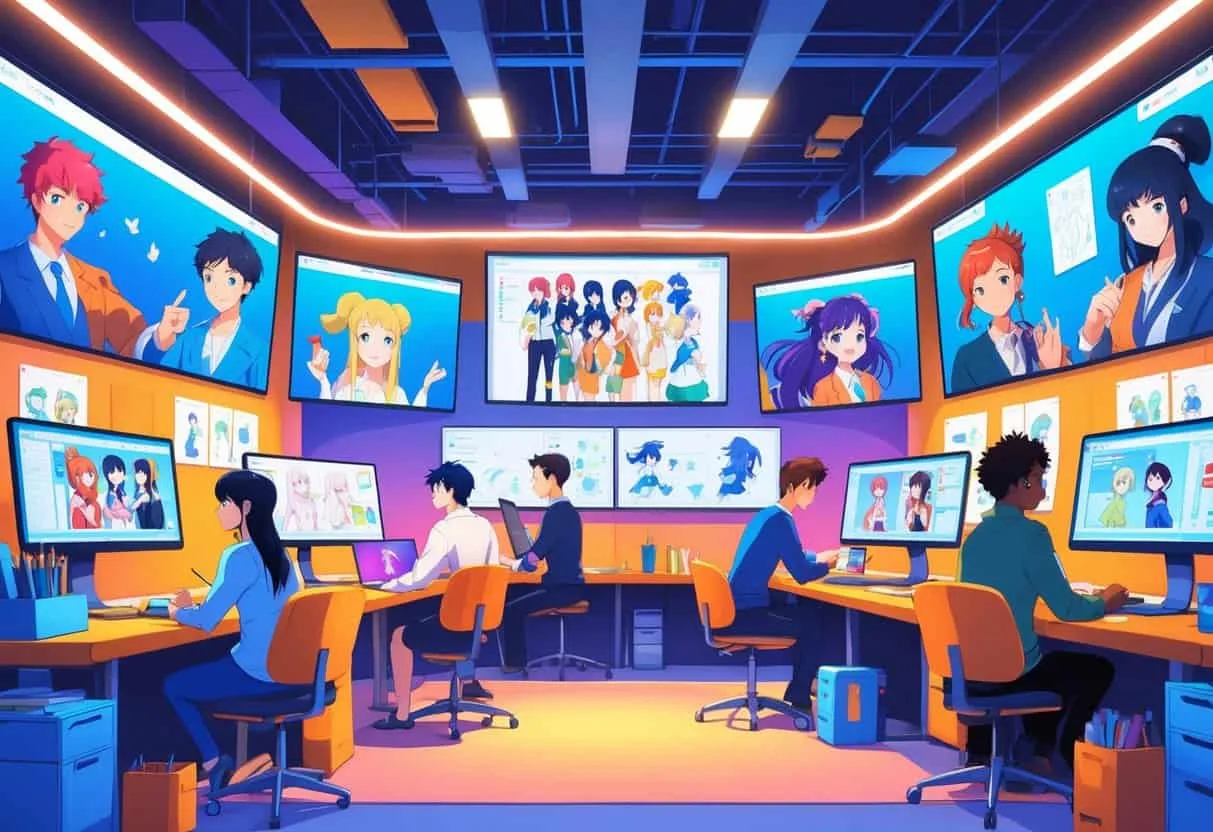
These international teams do not simply copy the Japanese template. They absorb the frame composition, the emotional exaggeration, and the rhythmic editing that define classic anime, then filter it all through their own cultural histories. The result is content that feels both warmly familiar and occasionally startling in its originality. Viewers are being pushed to rethink what "anime” means, and that redefinition is happening in real time.
The Global Expansion of Anime-Style Animation
Streaming platforms have dismantled the geographic walls that once kept anime a largely Japanese export. When a viewer in São Paulo or Berlin can simulcast the same episode as someone in Tokyo, the conversation around production shifts. Networks and investors notice where the eyeballs are, and increasingly, those eyeballs are on shows that carry the anime aesthetic but originate outside Japan.
Streaming Platforms Break Geographic Barriers
In the last five years, Netflix, Crunchyroll, Amazon Prime Video, and even Disney+ have funded or co-produced anime-style series with studios that have no physical presence in Japan. Crunchyroll’s global production arm, for instance, now actively pursues partnerships with animation houses in South Korea, the United States, and Europe. This strategy is not hidden; Crunchyroll has openly described its desire to build a pipeline of "borderless anime" that serves a planetary fanbase. The economics are straightforward: when a platform can commission a series that looks and feels like the anime millions already love, but can negotiate rights and budgets outside the tight Tokyo production committee system, everyone’s incentives realign.
This model gives non-Japanese studios an unprecedented platform. Series such as Dota: Dragon’s Blood from Studio Mir (South Korea) or Castlevania from Powerhouse Animation (Austin, Texas) arrived day-and-date on Netflix in over 190 countries. Their success confirmed that a global audience does not care about the studio’s zip code as long as the keyframe animation lands with impact.
Cultural Exchange and Creator Diaspora
The people making these shows often occupy a cultural middle ground. Studios outside Japan frequently hire Japanese freelance directors, key animators, and storyboard artists to embed authentic stylistic fingerprints. At the same time, Western showrunners have openly grown up on a diet of Dragon Ball Z, Cowboy Bebop, and Satoshi Kon films. That dual fluency creates a feedback loop where a French team might storyboard a sequence using the same cutting patterns as a vintage Gainax OVA, while a Korean background painter references ukiyo‑e composition for a modern fantasy landscape.
This diaspora of talent means that the old binary—Japanese versus non‑Japanese—blurs every season. When a show like My Adventures with Superman is produced by Warner Bros. Animation but animated by Studio Mir with a tone that echoes both shonen romance and American superhero serials, the label needs to stretch. Audiences are learning to judge the result, not the passport.
Western Studios Embrace the Aesthetic
Western animation companies that once stayed far from the anime look now treat it as a core competency. Some of the most prominent include:
- Powerhouse Animation – Known for Castlevania, Blood of Zeus, and Seis Manos, the Texas studio has built an instantly recognizable house style that merges anime fight choreography with Western dramatic pacing.
- Studio Mir – The South Korean powerhouse behind The Legend of Korra, Voltron: Legendary Defender, and Dota: Dragon’s Blood continues to define what high-budget, anime-influenced action looks like on Netflix.
- Rooster Teeth – With RWBY, the Austin-based company proved that a web‑born anime‑style franchise could sustain multiple volumes, a manga adaptation, and a dedicated convention following.
- Ankama – The French studio’s Wakfu and Dofus series draw from manga storytelling and Japanese RPG aesthetics, demonstrating that anime‑inspired 2D animation is a genuinely pan‑European venture.
- Legendary Television – The upcoming Tomb Raider: The Legend of Lara Croft series, animated by Powerhouse Animation, signals that major Hollywood IP holders now view the anime aesthetic as the best vehicle for action‑adventure serials.
This list keeps growing. As the domestic Japanese industry faces a production bottleneck—too many shows, not enough skilled animators—Western and Korean studios present a complementary engine that can feed the global hunger for anime‑style content without waiting for a Tokyo schedule slot.
Notable Works and Emerging Trends
The productions arriving from non‑Japanese studios are not mere imitations. They are steering the conversation in new directions, blending genres and visual approaches that are rarely attempted in mainstream Japanese anime. The sheer variety of source material, from Greek mythology to video game lore, is pushing the medium into territory that feels genuinely adventurous.
Milestones in Television and Film
Several series have already become touchstones for what non‑Japanese anime can achieve. Castlevania (2017‑2021) set the bar by taking Konami’s gothic horror game franchise and translating it into a four‑season saga that balanced existential monologues with extravagant, blood‑soaked combat. The choreography, heavily inspired by Japanese action anime, used speed lines, impact frames, and camera whip‑pans that would feel at home in a Shonen Jump adaptation.
Blood of Zeus (2020‑present) turned Greek myth into a painterly epic where gods and mortals clash with the elegance of a Saint Seiya arc. Dota: Dragon’s Blood tapped into high fantasy and political intrigue, marrying the narrative density of a light‑novel adaptation with the fluid monster designs accustomed to Korean‑led animation. Meanwhile, RWBY (2013‑present) blazed its own trail by evolving from a scrappy web series into a full‑blown franchise, proving that an original Western anime concept can carry the same merchandise and fandom weight as a Japanese property.
For 2025, attention is fixed on Tomb Raider: The Legend of Lara Croft. With Powerhouse Animation at the helm, the series aims to fuse the globe‑trotting spectacle of the games with the intimate character beats that define the best action anime. If it succeeds, it will further normalize the idea that a major Western IP can be best served by an anime‑native visual grammar.
Genre Bending and New Mythologies
While Japanese anime continues to excel in isekai power fantasies and high‑school romantic comedies, non‑Japanese creators are often gravitating toward terrain that feels less explored. Fantasy remains a dominant playground, but the mythologies are shifting. Blood of Zeus mines the Greek canon; Dota builds an entirely original high‑fantasy cosmology. Even Seis Manos, set in 1970s Mexico, blends kung‑fu cinema, folk magic, and an anime visual ethos into something that resists easy categorization.
Shojo‑adjacent storytelling, which emphasizes relational arcs and emotional growth, is also finding new expressions. My Adventures with Superman is not billed as a shojo, yet its focus on Clark Kent’s humanity, his romantic tension with Lois, and the gentler warmth of its character designs evoke the same intimate tone. That kind of cross‑pollination is easier for a non‑Japanese team that feels less bound by genre silos.
Shonen-style action, with its emphasis on friendship, rivalry, and escalating power levels, remains a staple that translates effortlessly across borders. Western productions retain the high‑velocity punch of battle anime but often infuse it with Western comic‑book paneling or a different sense of humor. The result is a hybrid that feels instantly readable to an anime fan while still carrying an unfamiliar cadence.
Collaborations and Cross-Cultural Projects
One of the most interesting developments is the rise of adaptations where a Japanese IP is handed to a non‑Japanese studio. Castlevania proved that a Texas‑based team could honor the tone of a beloved Konami franchise while expanding its lore in ways that resonated globally. Even upcoming projects like The Witcher: Nightmare of the Wolf (animated by Studio Mir) show that when a Western property is reinterpreted by a Korean studio fluent in anime syntax, the outcome can satisfy both hardcore fans and newcomers.
These collaborations are not limited to English‑language productions. China’s donghua industry—epitomized by series like The King’s Avatar and Mo Dao Zu Shi—continues to refine a 2D‑with‑3D aesthetic that draws heavily from Japanese techniques while serving domestic xianxia and wuxia narratives. Globally, the message is clear: anime as a style is no longer tethered to a single nation’s output.
Shifting Perceptions and Industry Impact
The influx of non‑Japanese anime is not just a creative moment; it is an economic and cultural shock that is reshaping how the medium is defined, funded, and consumed. Fans are reorganizing their tastes, and the industry is reacting with a mix of excitement and protective reflex.
Debating Authenticity
Perhaps no question burns brighter in fandom than “Is it really anime if it isn’t made in Japan?” The debate has been running for years and intensifies every time a high‑profile Netflix series drops. Purists argue that anime is intrinsically linked to the production culture, language, and artistic lineage of Japanese studios. For them, a show made in Texas, even with Japanese key animators, lacks the intangible texture that arises from working within Japan’s studio system.
The other camp defines anime as a set of visual and narrative conventions: large expressive eyes, stylized motion, melodramatic beats, and a willingness to tackle mature themes. By this standard, Castlevania and Blood of Zeus are as anime as anything airing on Japanese television. This stance is gaining ground as younger viewers, who grew up on a globalized media diet, rarely check a show’s country of origin before clicking play.
Studios themselves are careful. Many Western creators avoid labeling their work “anime” to sidestep the authenticity argument, opting instead for terms like “anime‑influenced” or “anime‑style.” Yet marketing departments rarely show such restraint. The tension is productive, forcing everyone to articulate what they value in the medium, which only deepens the conversation.
Fan Reception and Community Divides
Fan communities are not monoliths. On platforms like Reddit, MyAnimeList, and Crunchyroll comment sections, receptions are mixed. Some longtime anime fans express fatigue, worrying that the unique spirit of Japanese production will be diluted by a flood of Western‑produced series chasing the same aesthetic. Others celebrate the diversity and point to the fact that demand for anime has outstripped Japan’s production capacity, meaning that non‑Japanese studios are filling a genuine gap.
Online metrics tell a more unified story. Series like Castlevania sustained multiple seasons and strong completion rates. Blood of Zeus was renewed quickly. RWBY has amassed a dedicated global following over a decade. Audiences are voting with their attention, and the verdict is that non‑Japanese anime is not only welcome but expected.
Economic and Production Shifts
The business side is equally transformed. The success of these shows encourages streaming platforms to greenlight more projects, often with budgets that rival or exceed the average Japanese television anime episode. This influx of capital can be a double‑edged sword. On one hand, it provides steady work for animation studios outside Japan and helps raise standards for compensation, which has been a point of contention in the famously overworked Japanese anime industry. On the other hand, it can pressure Japanese studios to compete even harder for dwindling top talent, potentially accelerating the very production strain that opened the door in the first place.
Voice acting and localization are evolving too. English dubs are no longer afterthoughts for many of these series; they are primary audio tracks recorded alongside the animation process. That shift strengthens the identity of the show as a transnational product rather than a translated Japanese artifact. For fans who prefer subtitled Japanese audio, this can feel disorienting, but it reflects the reality of a production that was conceived in English from the storyboard stage.
The Continuous Thread of Japanese Influence
Even as non‑Japanese anime carves its own path, its DNA remains deeply Japanese. Every frame of a show like Blood of Zeus or Dota: Dragon’s Blood owes a debt to the pioneers who defined the style. That lineage is not a secret; it is worn proudly in the lighting, the layouts, and the beats of action.
The Unmistakable Marks of Classic Studios
Look at an action sequence in Castlevania. The sharp, skewed camera angles, the way a character’s eyes narrow before a lunge, the sudden switch to a held drawing on impact—these techniques trace directly back to the dynamic fight direction of Hiroyuki Imaishi (Studio Trigger) and the shadowed tension of classic Madhouse OVAs. Many directors on these Western series openly reference influence from yutapon cubes, kaneda‑style effects animation, and time‑manipulation tricks used in works like Kill la Kill and Fate/Stay Night.
Character design, too, stays rooted in Japanese semiotics. The simplified, geometric eye shapes that telegraph emotion, the chibi deformations for comedy, and the careful use of line weight to indicate depth are all borrowed from decades of Japanese refinement. Non‑Japanese studios have absorbed this vocabulary so thoroughly that they can now innovate on top of it—adding, for instance, a Western cartoonist’s flair for squash‑and‑stretch without breaking the anime illusion.
Ghibli’s Quiet Legacy
If the action lineage flows from Trigger and Madhouse, the meditative, character‑driven strand flows from Studio Ghibli. Hayao Miyazaki and Isao Takahata did not just make movies; they established a bar for emotionally resonant, hand‑crafted animation that international artists have been trying to clear ever since. The influence shows up less in direct visual quotes and more in a lingering attention to stillness, to the way wind moves through grass, to the weight of a simple meal shared between characters.
Shows like My Adventures with Superman often pause for quiet interludes that feel lifted from a Ghibli storyboard—a moment where the action stops and the camera simply observes a character lost in thought. In France, Ankama’s Wakfu series builds entire episodes around the bond between its heroes and the natural world, echoing Ghibli’s environmental undertones. The insistence that animation can treat gentle moments with the same respect as explosive battles is one of the most generous gifts Ghibli gave to the global industry, and non‑Japanese studios are honoring it by weaving that patience into their own pacing.
As the ecosystem evolves, it is likely that every major non‑Japanese anime production will continue to pull from these wellsprings. The craft may belong to the world now, but the foundational grammar was written in Tokyo, and that grammar remains the dialect all these new storytellers speak.
What comes next is not a replacement of Japanese anime but an expansion of its vocabulary. The shows arriving from outside Japan are not erasing the tradition; they are proving that the visual language of anime is robust enough to carry stories from every continent, and that the hunger for those stories is only growing.