Table of Contents
The Enduring Legacy of Samurai Cinema in Modern Anime
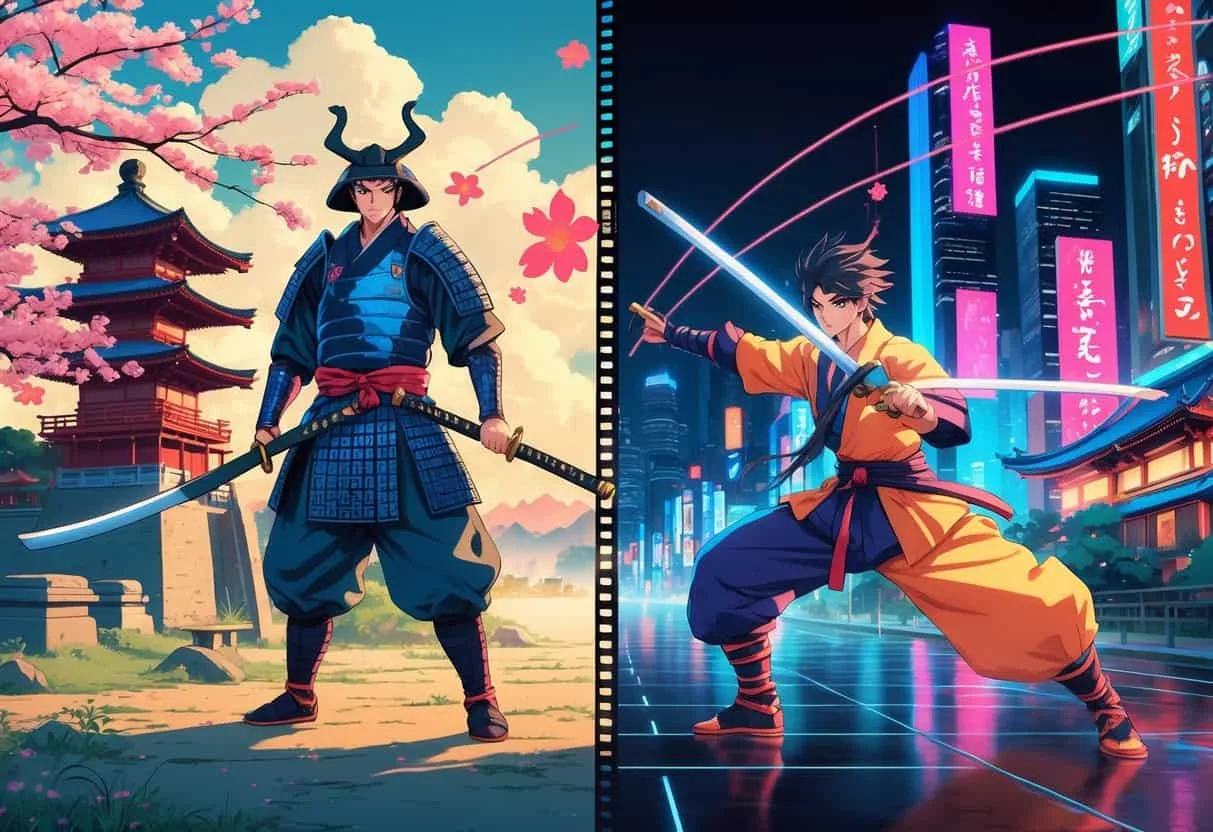
Samurai films did not merely entertain; they imported a distinct grammar of honor, violence, and existential silence directly into the DNA of global cinema. For enthusiasts of modern anime, the echoes of those monochrome epics are inescapable. They resonate in the deliberate pause before a killing stroke, in the torrential rains that backdrop a duel, and in the haunted eyes of an unmoored warrior. The lexicon of the wandering ronin, forged in the crucible of post-war Japan by directors like Akira Kurosawa, has become a fundamental narrative operating system for countless animated series and films. When you watch a lone swordsman struggle against a corrupt system in Rurouni Kenshin, or witness the stoic band of demon hunters in Demon Slayer: Kimetsu no Yaiba, you are not simply seeing historical fantasy—you are watching the repurposed heart of a cinematic tradition that redefined heroism.
The connection is less about cosplay and katana aesthetics than it is about structural storytelling. Samurai cinema introduced the world to the concept of the reluctant hero, bound by a fading code yet forced into brutal action by a calloused conscience. This archetype, perfected by Toshiro Mifune’s scratch-and-grin performances, broke the mold of the invincible warrior. Modern anime traded the straw sandals for school uniforms and cybernetic limbs, but the internal conflict remains identical. The visual language, too, was transported wholesale: the abrupt violence followed by static, poetic emptiness.
Japanese animation’s mastery of stillness—a character silhouetted against a blood-red sky, the wind animating a field of grass—owes a profound debt to the pacing of films like Sanjuro or Harakiri. These are not homages but evolutions of a mature stylistic blueprint.
Historical and Cultural Roots of Samurai Narratives
To trace the visual syntax of modern anime, one must return to the fertile soil of feudal Japan and the rigid ethical framework that governed the samurai class. The stories that anime inherits are not just fiction; they are refractions of a deeply stratified historical reality that shaped Japan's concept of the self and society.
The Samurai in Feudal Japan
For centuries, from the late Heian period through the Edo era, the samurai existed as more than soldiers. They were an elite, literate caste, serving as administrators, tax collectors, and enforcers of the shogunate’s will. Their monopoly on violence was legitimized by a cosmic sense of order that placed the lord at the apex of a moral pyramid. Anime often romanticizes this past as a time of noble struggle, yet the most intelligent series, such as Samurai Champloo, refuse to ignore the claustrophobic class restrictions of the era. Peasants lived at the mercy of a warrior class that could legally "test" a new blade on a disrespectful commoner (Kiri-sute gomen).
This brutal asymmetry creates the dramatic tension you feel when an anime samurai stands between duty to a corrupt liege and compassion for the downtrodden. The visual backdrop of crowded farming villages, dusty roads, and imposing castle towns in anime is a direct cosmetic inheritance from the historical settings meticulously reconstructed in epic chambara films.
Bushido: The Moral Compass of the Warrior
The path of the warrior—Bushido—was a fluid ideal, often codified in peacetime to prevent idle warlords from collapsing into anarchy. Values such as rectitude (Gi), courage (Yu), benevolence (Jin), and loyalty (Chugi) were absolute. In the realm of anime, these values are the psychological bedrock of countless character arcs. The fate-driven stoicism you admire in characters like Kenshin Himura or Guts from Berserk is a direct descendant of Bushido’s obsession with a "good death." Yet, samurai cinema from its inception questioned the toxicity of blind loyalty.
Kurosawa’s works frequently portrayed the agony of a samurai forced to choose between a flawed code and basic humanity. Anime amplifies this internal schism, creating characters whose "honor" becomes a curse. The subtlety lies in the silence between words—a narrative technique anime absorbed from the samurai film. In a visual medium often dominated by shouting and explosions, the heaviest moments often descend into a wordless, ritualized stillness that signals the impending eruption of violence.
Samurai Cinema as a Cultural Mirror
After the Second World War, Japan’s filmmakers used the samurai genre to navigate a national identity crisis. The films were not just distractions; they were therapy. They processed the trauma of defeat and the anxiety of modernization by looking backward at the last warriors to live by a unified code. Japanese animation inherited this reflective function. When you see a cybernetic soldier in Ghost in the Shell questioning her soul, she is repeating the internal exile of the masterless ronin.
The entire counter-culture movement in anime, with its nihilistic anti-heroes, stems from the dismantling of feudal certainties depicted in classic chambara. These films taught animation directors that action could be intellectually rigorous. The sweeping camera shots that analyze a battlefield’s geography before a massacre in Akira find their origin in Kurosawa’s telephoto lens setups, which flatten space to trap characters in a geometric labyrinth of fate. The connection is visceral and intellectual, proving that the samurai film is a cultural mirror that anime holds up to its own, perpetually modernizing face.
Visionary Filmmakers and Their Defining Works
Certain films did not just showcase swordplay; they engineered a new cinematic grammar. The directors who wielded the camera were no less skilled than the swordsmen they depicted, and their signature techniques migrated seamlessly into the hands of Japan’s leading animators.
Akira Kurosawa: Master of the Samurai Epic
Akira Kurosawa’s visual authority remains unparalleled. Known as "Tenno" (the Emperor) on set, he composed frames as paintings. His use of axial cuts—jumping directly closer to a subject along the same line of sight—creates a jolting, intimate intensity that anime directors exploit for dramatic reveals. His preference for filming during harsh, natural weather conditions gave mud, rain, and wind a tactile weight that animation studios like Studio Ghibli would later emulate through painstaking detail. Hayao Miyazaki’s epic battle sequences, dense with smoke and chaotic movement, owe as much to Kurosawa’s charged atmospherics as they do to fantasy art.
Furthermore, Kurosawa’s humanism, his insistence that a hero’s greatest battle is often against the savagery within himself, is the template for the "divided self" trope seen across the medium. Anime characters who pause to stare at their own bloody hands are living inside a Kurosawa close-up, wrestling with the moral hangover of violence.
Deconstructing Landmark Films: Seven Samurai, Yojimbo, and Rashomon
These three pillars of cinema formed the skeleton for modern action storytelling. Seven Samurai (1954) invented the "assembling the team" narrative structure. The meticulous recruitment of specialists for a suicidal, altruistic mission became the blueprint for everything from Samurai 7 (a direct sci-fi anime reinterpretation) to the eclectic hero groups in One Piece. Yojimbo (1961), with its sardonic, nameless protagonist manipulating two warring factions, gifted anime the archetype of the trickster bodyguard. The stylistic coolness, where an unreadable face masks a lethal strategy, defines characters like Spike Spiegel in Cowboy Bebop, whose lanky nonchalance is a direct descendant of Sanjuro’s shoulder-rolling swagger.
Rashomon (1950), however, might represent the deepest intellectual export. Its radical plotting—retelling a single event from incompatible, self-serving perspectives—shattered the concept of objective narrative truth. Anime frequently deploys this device to challenge the viewer’s loyalty. In series like Baccano! or The Tatami Galaxy, the fractured, unreliable recounting of events is a conscious echo of the Kurosawa-effect. It acknowledges that a samurai’s honor was often a fiction, a story told to sanitize butchery.
This reflexive storytelling technique equipped anime with a literary sophistication that rewards active viewing, forcing you to question not just the hero’s deeds, but the very medium in which they appear.
Toshiro Mifune and the Embodiment of the Samurai Archetype
Cast as the vehicle for Kurosawa’s genius, Toshiro Mifune delivered a performance style so feral and kinetic that it changed how heroes were depicted in animated motion. Mifune’s repertoire—the vicious speed of his draw, the animalistic scratching, the explosive transitions from clownish calm to psychotic fury—is the primary source code for the anime brawler. When Dragon Ball Z’s Goku adopts a low stance, screaming with a crackling, supercharged aura, the physicality traces back to Mifune’s rebellion against stiff, stylized chanbara acting. The "wild man" persona, a warrior with coarse manners but a diamond core, established the dual nature of the anime hero. His influence is corporeal; you recognize it in the exaggerated wind effects that follow a sword slash and the intense, lingering eye-lines during a standoff.
Mifune’s samurai was never pretty. He was dangerous, sweaty, and human—a combination that anime character designers have been replicating for decades to strip archetypes of their plastic perfection.
Global Echoes: Western Adaptations and Influences
The trans-Pacific journey of samurai tropes created a feedback loop that eventually returned to Japan. When Seven Samurai was reconfigured into The Magnificent Seven (1960), and Yojimbo into Sergio Leone’s A Fistful of Dollars (1964), the samurai became the gunslinger. This cross-pollination is seminal. George Lucas, a self-confessed Kurosawa devotee, extracted the Jedi concept—a knightly order with a quasi-spiritual discipline—directly from the samurai film, as explored in the documentary The Mythology of Star Wars. Anime, in turn, absorbed the Spaghetti Western cool that Leone invented.
Cowboy Bebop is essentially a samurai film set in space jazz, where the code of the ronin is reborn in the bounty hunter’s existential drift. This cultural ouroboros enriched anime’s visual landscape, allowing for hybrid settings like Trigun, where a gunslinger follows a pacifist bushido. The fluidity between the katana and the revolver in modern anime proves that the core values of loyalty and fatalism are iconographic, easily transferred across genres and galaxies.
The Samurai DNA in Modern Anime Storytelling
In transitioning from the jidaigeki era to the superflat world of anime, the philosophical weight of samurai films was not discarded. Instead, it was compressed into the emotional subtext of characters who now wield incredible power or navigate dystopian futures.
Honor, Duty, and Internal Conflict in Character Arcs
The rich narrative soil of modern anime is tilled with the conflict between Giri (social obligation) and Ninjo (human emotion), a tension that reached its apex in the samurai tragedy. This is the engine that drives the melancholic protagonists of the medium. The trope of the ex-assassin seeking atonement—executed flawlessly in Rurouni Kenshin—is a direct resurrection of the pacifist ronin who committed atrocities during the Bakumatsu. In these stories, the reverse-blade sword is less a weapon and more a cross of absolution. Likewise, the overwhelming survivor’s guilt that defines Guts in Berserk mirrors the isolated resilience of a samurai who has watched his entire clan fall.
The "lone wolf" aesthetic, complete with a shadow-veiled face and a massive, impractical blade, is not merely a visual signifier of coolness; it is a psychological barrier. Anime characters build these walls out of a feudal sense of personal pride, where asking for help is a fatal loss of face. This emotional stoicism, punctuated by catastrophic mental breaks, constitutes the classic five-act structure of the samurai tragedy, born in the kabuki theater and perfected in black-and-white cinema before finding a home in animation.
Visual and Cinematic Parallels
The way anime animates a fight scene is largely a direct transcription of live-action choreography and editing theory from the samurai canon. The classic "blink and you miss it" single-strike duel, known as Iaijutsu, was popularized by Sanjuro’s infamous blood-geyser finale. Anime replicates this freeze-frame pause before devastation to build unbearable tension. The screen often goes static, leaving only a line of light or a moving leaf to signal the strike. Moreover, the environmental symbolism is literal.
Heavy rain in samurai films, as analyzed by cinematic historians at The Criterion Collection, represents a cleansing flood that precedes a moral crossing of boundaries. Anime copied this entirely. No fight between equals in a series like Samurai X occurs on a sunny day; it requires a torrential downpour to signify the blood about to be washed away. The use of dramatic shaft lighting in spaceship hangars, borrowed from Rashomon’s forest scenes, isolates anime characters in existential ambiguity. Even the "wind line" speed marks that anime uses to convey kinetic force are a cartoon abstraction of the real wind machines Kurosawa used to batter his samurai.
Case Studies: From Samurai Champloo to Demon Slayer
Examining specific titles reveals the depth of integration. Samurai Champloo stands as a postmodern thesis on the topic. Director Shinichiro Watanabe violently spliced Edo-era calligraphy with hip-hop scratching and breakdancing body mechanics. Beneath the anachronistic surface, Jin and Mugen represent the two halves of the samurai dialectic: the refined, orthodox kendo tradition versus the chaotic, self-taught peripheral fighter. Their simmering rivalry mirrors the dynamic in Yojimbo, where survival depends on reading the room before spilling blood.
The series is a floating world where bushido is filtered through a turntable needle.
Conversely, Demon Slayer: Kimetsu no Yaiba translates the spirituality of samurai cinema into a supernatural idiom. The "Water Breathing" techniques are a lyrical visualization of the fluid, precise movements that Kurosawa pioneered. Tanjiro’s profound empathy for the demons he slays—pausing to offer a hand in their dying moments—echoes the "warrior’s compassion" seen in Seven Samurai, where a true swordsman respects the soul of the fallen foe. Studio Ufotable’s use of a floating camera perspective, swirling in 3D space around the thin edge of a blade, is a digital realization of the impossible crane shots that classic directors dreamed of but could not afford. These titles are not ripping off samurai culture; they are translating its mono no aware—the sensitivity to transience—for eyes that crave fluid 2D motion.
Socio-Political Undercurrents: Class, Prejudice, and Resilience
Samurai cinema was inherently political, often functioning as a coded critique of authoritarianism and rigid class structures. Modern anime retains this sharp edge. The clear feudal hierarchy that discriminated against peasants and the "Burakumin" underclass surfaces in narratives of resentment and rebellion. In Naruto, the titular outcast carries the legacy of a destructive force, demonized by a village that relies on him—a story that parallels the "despised yet necessary" role of the samurai mercenary in a starving rice economy. The theme of resilience, however, is the ultimate samurai export.
Japanese animation celebrates the battered body that refuses to collapse, a warrior who stands up again not for glory, but because lying down betrays the code. This is the visual poetry of the "bloodied crowning," where a character attains a higher spiritual state only after being physically shattered. It is a cycle of destruction and rebirth that masochistically refines the soul, a narrative law codified in Hagakure and ignited in anime through the trope of the "Last Stand" against a legion. The wind blows harder, the music swells, and the hero smiles—we are watching the death poem of a samurai, translated into moving pixels.
Samurai Influence Beyond the Screen: Literature, Games, and Global Pop
The conceptual framework of the samurai refuses to be confined to the screen. It spills over into the interactive and global imagination, creating a feedback loop that continually refreshes the anime aesthetic.
From Hagakure to Modern Manga
The foundational text of Hagakure, with its stark opening line "I have found the Way of the warrior is death," casts a long shadow over sequential art. Manga artists often structure their protagonists' journeys around the discovery that a worthy life is a constant preparation for the end. This nihilism, however, is liberating rather than crippling. Tsugumi Ohba’s Death Note, while modern, features a protagonist who adheres to a strict, self-imposed code of judgment that is indistinguishable in form from a corrupt daimyo’s declaration of righteousness. The stark, efficient line-art of early gekiga manga, which influenced modern action shows, derived its heavy shadows and gritty texture from the cinematography of the 1960s samurai film noir.
As explored in academic studies on Japanese visual narrative, the transition of the "man of action" from silver screen to ink-on-paper required a translation of motion that anime eventually animated perfectly. The pacing of a manga double-page spread, freezing a sword strike in a moment of pure tension, is the paper equivalent of a Mifune freeze-frame.
The Virtual Dojo: Samurai Ideals in Video Games
The interactivity of video games solidified the samurai stance as a global power pose. Ghost of Tsushima, while a Western outsider's love letter to Kurosawa, featured a "Kurosawa Mode" that included film-grain filters and Japanese audio tracks, explicitly closing the gap between play and cinema. Its influence on anime is cyclical: the game’s cinematic duels inspired a wave of mid-budget anime that aimed to replicate that authentic staccato rhythm. Contrast this with Sekiro: Shadows Die Twice, which focuses on the posture-bar, a system that requires players to read the balance of an opponent—a digital translation of the sakki (killing intent) pressure that marks a live-action sword duel. Anime fans who play these games begin to intuitively understand the vocabulary of the genre.
When an anime character circles an opponent, katana held low, the audience feels the weight of the controller. This synergy has completely blurred the lines of authorship, creating a shared "samurai simulation" space where the player, the viewer, and the filmmaker speak the same bushido dialect.
The Samurai in Western Culture: Star Wars and Beyond
The most potent vector for samurai influence into Western pop culture remains Star Wars. George Lucas’s debt to Kurosawa’s The Hidden Fortress is legendary—the narrative prism of two bickering peasants, the telekinetic duel of the mind, and the princess in the fire zone. But anime took this Westernized hybrid and reclaimed it. The Jedi are essentially space ronin, and anime delights in deconstructing this cross-cultural knight. Afro Samurai, with its stark, high-contrast visual style and eclectic hip-hop score, is a revenge drama sculpted from the stoic rage of a lone warrior.
This aesthetic drifted into the visual design of Western animation and music videos, creating a monoculture of the "cool samurai." The neon-bathed katana in Cyberpunk: Edgerunners shows that the icon of the Japanese blade has fully matured into a symbol of a dystopian edge, completely divorced from conservative feudal imagery. Yet, the inherent tension of destiny—a samurai’s inescapable fate—remains bottled inside the chrome and circuitry. Anime serves as the creative mediator, taking the exported sword and returning it to the West honed with a fresh, self-aware edge.