Table of Contents
The Anime Dubbing Landscape in Latin America
For decades, anime fans across Latin America have navigated a familiar crossroads: watch a series with a Spanish dub, or stick to the original Japanese audio paired with subtitles. While the debate surfaces in every region where anime is popular, the dynamics here are shaped by unique linguistic, cultural, and historical forces. Most viewers lean heavily toward Spanish-dubbed versions, drawn by the comfort of a neutral accent that bridges national borders and makes dialogue effortless to follow. Others swear by the original Japanese, convinced that no translation can fully replicate the intent of the voice actors and the cultural texture they carry. The reality is more nuanced than a simple binary choice, and understanding why each camp thrives means looking at everything from broadcasting history to modern streaming algorithms.
How Latin America’s Anime Fandom Took Shape
Anime arrived in Latin America long before the internet made global simulcasts possible. In the 1990s, television channels in Mexico, Brazil, Argentina, and Chile began importing Japanese series, dubbing them into Spanish, and broadcasting them during afternoon and weekend blocks. Titles like Dragon Ball, Sailor Moon, Saint Seiya, and Candy Candy became cultural phenomena. The dubs produced in those early years were rarely just quick translations—they were full adaptations, often recorded with theatrical flair and local humor that endeared entire generations to the medium.
Because these shows aired across multiple countries, dubbing studios opted for a standardized, neutral Spanish accent that would feel natural from Mexico to Argentina. This deliberate choice avoided regional slang that might alienate viewers elsewhere, creating a sound that, while sometimes criticized for lacking local color, became the default voice of anime in the region. Even today, when a Latin American fan hears Goku or Seiya speak, they likely recall the same voice actor they’ve heard since childhood, a through line that keeps dubs dominant in nostalgic hearts.
Subtitled anime, by contrast, was initially the province of smaller, more dedicated circles. Before streaming platforms, fans shared VHS tapes and later digital files through communities that valued fidelity to the source material. Fansubs—subtitles created by passionate volunteers—filled the gap for series that never received official dubs, and in doing so cultivated an audience that prized the original language track as part of the artistic whole. Even as official subtitling became more common, that early divergence planted seeds for a cultural rift that persists.
Neutral Accent and the Unifying Power of Dubbing
The concept of a “neutral Spanish” accent is central to the Latin American dubbing industry. Voice actors are trained to suppress regional markers—the “yeísmo” of Buenos Aires, the seseo that unifies much of the region, the distinctive intonation of Mexico City or the aspirated s’s of the Caribbean—in favor of a clear, evenly paced delivery that no single country claims as its own. This practice, refined over decades, has created a library of dubbed anime that can be broadcast without controversy from the Río Grande to Tierra del Fuego.
For fans, this consistency reduces cognitive load. You can focus entirely on the animation and storytelling without deciphering unfamiliar accents or reading subtitles. It’s an accessibility feature as much as an artistic choice. The result is a shared cultural experience: friends in Lima, Bogotá, and Santiago can discuss the same voice performances and catchphrases without translation. That shared lexicon strengthens the sense of regional fandom and often leads viewers to defend their preferred dub with fierce loyalty.
Still, some argue that the neutral accent can feel sterile, flattening the emotional range a character might express in a more idiosyncratic tongue. Online debates often pit purists who crave the raw Japanese performance against those who see the dub as a masterpiece of localization. What’s undeniable is that the neutral accent has become an anchor of anime consumption for millions, a sonic signature that signals childhood and community.
The Mechanics of Dubbing Versus Subtitling
Behind the screen, the processes of dubbing and subtitling follow markedly different paths. Dubbing involves replacing every Japanese voice with a Spanish equivalent, a task that demands careful lip-sync adaptation, accurate translation, and voice direction that matches the emotional beats of the original. A typical pipeline includes translation, timing adjustment (rhythm banding), casting, recording, and final mixing. The biggest technical hurdle is fitting Spanish lines into the mouth movements of animated characters—an art that requires scriptwriters to tweak sentences without distorting meaning.
Subtitling, while often seen as simpler, carries its own set of constraints. Translators must condense dialogue into two lines of text that appear on screen for just a few seconds. Reading speed limits what can be conveyed, so complex phrases get trimmed, and allusions sometimes vanish. In exchange, subtitles preserve the Japanese audio track, allowing viewers to hear the original intonation, pauses, and vocal nuance. That’s why sub fans frequently cite the authenticity of the voice acting as their primary motivation.
They argue that a subtitle is a necessary compromise to keep the intended performance intact, and that the emotional weight of a line is often carried as much by sound as by meaning.
Both approaches wrestle with the same core problem: Japanese is a high-context language dense with honorifics, unsaid implications, and culturally specific humor. Translators must decide whether to explain, adapt, or omit. Dubbing teams additionally labor under the constraint of lip sync, which can push them toward solutions that prioritize readability over literal accuracy. Subtitlers enjoy more freedom to stay close to the original script, yet they still battle space and time limits that can swallow nuance whole.
Cultural Adaptation and the Challenge of Censorship
Localization isn’t just about words—it’s about context. Spanish dubs routinely replace Japanese cultural references with approximations that Latin American audiences recognize. A bean-filled daifuku might become a generic pastry, a pun on kanji might turn into a local joke, and honorifics like “-san” or “-sama” usually disappear altogether. These choices can make dialogue feel more immediate, but they also risk eroding the cultural specificity that some fans treasure. Subtitles often preserve the honorifics and include translator’s notes, creating a learning effect that hardcore fans appreciate as part of their immersion in Japanese culture.
Content adaptation goes further. Broadcast regulations in many Latin American countries have historically imposed tighter standards than Japanese television. Scenes of strong violence, suggestive content, or coarse language were sometimes softened or removed from dubbed versions, especially in the 1990s and early 2000s. Today, streaming platforms usually distribute uncut versions with multiple audio tracks, but the memory of sanitized edits lingers, fueling distrust among purists who worry that dubbing equals censorship. In practice, modern dubs are far more faithful, but the reputation persists and pushes some viewers toward subtitles as a guarantee of unaltered content.
Streaming Platforms Reshape the Debate
The rise of Netflix, Crunchyroll, Amazon Prime Video, and regional players like Claro Video has fundamentally altered the dub versus sub calculus. For years, Netflix prioritized Spanish dubs for its anime catalog, investing in high-quality recording and aiming to attract casual viewers who might never choose a subtitled show. Its dubs are frequently produced with the same neutral accent tradition, and the platform’s recommendation algorithms often default to the dubbed track for Latin American users. This strategy has broadened anime’s appeal dramatically, pulling in audiences who would have bounced off a subbed experience within minutes. You can learn more about Netflix’s dubbing approach from Netflix’s own report on dubbing.
Crunchyroll, rooted in the subtitling world, originally catered to purists who wanted episodes hours after Japanese broadcast. Its platform offered multiple subtitle languages, and the community expectation was clear: you were there for the original audio. Over time, Crunchyroll began producing dubs as well, including Latin American Spanish dubs for popular series, in response to demand from regions where reading subtitles is less common. This dual approach now means that a single platform often offers both tracks, letting viewers toggle between them instantly—a feature that encourages experimentation and blurs the old dividing lines.
The platform’s recommendation engine and interface design subtly shape preferences, too. When the default audio is set to Spanish, new users may never discover the Japanese option unless they actively seek it out. This design choice has a measurable impact on consumption patterns, contributing to the continued dominance of dubs even as the sub community grows louder online.
Community Influence and the Social Life of Anime
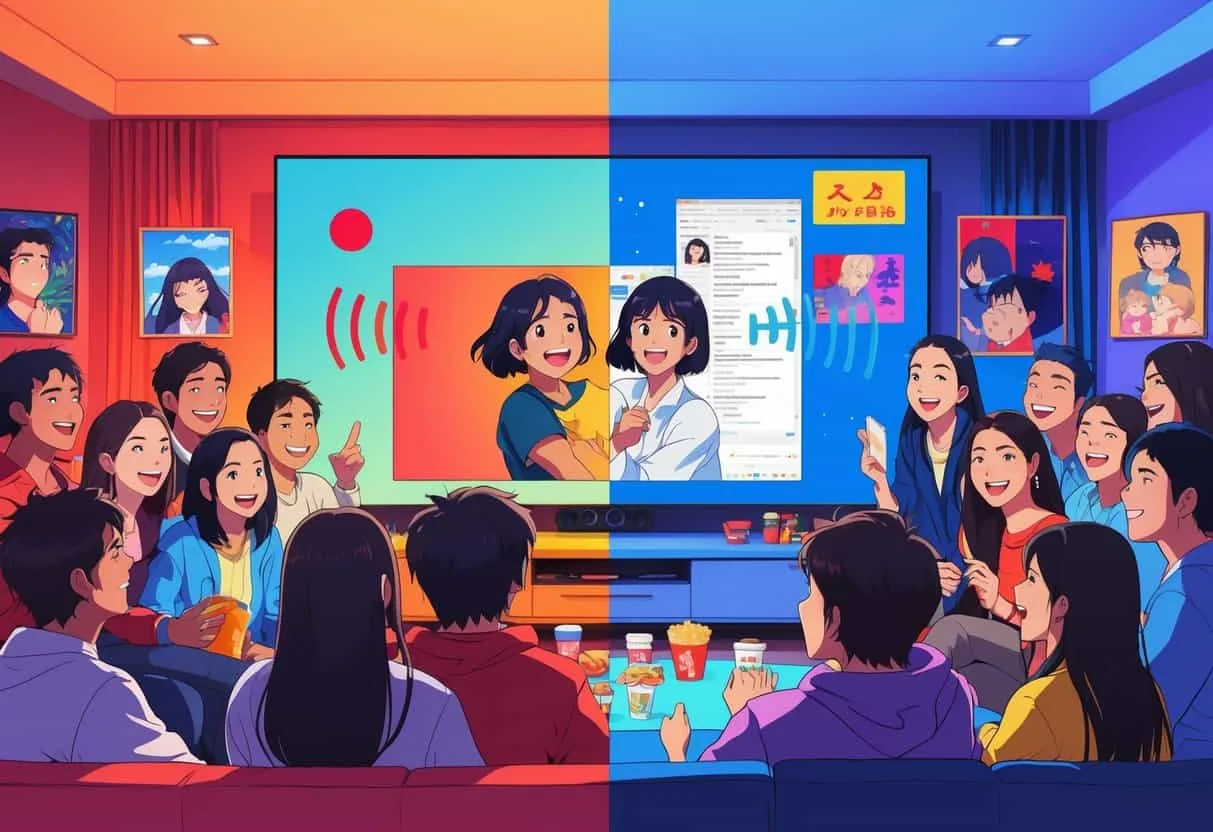
Anime has always been a social experience in Latin America. Local clubs, convention meet-ups, and massive online forums like those on Reddit or Facebook groups buzz with talk of voice actors, translation choices, and dubbing quality. These spaces are where the sub versus dub debate gets its emotional charge. In-person watch parties often default to the version that requires the least effort for the largest number of attendees, which usually means Spanish dub. But founder-run clubs and university anime circles frequently champion Japanese audio with subtitles as a mark of connoisseurship.
Influencers on YouTube and TikTok further amplify the conversation. A well-known creator declaring allegiance to subtitles can sway thousands, while a viral clip comparing a pivotal scene in both versions can reignite arguments about which is superior. The role of fansubs also endures: for niche series that never receive an official Latin American release, volunteer subbers remain the only gateway, reinforcing a subculture that values direct translation and unmediated access to original performances.
Regional Nuances Within Latin America
Though the neutral accent aims to unify, regional tastes do diverge. In Mexico, which hosts many of the largest dubbing studios, the local audience often embraces the neutral dub without hesitation. Argentine fans, accustomed to their own passionate dubbing tradition in live-action media, sometimes criticize neutral dubs as emotionally muted. In Chile and Colombia, the convenience of Spanish audio frequently wins out, but younger, internet-savvy demographics are increasingly switching to subs for the sake of freshness and perceived authenticity.
Streaming data from platforms like Crunchyroll hints at these patterns, though precise breakdowns are rarely public. Anecdotally, urban centers with higher English proficiency and greater exposure to original-language content tend to produce louder sub advocacy, while rural and semi-urban audiences stick with the familiar Spanish track. The availability of dubs in local slang—occasional experiments that leak into official releases—can spark both delight and controversy, as it shatters the neutral accent tradition and risks alienating viewers who don’t share the chosen slang.
Landmark Anime That Shaped the Conversation
Certain series have become touchstones in the dub versus sub dialogue. Dragon Ball Z stands as perhaps the most iconic example of a dub that took on a life of its own. The Spanish voice cast’s energetic delivery and slight adaptations of dialogue created a version that many fans consider definitive, sometimes even surpassing the Japanese original in emotional impact within the region. Ask a Latin American fan to imitate Goku, and they’ll likely mimic Mario Castañeda, not Masako Nozawa.
Naruto and One Piece present more complex cases. While their Spanish dubs enjoy widespread popularity, the sheer length of these series means that sub fans often talk about watching ahead via subtitles to avoid waiting years for dubs to catch up. This release lag can convert even staunch dub viewers into temporary sub watchers, creating a hybrid consumption pattern where the choice depends on episode availability rather than ideology. Ghibli films, directed by Hayao Miyazaki and Isao Takahata, introduce another layer: the Spanish dubs for movies like Spirited Away and My Neighbor Totoro are so carefully crafted that many families prefer them, yet cinephiles still argue the Japanese track reveals more about the directors’ original vision. For a deeper look at anime dubbing quality across regions, see Crunchyroll’s feature on dubbing.
The Choice as Personal Identity
Ultimately, the preference for Spanish-dubbed or Japanese-subbed anime in Latin America is rarely just about convenience. It’s tied to nostalgia, to the voice actors who became like family members during childhood afternoons, and to the identity of a fandom that prides itself on deep, unfiltered engagement with Japanese culture. The two camps coexist, sometimes clashing, but more often enriching the landscape with passionate discourse and creative output.
Streaming technology has made the choice trivial at the press of a button, yet the emotional weight remains. A dub offers a bridge, a way to welcome anyone into the story without barriers. Subtitles promise a window, a transparent pane through which to glimpse the original artistry. As the industry grows and Latin American studios continue honing their craft—and as AI-assisted dubbing begins to emerge in experimental projects—the conversation will evolve, but the core tension between comfort and authenticity will likely never disappear. It’s a debate fueled by love for the medium, and that love, in any language, is the one thing every fan shares.