Table of Contents
The Ultimate Showdown of Inner Demons: Kurama vs Sukuna
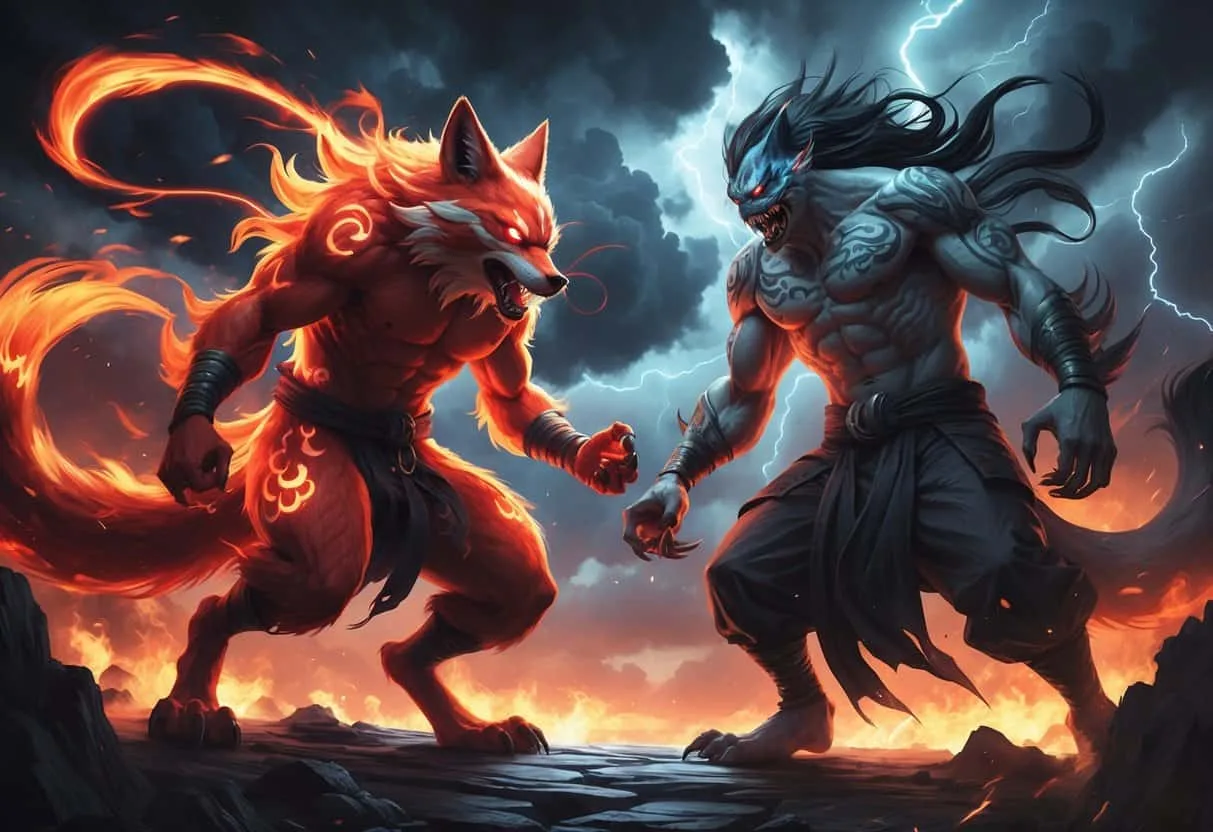
Few debates in anime fandom ignite as much passion as the clash between two of the most iconic inner demons ever created: Kurama, the Nine‑Tailed Fox sealed within Naruto Uzumaki, and Ryomen Sukuna, the King of Curses inhabiting Yuji Itadori. Both characters carry apocalyptic power, yet their personalities, narrative arcs, and the very nature of the threats they pose could not be more different. Sukuna embodies unrestrained malevolence and pure ego, a force of nature that exists only to dominate and destroy. Kurama, on the other hand, undergoes a layered journey from relentless hatred to loyal partnership, giving him a depth that redefines what a dangerous entity can become. In a head‑to‑head comparison, Kurama often claims the top spot—not just for his raw, world‑shattering chakra but because his influence extends far beyond destruction, reshaping an entire series and the shonen genre itself.
Origins and Mythology: Ancient Roots of Modern Monsters
To understand why Kurama and Sukuna feel so immense, we must look backward. Neither character is a purely original anime creation; both draw from centuries‑old Japanese folklore and historical texts, grounding their modern stories in mythic weight.
The Legend Behind Kurama
Kurama’s inspiration is deeply rooted in kitsune, the fox spirits of Shinto and Buddhist tradition. Kitsune are famously ambiguous—tricksters one moment, devoted guardians the next—and Kurama mirrors this duality perfectly. In Naruto, he begins as a chakra construct, one of the nine tailed beasts born from the Ten‑Tails, feared across the shinobi world simply as a natural disaster made flesh. His original name, Kurama (九喇嘛), echoes Mount Kurama north of Kyoto, a site tied to esoteric spiritual practices, tying him even closer to real‑world mysticism (explore kitsune mythology in depth).
Rather than a purely evil entity, Kurama is written as a creature of trauma—imprisoned for generations, his fury is a response to exploitation and betrayal by humans who sought only to control him. Over time he evolves into a guardian, a shift that mirrors the folkloric trope of a yōkai who finds redemption through genuine connection. This character arc makes Kurama more than a monster; he becomes a symbol of how rage can be transformed into protection, something no other inner demon in mainstream shonen had achieved so prominently before him.
The Historical Roots of Ryomen Sukuna
Ryomen Sukuna traces back to the ancient chronicle Nihon Shoki, where he is described as a fearsome figure with two faces, four eyes, and eight arms who defied the Yamato court. Historical debate persists over whether the original Sukuna was a rebel leader from the Hida region or a demonized local deity, but his legend carries the aura of an unstoppable, Japan‑defying force (read about the Nihon Shoki). Jujutsu Kaisen takes this foundation and reimagines Sukuna as a human sorcerer who became a curse after death, so powerful that his twenty indestructible fingers alone act as cursed objects of immense potency.
The esoteric Buddhist threads in his story are impossible to ignore. In certain traditions, multi‑armed deities are protectors of the Dharma, yet Sukuna subverts that expectation into a walking calamity. His existence challenges the boundary between a protector and a destroyer, a theme that runs through Japanese demon lore. Unlike Kurama’s eventual redemption, Sukuna is fascinating precisely because he remains irredeemable—a pure distillation of ego and appetite, mirroring the darker aspects of humanity’s desires for power and control.
The Role of Japanese Demons in Popular Culture
Kurama and Sukuna sit atop a long tradition of Japanese demons who refuse to stay one‑dimensional. From the tormented yōkai in Natsume’s Book of Friends to Muzan Kibutsuji’s chilling narcissism in Demon Slayer, anime consistently treats demons as complex entities with agency and depth. What sets Kurama apart is his emotional evolution; what sets Sukuna apart is his unflinching embrace of destruction as a philosophy. Pop culture has embraced both extremes because they offer different mirrors to the human psyche: Kurama represents the possibility of change and redemption, while Sukuna embodies the consequence of unchecked hunger for power. They stand as twin pillars of what makes an inner demon truly terrifying or, in Kurama’s case, unexpectedly noble.
Abilities, Power Scaling, and Legendary Battles
Power is not just about who can blow up the biggest crater—it is about versatility, regeneration, battlefield intelligence, and the ability to tip the scales in a life‑or‑death clash. Kurama and Sukuna operate on vastly different energy systems, yet their destructiveness places both at the apex of their respective worlds.
Kurama’s Chakra Mastery and the Tailed Beast Bomb
The Nine‑Tails’ signature attack, the Tailed Beast Bomb, is a condensed sphere of positive and negative chakra that can obliterate mountains with ease. Kurama can fire these bombs in rapid succession, alter their trajectory mid‑flight, and even team up with Naruto to launch a Super Mini‑Tailed Beast Bomb for surgical strikes against powerful opponents. His chakra reserves are so vast that he can continuously heal any host, revive them from near‑death, and share his power with entire armies through the Kurama Cloak. This collaborative aspect—borrowing chakra and sensing negative emotions—turns Kurama from a simple cannon into a strategic asset, something directly demonstrated during the Fourth Great Ninja War (full breakdown of the Tailed Beast Bomb).
After forming a true bond with Naruto, Kurama unlocks the Six Paths Sage Mode, elevating speed and reflexes to levels that can keep pace with Madara Uchiha and Kaguya Ōtsutsuki. His ability to manifest chakra arms for combat and defense, erect barriers that withstand massive attacks, and transfer his full chakra to allies without hesitation makes him a force multiplier unmatched by any other tailed beast. The emotional core here is that Kurama’s power is directly tied to trust—the stronger the bond with his jinchuriki, the more seamless and devastating the synchronization becomes.
Sukuna’s Cursed Techniques and Domain Expansion
Sukuna’s danger is equally overwhelming but far more personal and tactical. His Cleave and Dismantle attacks slash through flesh and cursed energy alike, adjusting their power to match the target’s toughness. These attacks are not brute force but surgical precision, capable of dismembering opponents before they can react. When he elevates a fight to Domain Expansion: Malevolent Shrine, the rules become absolute: everything within a 200‑meter radius is relentlessly shredded by a guaranteed‑hit effect that does not require a barrier, a feat considered virtually impossible by modern sorcerers. This open‑barrier domain, paired with his fire‑based technique known as the flame arrow, makes him a walking apocalypse who casually dispatched Jogo, one of the strongest disaster curses, without needing his full finger count.
After taking over Megumi Fushiguro’s body, Sukuna gains access to the Ten Shadows Technique and tames Mahoraga, a shikigami that can adapt to any phenomenon or attack it encounters. This strategic mind—storing techniques, exploiting the rules of jujutsu sorcery, and anticipating opponents’ moves several steps ahead—elevates Sukuna far beyond a brute. His Heian‑era form, a four‑armed, two‑faced colossal body, further underscores that his power is ancient and untempered by modern limitations (details on Malevolent Shrine).
Cross‑Universe Comparisons: Kurama vs Susanoo
While the two have never appeared in a canonical crossover, video games like J‑Stars Victory VS and Jump Force have thrown them into the same arena for fans to test. When Kurama collides with a fully‑manifested Susanoo, the contrast becomes vivid. Kurama’s Tailed Beast Bomb delivers a kinetic, explosive punch that can overwhelm Susanoo’s layered armor, but Susanoo’s slashing sword and Yata Mirror offer near‑perfect defense. In a hypothetical battle of endurance, Kurama’s near‑limitless chakra and regeneration would outlast a Susanoo sustained by a single Uchiha’s reserves, which finite. However, when considering Sukuna’s slashing techniques combined with his domain expansion, the match‑up becomes a question of whether Kurama can survive an instantaneous barrage of slices before his chakra arms overwhelm the King of Curses.
The stalemate nature of these debates only fuels fan passion and keeps discussion threads active for years.
Unleashed Forms: Beyond Limits
Both entities possess transformations that redefine the battlefield. Kurama’s full Nine‑Tails form towers over entire villages, and when combined with Naruto’s Asura Avatar and a Perfect Susanoo, the resulting colossus can slice through meteors and tank continent‑level attacks. The emotional pulse is unmistakable—Kurama’s power is tied to trust, and the stronger the bond with Naruto, the more seamless the synchronization becomes. This cooperative dynamic adds layers of strategy not available to a purely solo fighter.
Sukuna’s unleashed state, by contrast, represents monstrous independence. His Heian form gives him twice the arms, two faces for omnidirectional awareness, and a physicality that shrugs off decapitation. It is a body built purely to dominate, and every additional finger he consumes expands his cursed energy pool. While Kurama needs a willing partner to reach peak output, Sukuna only needs to consume—a chillingly self‑sufficient escalation that makes him unpredictable and terrifying in any scenario.
Character Development and Narrative Roles
The greatest differences between Kurama and Sukuna lie not in their power sets but in their roles as characters within their respective stories. These roles define how audiences perceive them and why they resonate so deeply.
Kurama: From Enemy to Friend
Kurama’s character arc is one of the most celebrated in anime history. He begins as a mindless force of destruction, feared and hated by the entire shinobi world. Naruto’s teacher, Jiraiya, describes the Nine‑Tails as a natural disaster that would destroy everything in its path. But as the series progresses, Kurama’s backstory unfolds—his manipulation by Obito Uchiha, his forced containment within Naruto, and his long‑simmering hatred for humanity. What makes Kurama special is that his rage is justified, and his eventual change of heart feels earned rather than convenient.
The turning point comes during the battle against Pain, where Naruto’s refusal to give up hate finally breaks through Kurama’s walls. Their eventual cooperation leads to the discovery that Kurama is not just a weapon but a sentient being with his own hopes and fears. By the end of Naruto Shippuden, Kurama sacrifices parts of his power willingly to protect Naruto’s family, and in Boruto, he pushes himself to the brink of death to save his friend from Isshiki Ōtsutsuki. This complete reversal—from enemy to father figure—gives Kurama an emotional depth that few inner demons in any medium achieve. He is dangerous not because he destroys but because he could have destroyed and chose not to.
Sukuna: The Unchanging Force of Chaos
Sukuna operates on the opposite trajectory. He does not change, does not grow, and does not learn lessons. From his first appearance in Jujutsu Kaisen, he is clear about who he is: a being who exists only to satisfy his own desires. His character is fascinating precisely because of his consistency. Sukuna’s philosophy is simple—strength is the only value, and everything else is weakness waiting to be exploited.
This makes him terrifying in a way that Kurama is not. Kurama’s danger is conditional; Sukuna’s danger is absolute.
What makes Sukuna particularly compelling as a character is his intelligence. He is not a rampaging beast but a calculating strategist who manipulates everyone around him, including his own host. His interest in Megumi Fushiguro’s Ten Shadows Technique shows a long‑term planning capacity that Kurama never displayed. Sukuna plays the long game, positioning himself for ultimate freedom and power. Where Kurama represents the possibility of redemption, Sukuna stands as a warning about what happens when power has no ethical constraints.
He is the mirror that forces Yuji—and the audience—to confront difficult questions about justice, sacrifice, and what it truly means to be human.
Cultural Footprint: From Screen to Street
The rivalry between these two inner demons does not stop at lore threads and power debates—it bleeds into fashion, gaming, and the way fans connect around the world. Their silhouettes are as recognizable as any superhero emblem in modern pop culture.
Representation in Anime, Manga, and Video Games
Kurama’s role in Naruto and Boruto spans over 700 episodes and multiple films, often framed as the emotional core of the protagonist’s growth. His image appears across every Naruto Shippuden: Ultimate Ninja Storm installment, where players can summon his Tailed Beast Bomb as a cinematic finisher. The Naruto franchise has sold over 250 million copies worldwide, making Kurama one of the most recognized fictional characters on the planet.
Sukuna, though younger in pop culture terms, has already carved out a legendary status. Jujutsu Kaisen 0 and the ongoing anime adaptation have made his instant‑kill Domain Expansion one of the most replayed clips in online anime fandom. The series has sold over 90 million copies as of 2024, and Sukuna’s iconic smile is now a staple of anime meme culture. Both appear in mobile gacha games like Genshin Impact and Honkai: Star Rail, as well as crossover titles like Jump Force, ensuring that new audiences constantly discover them.
Influence on Fashion and Merchandise
Anime‑inspired streetwear has elevated these two into fashion icons. Collaborations like Uniqlo’s UT line regularly feature Kurama’s snarling visage on stark black tees, while Sukuna’s finger seals and four‑eyed stare appear on oversized hoodies and jackets. A Bathing Ape’s limited drops have nodded to Naruto lore, turning the Nine‑Tails into a luxury motif. Even beyond Japan, independent artists on platforms like Etsy and Redbubble sell enamel pins, embroidered jackets, sneaker customs, and phone cases dedicated to their iconic markings (see an example of anime fashion collaborations). Wearing their symbols is a quiet brag—a way to signal membership in a global fan culture that reveres inner demons as ultimate power fantasies.
Online Fandoms and Community Theories
Across Reddit, YouTube, and Discord, the Kurama versus Sukuna debate is a permanent fixture. Subreddits like r/Naruto and r/Jujutsufolk host weekly power‑scaling threads where fans calculate damage output, speed feats, and hax potential. A classic recurring argument asks whether Kurama’s chakra perception can sense Sukuna’s soul before Malevolent Shrine activates. YouTube theorists have built entire channels analyzing frame‑by‑frame scenes to prove one entity could out‑regenerate the other. This constant engagement proves that both demons have transcended their source material to become cultural conversation pieces.
Their impact is measured not just in Blu‑ray sales but in the sheer volume of fan art, cosplay, and impassioned late‑night discussions they inspire (join the debate on r/Naruto).
The Verdict: Complexity vs Malice
If most dangerous means the highest potential for unconditional mass destruction, Sukuna’s open‑barrier domain and tactical cruelty place him at the top of the immediate‑threat list. He can delete entire city blocks with a hand sign, and his insatiable desire to torment makes every encounter a psychological war. There is no reasoning with Sukuna, no negotiation, no redemption arc waiting in the wings. He is a pure force of chaos that exists solely to consume and destroy.
But when danger is measured by enduring influence—power that can both annihilate and resurrect, that can reshape the soul of a shinobi world and the shonen genre itself—Kurama pulls ahead. His journey from living weapon to beloved ally created a blueprint for inner‑demon storytelling that no series has quite replicated. Kurama’s chakra empowered an entire era of anime, his bond with Naruto defined the emotional arc of a global sensation, and his continued presence in Boruto proves his relevance has not faded. Sukuna, as a newer contender, may yet reach that level of cultural depth—Jujutsu Kaisen has time to explore his character further—but for now, the Nine‑Tailed Fox remains the more formidable force. Not just in raw strength, but in the depth of character that keeps fans returning, year after year, to watch a monster become a hero.