Table of Contents
The Overlooked Powerhouse: Why Anime EDs Often Strike a Deeper Chord
Anime opening sequences grab your attention with high-energy animation and bombastic J-rock or J-pop tracks. The ending theme, however—commonly called the ED—operates in a quieter, more insidious register. It rolls as the credits fade in, after the climax has passed and the tension has broken. This precise placement allows a strong ED to bypass your analytical brain and target raw emotion. When done right, it reframes the entire episode you just watched, highlighting themes of loss, hope, or quiet determination that the main plot only hinted at.
An iconic anime ED can hit harder than the final scene precisely because it doesn't compete for your attention; it consoles, probes, and solidifies the story's emotional truth while you sit in silence.
Many viewers skip the credits to jump to the next episode. But a masterfully crafted ED punishes that habit. It transforms the ending from a simple exit ramp into a destination of its own—a place where the narrative breathes, and the audience reflects. The combination of a melancholic melody, poetic lyrics, and subdued but intentional animation creates a concentrated dose of feeling that often surpasses the immediate action of a finale. These sequences prove that a show's emotional intelligence is best measured not by how it screams, but by how it whispers when the battle is over.
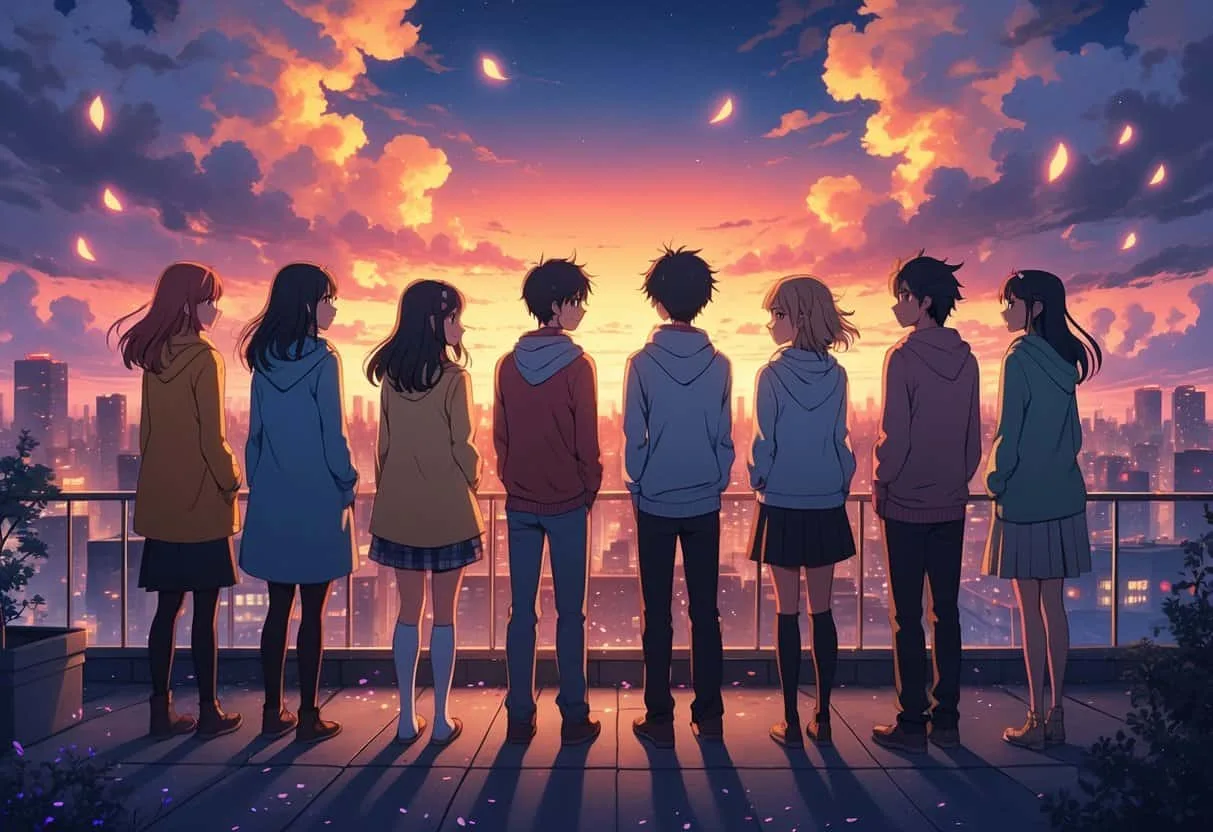
What Makes an Anime ED Hit Hard?
The most devastating EDs share a common architecture. They don't rely on spectacle; they build a sensory echo chamber where sound, story, and imagery amplify each other. This trifecta bypasses the need for dialogue or explosive action, instead encoding the anime’s core message into a purely emotional afterimage. When you finish an episode and feel that distinct ache in your chest, it’s rarely because of the last line of script—it’s because the ED transported you into the characters' internal landscapes in 90 seconds flat.
Emotional Storytelling Through Subtle Moments
Anime episodes rush through action set-pieces, plot twists, and rapid-fire banter. The ED offers a deliberate deceleration. It zooms in on the quiet aftermath: a character staring out a rain-streaked window, a childhood photograph pinned to a wall, a scarf gently lifting in an autumn breeze. These vignettes often show events that exist outside the canonical timeline—glimpses of normalcy, or symbolic representations of a character’s psychological state. In a romance series, the ED might depict the couple living a peaceful domestic life that the main story has not yet granted them, reinforcing the stakes of their struggle.
In a war drama, it might reveal images of soldiers laughing in a bar after hours, reminding you that underneath the tactical jargon, human hearts are breaking.
This form of storytelling acts as a pressure release. It allows the weight of the episode's events to settle by showing rather than telling. The narrative pauses, and the characters are allowed to simply exist. This feeling of being a silent observer to their most vulnerable, unguarded moments fosters a profound intimacy. When an ED stitches together vignettes of small kindnesses, shared meals, and lonely commutes, it builds a collective memory that makes the series' eventual losses or triumphs feel more justified.
The emotional payload is not in the frame-by-frame action, but in the silent moments between them.
The Symbiotic Relationship Between Music and Lyrics
You can't separate a great ED from its soundtrack. The music carries the emotional blueprint. A soaring chorus might signal the dawn of new resolve after a defeat, while a sparse piano arrangement can underscore the hollow ache of regret. Unlike OPs, which often favor driving tempos to whip up excitement, EDs typically lean into minor keys, gentle strings, or ambient electronic textures. This shift in frequency tells your nervous system that the fight is over and it’s safe to feel the hurt.
The lyrics often do the heavy lifting of the subtext. They commonly adopt a first-person perspective that mirrors the protagonist's internal monologue—confessions of weakness, promises made in desperation, or lullabies for a lost past. When these words are synced to the animation, the effect is hypnotic. A lyric about "letting go" paired with an image of a character releasing a balloon transforms a generic sentiment into a specific, painful metaphor for death or farewell. Bands and artists commissioned for these projects often write songs directly inspired by the script, ensuring a level of thematic cohesion that generic stock music could never achieve.
The process of commissioning narrative-driven music elevates the ED to a form of concluding poetry for each episode.
Visual Mastery: How Animation Elevates the Ending
Animation quality in an ED isn't about frame rate or flashy particle effects. It’s about restraint and implication. Directors use color grading, aspect ratios, and stylized, sometimes abstract art to create a distinct sensory pocket away from the main show. A series known for its kinetic fight scenes might shift to watercolor-style illustrations or charred, monochromatic sketches for its ED. This visual disconnect serves as a shock absorber, telling the viewer they’ve transitioned from the external plot to the internal soul.
Details matter. The specific way a character’s hair falls over their eyes, the slow blink of a cat in an empty apartment, the steam rising from an untouched cup of coffee—these are the elements that make an ED linger. They convey a sense of time passing and wounds healing, or deepening. Intelligent EDs often evolve over a season. A scene that once showed two characters walking side-by-side gradually reveals them walking apart as the story darkens.
This visual storytelling rewards patient fans and deepens the series' lore without a single line of dialogue. The best endings, like the closing sequence of Attack on Titan’s final season, use heavy symbolism and static, almost painted shots to leave a trail of breadcrumbs for the devastating conclusion ahead.
Case Studies: Iconic Anime EDs That Define the Genre
Some EDs have transcended their source material to become cultural touchstones. They are shared on social media, covered by orchestras, and tattooed on dedicated fans. Analyzing these specific sequences reveals the varied techniques artists use to stab us right in the heart during the credit roll.
Fullmetal Alchemist: Brotherhood – The Lie and the Letting Go
Fullmetal Alchemist: Brotherhood utilized its endings to probe the psychological trauma at its core. "Uso" (Lie) by SID, the series' first ED, is a masterclass in bittersweet dissonance. The cheerful, poppy rhythm belies the deep sadness of the lyrics, which speak of hiding pain behind a smile—the exact coping mechanism of the Elric brothers. The animation focuses on young Edward and Alphonse as children, juxtaposing their innocence with the grim alchemical imagery of their present. It captures the central tragedy: these are children playing soldier, and the cost is their literal bodies and souls.
The transition to "Let It Out" by Miho Fukuhara marks a thematic shift. The melody becomes more expansive, and the visuals include side characters like Izumi and even the tragic Nina, reminding us of the community holding the brothers up and the innocent lives lost. These songs act as a Greek chorus, mourning what the breakneck pacing of the main story often glosses over. The EDs force the viewer to remember the scent of home and the weight of failure, making them some of the most unforgettable sequences in modern anime.
Naruto – The Soundtrack of a Lonely Childhood
The Naruto franchise is a long epic, but its original EDs from the pre-Shippuden era remain hall-of-fame worthy precisely because they zoom in on the isolation. "Wind" by Akeboshi is legendary not for complexity, but for its raw sincerity. The simple acoustic guitar loop and the singer’s strained, hopeful voice pair with minimalist animation of Naruto swinging alone. It’s a direct line into his childhood trauma of being despised and ignored. This ED didn’t just play; it apologized on behalf of the village and promised the viewer that the bond of friendship would eventually mend this gaping wound.
As the series moved into Shippuden, EDs like "Broken Youth" adopted heavier rock tones and darker imagery—Sasuke’s silhouette wreathed in smoke, Naruto’s back turned to the camera. The lyrics spoke of shattered futures and the rage of the displaced. The music team consistently leveraged the ED slot to refocus the sprawling, mission-heavy arcs back onto the single, aching question at the series' core: can empathy heal the deepest of wounds? This emotional consistency is why fans often cite the EDs, not the battles, as the moments that made them cry. The impact of these endings is preserved in official soundtracks worldwide.
Mobile Suit Gundam – The Quiet Cost of War
Mecha anime often struggles to be heard over the sound of metal grinding and beam rifles. Yet the Gundam franchise’s EDs, particularly from the Universal Century timeline, provide a sobering counter-narrative. Sequences like "The Winner" from Gundam 0083 or "Eternal Wind" from Gundam F91 are steeped in a mournful jazz and city-pop melancholy. The visuals on screen are rarely of mecha in glorious combat; instead, we see mechanics repairing hulls in the dead of night, or civilian families looking up at the sky with dread.
This deliberate focus on the backstage of war carries the ideological weight of the series. The lyrics often speak of mothers, lost colonies, and the erosion of love under the shadow of colony drops. The pacing is slow, almost haunted, allowing the anti-war message to sink in. Even decades later, the sound design of these endings—like the deep hum of a Minovsky reactor spooling down—triggers a Pavlovian sense of sorrow in fans. The ED becomes a eulogy for the characters who didn't make it to the credits, reminding us that for the victor, there is still only an empty hangar and a tarnished trophy.
Comedy and Superhero Shows – The Surprising Gut Punch
The most unexpected source of an emotional battering comes from the genres that promise laughter and invulnerability. One Punch Man’s ED, "Hoshi yori Saki ni Mitsuketeageru" by Hiroko Moriguchi, is the definitive example of an emotional sucker punch. After an episode filled with absurd slapstick and God-level sarcasm, the ED slides into a sweeping, sentimental ballad that focuses entirely on Saitama’s crushing ennui. The animation shows a mundane slideshow of his boring, unnoticed heroism—a stark contrast to his boredom with omnipotence. It forces the viewer to realize that the joke is actually a tragedy.
Similarly, Gintama uses its extensive catalog of EDs as a pressure valve. During the show's hard-hitting serious arcs, a typically playful ED will swap out for a track like "Speed of Light." The contrasting weight of the music signals to the audience that the comedy safety net has been ripped away, and they are now watching a raw historical drama about sacrifice. These tonal shifts prove that the ED isn't just a formality; it's a structural tool that can alter the genre of the show in real-time. The laughter stops, and all that’s left is the underlying human mess that the comedy was trying to hide.
| Anime Genre | ED Emotional Tactic | Example of Visual Strategy |
|---|---|---|
| Battle Shonen | Focuses on childhood innocence and lost simplicity | Flashbacks to pre-conflict peace, often in warm sepia tones |
| Mecha / War | Emphasizes survivor’s guilt and mechanical solitude | Empty pilot cockpits and maintenance bays under harsh fluorescent light |
| Psychological Thriller | Externalizes fractured mental states | Surreal, Escher-like architecture and glitch-art effects |
| Satire / Comedy | Re-contextualizes the joke as existential dread | Slow-motion everyday scenes devoid of the main cast’s usual antics |
The Ripple Effect: How EDs Shape the Anime Experience Long-Term
A killer ED doesn't just end the episode; it monetizes nostalgia. It becomes the standard by which the entire series is remembered. Years after the plot details blur together, the melody of the ED can instantly restore the weather of a specific season of your life and the weight of a fictional world. This psychological anchoring changes how series are marketed, discussed, and rediscovered.
Forging Lasting Fan Memories
The neural link between music and memory is physical, and anime EDs exploit this ruthlessly. Hearing “Secret Base ~Kimi ga Kureta Mono~” from Anohana is rarely a casual experience; for many fans, those first piano notes trigger an immediate somatic recall of the show’s climactic grieving process. The song has ceased to be a separate entity—it is the memory of the animated characters' catharsis. This phenomenon is amplified by the global anime convention circuit and the internet, where AMV editors isolate these ED sequences and re-cut them into new emotional narratives. The ED becomes a ritualistic piece of media, not just a song on a playlist.
It binds the community together through a shared, unspoken understanding of "the feeling." Fan polls and retrospectives often rank EDs higher than OPs precisely because of this deeper personal connection.
Bridging Seasons and Setting Expectations for What Comes Next
In an era of split-cour and multi-season releases, the ED acts as a transition ritual. It manages the audience's psychological state between story arcs. A show like Attack on Titan masterfully cycled through EDs that acted as historical artifacts or prophecies. The ending for Season 2, “Yuugure no Tori” by Shinsei Kamattechan, eschewed standard animation for a fever dream of disturbing historical paintings layered with hidden text about an ancient apocalypse. It didn't cool you down after the episode; it terrified you about what was yet to come.
This is a strategic deployment of the format. The ED resets expectations, whispering that the tone has permanently shifted. It is a manifesto of intent for the next chapter, ensuring that even when the screen is dark, the story is aggressively colonizing your imagination.
Breaking Boundaries: EDs in the Global Pop Culture Sphere
Iconic EDs have broken free of the "anime song" ghetto entirely. Tracks from shows like Demon Slayer and Your Name dominate mainstream streaming charts, and artists like LiSA and Radwimps have headlined international tours on the back of these themes. But the cross-media pollination goes deeper. Fashion brands collaborate with characters seen in iconic ED art styles, and the visual language of the moody, introspective anime ED has influenced Western animation and live-action film title sequences. The soft, backlit scenery and loose character sketches popularized by shojo and slice-of-life EDs are now a staple in global visual design.
Furthermore, the licensing and distribution of these songs turn them into standalone musical assets. A track like “Ref:rain” by Aimer from After the Rain is played in cafes across Asia, often with patrons unaware it originates from an anime. The ED morphs into a piece of ambient culture. This ubiquity speaks to the authentic artistic quality of the compositions. They weren't just written to sell a season; they were written to articulate a human condition, and that is why they survive translation and localization intact.
The English dub versions and the original Japanese tracks coexist as distinct but equally potent delivery systems for the same devastating emotional payload.
Conclusion: The Architecture of a Beautiful Farewell
Anime EDs that hit harder than the final scene are timeless because they trade plot for poetry. They are not bound by the laws of narrative climax or denouement; they operate in the abstract space of pure feeling. When a great anime ends, the story completes its logical contract with the viewer. But when a great ED plays, it fulfills the emotional contract. It assures us that the grief, the joy, and the fatigue we feel are valid, and that the characters we’ve loved will linger in that quiet, liminal space where the melody never fades.
The final scene might give us resolution, but a powerful ED gives us permission to hold on a little longer.
The definitive anime ED understands that credits rolling are not a signal to leave. They are an invitation to stay, sit with the ache, and let the show truly settle into the bones. That is why they hurt so beautifully.