Table of Contents
Anime has a distinctive way of approaching mental illness—one that leans into emotional truth rather than clinical language. Many series choose to illustrate the invisible weight of conditions through feeling, atmosphere, and behavior, letting characters’ inner worlds unfold through symbolism and story rather than diagnostic labels. You’re rarely handed a medical term; instead, you’re shown what it’s like to be paralyzed by dread, hollowed out by grief, or fractured by invisible pressure. This storytelling choice invites viewers to understand mental health struggles from the inside out, anchoring them in lived experience rather than textbook definitions.
When anime creators reduce mental illness to a set of diagnostic criteria, something essential can be lost—the messy, contradictory, deeply personal nature of suffering. By sidestepping clinical shorthand, the medium builds a bridge between the character’s reality and your own empathy. You don’t need to know the difference between persistent depressive disorder and major depression to feel the ache of a character who can’t get out of bed. That focus on the raw texture of pain and recovery makes the conversation about mental health accessible, even though it’s rarely presented as an explicit “message” piece.
How Anime Communicates Mental Health Through Emotion
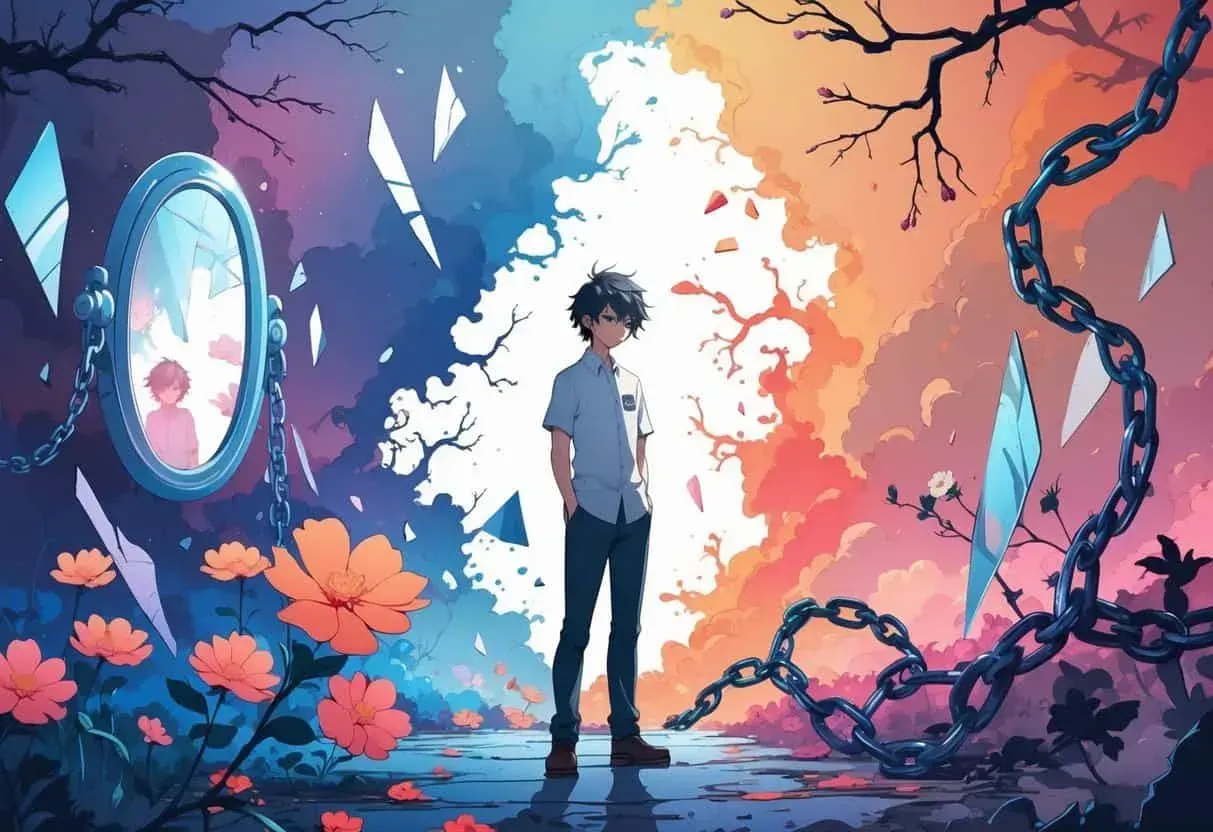
Instead of naming disorders, anime often externalizes internal states. A character’s mental landscape might be rendered as a crumbling dreamscape or an oppressive, monochromatic room. These visual metaphors bypass intellectual analysis and hit you in the gut. The goal isn’t to teach you symptoms—it’s to make you feel them. That distinction matters.
Many viewers who have struggled with their own mental health report recognizing themselves in scenes that never once utter the word “anxiety” or “trauma.” The recognition is immediate and wordless.
This approach also allows for nuance. In real life, mental health doesn’t unfold in neat diagnostic boxes. People drift between states, experience contradictory emotions, and often lack the vocabulary to describe what’s happening to them. Anime mirrors that confusion. A character might spiral into self-destructive behavior one episode and find fleeting peace the next, never once attaching a label to the oscillation.
You’re left to interpret the patterns, which can be a more active and empathetic viewing process.
On the flip side, this lack of explicit naming can sometimes blur the line between artistic metaphor and harmful stereotype. When mental illness is shown only through extreme violence or exaggerated quirkiness, the risk of trivialization grows. Not every series gets the balance right. Still, the best examples use non-medical language not to evade responsibility but to honor the complexity of inner experience. For more on how creative media handles psychological themes, the Mental Health Foundation offers insight into stigma and storytelling.
Emotional Landscapes Over Clinical Labels
Isolation and Trauma as Story Drivers
Many anime protagonists are profoundly alone, even when surrounded by people. This isolation often stems from past trauma—loss, abuse, betrayal—that the story doesn’t spell out in psychiatric terms. Instead, the aftermath manifests in avoidance, flashbacks, trust issues, and self-imposed exile. Take Shinji Ikari from Neon Genesis Evangelion: his crippling fear of rejection and self-loathing aren’t labeled “avoidant attachment” or “depression.” They’re shown through his hesitation to pilot the Eva, his desperate need for approval, and the surreal mindscapes that represent his fractured psyche.
You don’t study his condition; you feel trapped with him.
Trauma, in these stories, doesn’t only appear as dramatic flashbacks. It lives in small, everyday moments: an inability to enjoy food, a flinch at physical touch, a pattern of sabotaging relationships when they get too close. Anime excels at depicting the ripple effects of pain without turning it into a case study. The silence around the original wound often mirrors how people actually carry trauma—as something unspeakable that leaks out through behavior and emotion.
The theme of isolation can also be self-reinforcing. Characters who have been hurt may believe they don’t deserve connection, so they push others away, deepening their solitude. The visual language drives this home: a character sitting alone in a spacious, underlit room while life buzzes outside, or a frame where they’re physically present but visually separated from the group by shadow or perspective lines. These tools don’t lecture you about social withdrawal; they make you feel its gravitational pull.
Symbolism, Metaphor, and Visual Language
Anime’s ability to convey mental states through imagery is one of its greatest strengths. Depression might be depicted as a veil of static, slowly draining the color from the world. Intrusive thoughts could appear as whispering apparitions or cracking mirrors. This non-literal approach allows the medium to tackle conditions that are hard to verbalize. In Puella Magi Madoka Magica, the labyrinthine witch barriers are expressions of despair and psychological fragmentation, each one a surreal landscape born from a magical girl’s shattered hope.
No diagnosis is given; the visual chaos tells you everything about the inner collapse.
Sound design and music often work hand in hand with these visuals. High-pitched tones, discordant strings, or oppressive silence can signal a character’s mental unraveling. Serial Experiments Lain uses the hum of power lines and electronic static to evoke dissociation and the blurring of self in a hyperconnected world. You’re not told Lain has a dissociative disorder—the entire sensory experience communicates fragmentation. The viewer is immersed in a state that feels psychologically true, even if it’s never named.
These storytelling choices create a kind of emotional shorthand. Once you recognize the visual cues—a character’s shadow acting independently, a sudden shift to a desaturated palette, the motif of falling—you understand the internal weather without needing dialogue. This allows anime to depict mental illness in a way that’s both poetic and brutally honest. For viewers who struggle to articulate their own mental health, these metaphors can supply a much-needed vocabulary of images.
Character Journeys: Identity, Self-Worth, and Social Pressure
The Weight of Bullying and Ostracism
Bullying in anime often serves as a crucible for character development, but it’s never just a plot device. Series like A Silent Voice examine how bullying scars both the victim and the perpetrator, tracing the lasting damage to self-esteem, identity, and the ability to form relationships. Shoya Ishida’s anxiety and suicidal ideation aren’t introduced with a clinical preamble—they emerge through his avoidance of eye contact, the crosses he sees on people’s faces, and his internal monologue of self-hatred. You watch him wrestle with shame and isolation long after the actual bullying ends, a realistic depiction of how social trauma imprints on the psyche.
Ostracism doesn’t always come from overt cruelty. Sometimes it’s the quieter violence of being ignored or misunderstood. Characters who are “different”—whether because of neurodivergence, past mistakes, or simply an inability to perform social scripts—find themselves on the fringes. The pain of being left out is amplified by the collectivist undertones present in many Japanese stories, where group harmony is prized. Standing apart can feel like a failure of self, and that internalized shame becomes its own source of psychological distress.
Watching these narratives can be uncomfortable, but that discomfort is part of the point. By refusing to soften the emotional consequences of social exclusion, anime forces you to sit with the character’s pain. And when someone finally extends a hand—listening without judgment, offering simple presence—the relief is visceral. It’s a non-medical affirmation that connection is a fundamental component of healing.
Recovery Through Connection and Support Networks
Healing in anime is rarely depicted as a swift, triumphant moment. It’s a slow stutter of progress, marked by setbacks and small victories. Friends, family members, or found communities become lifelines, demonstrating that recovery doesn’t happen in isolation. In March Comes in Like a Lion, Rei Kiriyama’s depression is never formally diagnosed, but the narrative shows him gradually rediscovering warmth through the Kawamoto sisters, who offer food, company, and unconditional acceptance. Their kindness doesn’t “cure” him; it simply makes the darkness more bearable, day by day.
This portrayal of support emphasizes patience over expertise. The helpers in these stories are rarely therapists. They’re people who notice when someone stops eating, who sit in silence without demanding explanations, who show up consistently without expecting instant gratitude. The unspoken message is powerful: you don’t need a degree to make a difference in someone’s mental health journey; you need presence and compassion. This de-medicalizes the act of helping, making it feel accessible and human-scale.
At the same time, anime doesn’t shy away from the burden that caring can place on supporters. Relationships under the strain of mental illness are often portrayed with nuance, acknowledging fatigue, frustration, and the limits of what one person can absorb. The honesty of this dynamic prevents support from feeling like a magical fix. For further reading on the role of social support in mental health, NAMI’s resources on friendship and mental illness provide a real-world parallel.
Case Studies in Non-Medical Storytelling
Death Note: The Corrosive Power of Obsession
Death Note is a masterclass in depicting psychological unraveling without clinical vocabulary. Light Yagami starts as a brilliant but ordinary student; the notebook doesn’t create his darkness—it amplifies a pre-existing moral rigidity and narcissistic seed. His descent isn’t named a disorder, but the signs are unmistakable: grandiosity, paranoia, emotional numbing, and a god complex that isolates him from everyone. The show externalizes his internal rot through Shinigami companions and dramatic visual shifts, but the core psychological portrait remains subtle. You’re watching a mind erode under the weight of absolute power, not reading a case file.
Light’s relationships disintegrate one by one, mirroring how untreated mental health issues can sever connections. His family, his girlfriend, his allies—all become pawns or obstacles. The thin line between justice and self-aggrandizement blurs until the audience can’t be sure when he stopped believing his own rationalizations. This ambiguity is true to real-world obsessive-compulsive and narcissistic patterns, which often protect themselves with layers of self-deception. By the end, the psychological cost is written not in words but in Light’s hollow eyes and the impossible solitude of his victory.
Attack on Titan: Trauma, Resilience, and Desensitization
Few series immerse characters in sustained, inescapable trauma like Attack on Titan. From the first episode, Eren Yeager witnesses horrors that would shatter most people, and the story tracks his psychological transformation from vengeful youth to morally compromised force of nature. The anime never pauses to label his post-traumatic stress, but symptoms cascade through his behavior: hypervigilance, emotional numbing, explosive rage, and a terrifying single-mindedness that erodes his capacity for empathy. It’s a raw depiction of how atrocity rewires the mind, communicated through the furrow of a brow, the deadness in a voice, the sudden violence.
Other characters display different coping fractures—Mikasa’s protective fixation, Armin’s dissociative rationalizations, Levi’s laconic exterior masking deep grief. The collective trauma of an entire civilization under siege becomes a shared psychological environment. Attack on Titan doesn’t offer tidy recovery arcs; often, the coping mechanisms themselves become destructive. That unflinching honesty avoids romanticizing mental illness, instead showing how survival itself can become a pathology when no space for healing exists.
Studies of traumatic stress, like those discussed by the National Center for PTSD, parallel many of these depictions. While anime exaggerates for dramatic effect, the core insight—that trauma reshapes identity and morality—is grounded in reality. By refusing to name it, the series lets you observe the shape of the wound rather than just the label on the chart.
March Comes in Like a Lion: Depicting Depression Without Naming It
Perhaps the most tender and accurate anime portrayal of clinical depression comes from March Comes in Like a Lion. Rei Kiriyama, a professional shogi player, lives alone, struggles with simple tasks like cooking, and sometimes feels so heavy he can’t move. The series shows his depression through oppressive water imagery—waves that drag him under, a room that fills with dark water until he’s submerged. No one calls it depression; they call it “being down” or “feeling heavy.” The language is deliberately everyday, which mirrors how many people first experience and describe their own symptoms before finding clinical help.
The narrative doesn’t pathologize Rei. It presents his state as a response to cumulative loss and emotional neglect, never reducing him to a diagnosis. His slow recovery involves small anchors: a warm meal, a kitten, a genuine conversation. These incremental moments accumulate into something resembling stability, but the water always lurks in the background. This honesty—that depression can be managed but not always vanquished—resonates powerfully because it doesn’t promise a cure.
Serial Experiments Lain and the Fragmented Self
Serial Experiments Lain takes a more avant-garde approach to mental fragmentation, embedding the viewer in the protagonist’s dissolving sense of identity. Lain Iwakura exists in multiple realities, online and offline, and the distinctions between them bleed until she no longer knows who she is. The series could be read as an extended metaphor for dissociative disorders, psychosis, or the psychological toll of digital immersion, but it never settles on a tidy explanation. Instead, it uses static-laden audio, repeating corridors, and shifting character designs to immerse you in Lain’s confusion.
The lack of medical framing is deliberate: the show is about the experience, not the diagnosis. It asks what it means to have a self when your consciousness is distributed across networks, when memory is unreliable, when other people’s perceptions of you feel more real than your own. This resonates with modern discussions about online identity and mental health, where boundaries blur and selfhood fragments. By refusing to name Lain’s condition, the series keeps the focus on the existential terror of not knowing what is real. For those interested in the intersection of technology and mental health, Psychology Today’s overview provides a grounding.
The Role of Animation Style, Sound, and Directing
Directing choices that support non-medical depictions are often overlooked but essential. A director might use a sudden cut to a distorted wide-angle lens when a character’s anxiety spikes, or thread a low-frequency hum under scenes of dissociation. These techniques bypass the analytical brain and communicate mental states directly to the nervous system. In Perfect Blue, Satoshi Kon’s rapid cuts between reality and hallucination, along with the collapsing boundaries of time and perspective, simulate the protagonist’s psychotic break without a single clinical term. The viewer experiences the disintegration, not an explanation of it.
Color grading serves as another emotional signifier. A warm palette can suddenly desaturate when a character enters a depressive episode; a scene might be overexposed to create a sense of unreality. These shifts often happen subtly, registering below conscious awareness. In series like Your Lie in April, the visual world brightens or darkens in lockstep with the protagonist’s emotional state, creating a synesthetic bond between the character’s mental health and the audience’s perception. The method is deeply empathetic: you are placed in the character’s sensorium, not given a guided tour.
Even sound design can carry the weight of mental illness. The intrusive ring of tinnitus, the muffled quality of sound during a dissociative episode, the oppressive silence that follows a panic attack—these auditory cues are instantly recognizable to those who have experienced them. They provide a non-verbal vocabulary that makes the invisible visible (or audible), bridging the gap between the character’s internal world and the viewer’s understanding. This is non-medical storytelling at its most immersive.
Cultural Nuances and Global Interpretation
Lost in Translation: Linguistic and Cultural Frames
When anime travels across borders, its mental health themes often undergo subtle shifts due to translation and cultural context. Japanese terms like hikikomori (severe social withdrawal) carry specific cultural weight that doesn’t have a perfect English equivalent. Translators may render it as “shut-in” or “recluse,” missing the nuanced link to societal pressure and the specific psychological profile it implies. Similarly, phrases that describe emotional states—like mono no aware (the bittersweet awareness of impermanence)—can be flattened into simple sadness, losing the layered understanding of melancholy that informs many anime narratives.
The avoidance of clinical terms in the original Japanese is often a stylistic choice that reflects broader cultural attitudes toward mental health. In Japan, mental illness has historically carried significant stigma, and direct discussion can be uncomfortable. Encoding distress in metaphor and indirect language becomes a way to talk about the unspeakable. When this content is translated for Western audiences, where directness is more valued, the nuance can get lost. What feels poetic and respectful in its original context might strike a global viewer as evasive or insufficiently clear.
The World Health Organization’s mental health resources highlight how cultural framing shapes understanding worldwide.
How International Audiences Perceive Mental Illness Portrayals
Viewer reception varies dramatically. In regions with robust mental health advocacy, audiences often scrutinize anime for accuracy and potential harm. A depiction that uses exaggerated violence as a metaphor for trauma might be criticized for sensationalism, while the same scene in a context where mental health is rarely discussed might be taken at face value. This gap can lead to heated debates: Is the series destigmatizing or reinforcing stereotypes? The answer often depends on the cultural lens you bring to it.
Some international fans find deep validation in anime’s indirect approach. For those who have felt pathologized by medical language, seeing a character navigate similar pain without being labeled can feel liberating. It allows them to hold their own experience without reducing it to a diagnosis. Others, however, argue that failing to name disorders perpetuates the idea that mental illness is a mysterious, unspeakable affliction rather than a treatable condition. Both perspectives highlight the double-edged nature of non-medical storytelling: it opens doors to empathy but can also obscure the realities of living with a recognized mental health condition.
The growing global conversation around mental health has prompted some anime creators to be more mindful, while others continue to operate within traditional narrative frameworks. As the medium evolves, the tension between artistic metaphor and responsible representation remains a productive friction point, pushing stories that are both emotionally resonant and increasingly aware of their impact.
Why This Approach Matters: Empathy Without Pathologizing
There’s a quiet radicalism in anime’s refusal to pathologize every psychological struggle. By presenting mental illness as an understandable human response to pain, loss, and pressure, these stories resist turning characters into collections of symptoms. They suggest that the line between “healthy” and “unhealthy” is often blurrier than clinical manuals imply, and that suffering is a universal language. This can be profoundly validating for viewers who feel alienated by medical jargon, or who have been made to feel that their suffering needs a formal diagnosis to be legitimate.
The non-medical lens also encourages a more holistic view of mental health, one that includes social environment, relationships, and personal history. Recovery isn’t just about symptom reduction; it’s about reconnecting with community, rediscovering purpose, and finding small joys. That narrative aligns with a growing understanding in psychology that mental health is deeply intertwined with social determinants. The anime that get it right don’t treat the character as a broken machine to be fixed; they treat them as a person to be accompanied.
Of course, this approach has limits. Some conditions benefit greatly from accurate naming and destigmatized treatment, and romanticizing suffering without pathways to professional help can be dangerous. The most responsible anime stories don’t deny the existence of mental illness—they simply refuse to reduce it to a clinical label, preserving the messy, human reality at the center. It’s a balancing act, and not every series walks it perfectly, but the intention to foster empathy rather than fear is unmistakable.
Conclusion: A Mirror for Emotional Experience
Anime’s depiction of mental illness through symbolism and emotion rather than medical terms creates a unique mirror. You don’t just observe a character’s struggle; you’re immersed in its texture. Whether through the atmospheric ache of March Comes in Like a Lion, the obsessive descent of Death Note, or the fragmented consciousness of Serial Experiments Lain, the medium speaks to the part of you that knows what it’s like to not be okay, even when you lack the words. That unsaid understanding can be more powerful than any diagnosis—a reminder that you’re not alone in the mess of being human.
As global audiences continue to engage with these stories, the conversation around mental health in anime will keep evolving. The best works prove that you don’t need a clinical vocabulary to tell the truth about psychological pain. You need honesty, creativity, and a willingness to show the cracks. In that cracked mirror, many viewers find a version of themselves that finally makes sense.