Table of Contents
The Unique Lens of Anime on Creative Work
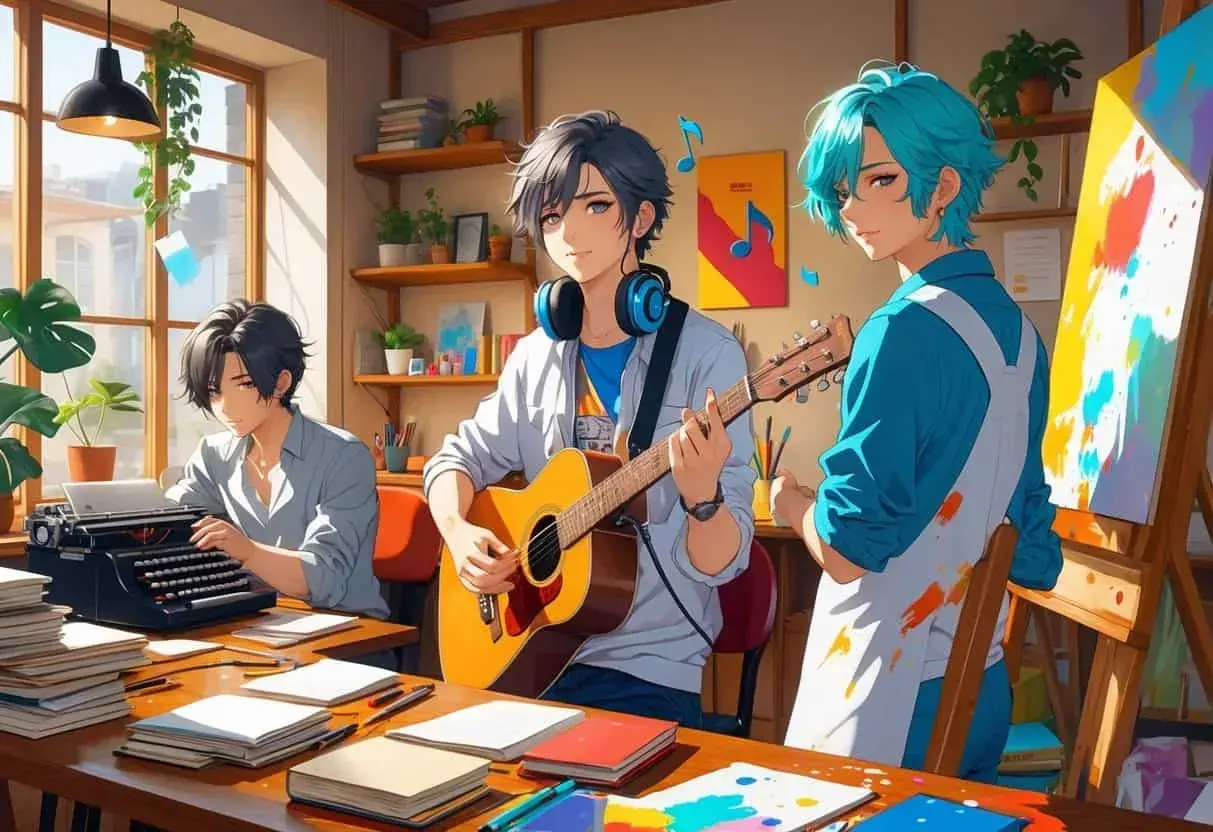
Anime has an extraordinary ability to illuminate the inner workings of artistic professions. Unlike other media that often show only the polished final product, anime dives deep into the messy, repetitive, and emotionally charged process of creation. Writers, musicians, and painters are not just characters with a side hobby; their craft becomes the central engine of the story, exploring the tension between inspiration and discipline, ego and humility, isolation and community. By animating the internal struggle—the frantic scribble of a blocked novelist, the aching repetition of a pianist's scales, the trembling brush of a painter before a blank canvas—anime offers a visceral, often painfully relatable portrait of what it means to make something from nothing. This article examines how anime portrays these artistic journeys and what they reveal about creativity itself.
The Writer's Solitude: Wrestling with Narrative and Self
Writers in anime are frequently depicted as solitary figures locked in a battle with the architecture of story. They are not simply typing words; they are constructing entire worlds inside their minds while wrestling with the psychological weight of that creation. Bakuman offers one of the most exhaustive depictions of the manga creation process. The series follows the partnership between writer Takagi and artist Mashiro, where storyboarding, pacing, and reader polls become life-or-death stakes. Every chapter is a gamble, every ranking a verdict on months of sleepless work.
The show captures the peculiar agony of waiting for magazine feedback, the creative friction with overbearing editors, and the physical toll of drawing weekly serializations. This is not a romanticized vision of art; it is a sweaty, caffeine-fueled grind where success is measured in incremental percentages.
Beyond the mechanics, anime probes the existential dread of the writer. The protagonist often stares at a blinking cursor, not merely blocked, but questioning the very value of their voice. This internal conflict frequently mirrors the autobiographical. The legacy of Osamu Tezuka, whose Star System and self-insertion techniques blurred the line between creator and creation, echoes in modern works. Even a series like Neon Genesis Evangelion, while ostensibly about giant robots, functions as a raw deconstruction of creator Hideaki Anno's psyche—the script becomes a public therapy session.
Anime demonstrates that for writers, the boundary between life and art is porous; personal trauma and philosophical inquiry bleed directly into the text. The act of writing is a tightrope walk over an abyss of isolation, and anime captures that vertigo with startling clarity.
The Manga Artist as Writer-Artist
In Japan, the term mangaka refers to a person who both writes and draws their comic—a fusion of writer and visual artist. This dual role is a recurring theme in anime about creation. Characters like those in Bakuman or Monthly Girls' Nozaki-kun embody the integration of storytelling and illustration. The mangaka must master not only narrative structure and dialogue but also visual pacing, character design, and panel composition. Anime often highlights the physicality of this work: the cramped wrists, the strained eyes, the endless redrawing of scenes.
The partnership between writer and artist in a duo—or the lone mangaka struggling to balance both roles—becomes a microcosm of the creative process itself. The pressure to stay ranked in a magazine like Weekly Shonen Jump is depicted as a brutal, body-breaking trial that tests not just talent but endurance.
Musicians: The Physical and Emotional Battle for Sound
Music in anime is never just an auditory backdrop; it is a physical and emotional battleground. The portrayal of musicians centers on the grueling discipline required to translate raw feeling into precise technical execution. Characters bleed into their strings, gasp for breath during a piano crescendo, or experience the crushing silence of a missed note. Your Lie in April stands as a masterful exploration of this intersection. Protagonist Kousei Arima's trauma-induced inability to hear his own piano notes becomes a profound metaphor for the blockade of self-expression.
The series illustrates that performance is not a sterile recital but a risky act of laying one's innermost fears bare before an audience. Every public concert is a confession, every wrong note a wound.
Anime often draws a stark line between technical virtuosity and soulful performance. This theme resonates across titles like Nodame Cantabile and Kids on the Slope. In these stories, the rigid structures of classical training clash with the raw, improvisational pulse of jazz or the passionate excess of a Romantic era interpretation. The musician's journey is a search for a unique voice, a task that requires not just mastering the instrument but synthesizing personal loss, love, and joy into sound. Studio Ghibli's quieter moments, such as the violin crafting in Whisper of the Heart, show a gentler side: a luthier's dedication as a meditative practice.
Yet even there, the message is consistent—music demands everything, and in return, it offers a fleeting, transcendent connection that words cannot provide.
The Orchestra as a Social Microcosm
Series like Hibike! Euphonium expand the musician's story beyond the soloist. The concert band becomes a social microcosm where individual talent must harmonize with group discipline. Anime explores the tension between the prodigy who wants to shine and the ensemble that needs cohesion. The director's role is often that of a stern mentor who forces characters to confront their weaknesses.
Rehearsals are shown as repetitive drills, not glamorous performances. The payoff—a flawless ensemble piece—is earned through countless hours of frustration and compromise. This depiction resonates with anyone who has participated in a collaborative art form, highlighting that music is as much about listening to others as it is about playing your own part.
Painters and the Precision of Seeing
Visual artists in anime are often characterized by a hyper-sensitivity to the world around them. Painters, whether using traditional oils or modern digital tablets, are shown constantly observing—studying the fall of light, the weight of a fabric fold, the subtle distortion of a reflection. Their craft is a study in patience. In series like Honey and Clover, art students wrestle not only with technique but with the philosophical purpose of creation. They question whether a massive canvas covered in gold leaf is a masterpiece or a monument to their own inadequacy.
The artist's studio is a crucible of self-discovery, where every brushstroke is a battle against the inner critic.
Barakamon brilliantly expands this concept by focusing on a calligrapher, Seishu Handa, whose artistic identity is shattered and rebuilt through immersion in a rural island community. Calligraphy, a highly regimented art form, becomes a conduit for personal growth. The show captures artist's block not as a lack of ideas but as a stiffness of the soul. The moment of breakthrough comes not from a technical fix but from letting go of ego and embracing messy, imperfect spontaneity. Meanwhile, Keep Your Hands Off Eizouken! turns the spotlight on animators—painters of motion.
They deconstruct movement into constituent frames, sketching crumbling mechanical towers or flying humanoids with mad, infectious obsession. The series emphasizes that the visual artist's life is a continuous loop of visual research, frantic sketching, and the euphoric terror of bringing a static world to motion by sheer force of will.
Digital Artists and the New Canvas
Modern anime also explores the world of digital art and illustration. Characters wield styluses instead of brushes, working on tablets and navigating software like Clip Studio Paint. Series like The iDOLM@STER and New Game! depict character designers and game artists who must balance creative vision with corporate demands. The digital medium introduces new challenges: layers, resolution limits, and the pressure to produce content for social media. Yet the core struggle remains the same—the fear of the blank screen, the joy of a line that finally flows, and the exhaustion of a deadline.
Anime portrays the digital artist as equally valid as the traditional painter, reflecting the real-world shift in artistic professions.
The Weight of Japanese Artistic Heritage
The way anime frames artistic professions is deeply rooted in Japan's own aesthetic traditions. There is a visual and philosophical lineage that stretches back centuries, influencing how a creator's struggle and triumph are visually coded. You cannot ignore the influence of mono no aware—the bittersweet awareness of impermanence—in how anime treats a fleeting moment of musical harmony or a cherry blossom petal drifting onto an unfinished painting. This cultural subconscious adds a layer of dignified melancholy to the creative process, elevating a mere hobby to a spiritual discipline.
Ukiyo-e and the Legacy of the Floating World
Edo period ukiyo-e woodblock prints, pioneered by masters like Hokusai, provide a direct visual antecedent to anime's stylized representations of artists. The bold compositional lines, dramatic cropping of figures, and use of striking, flat color planes are techniques that modern anime directors consciously employ. More profoundly, the ukiyo-e ethos captured the "floating world" of transient pleasure and artistic bohemianism—a mirror to the often-precarious, consumption-driven lives of modern manga artists and musicians depicted in anime. The way a painter in an anime frames a scene, isolating a dramatic moment with a subtle tilt or a sudden zoom, echoes the asymmetrical drama of a Hiroshige landscape. It is an artistic conversation across centuries, where the pressure of a weekly manga deadline is not so different from the woodblock carver's race to meet the season's latest fashion print.
Superflat and the Blurring of High and Low Culture
Modern Japanese art theories, particularly Takashi Murakami's Superflat movement, articulate what anime has been doing for decades: collapsing the hierarchy between high art and pop culture. In anime, a character designing a vinyl figure or a digital avatar is treated with the same narrative seriousness as a classical sculptor. The visual chaos of an otaku's bedroom, littered with figurines and self-made doujinshi, becomes a valid installation. This post-modern lens validates the artistic professions often looked down upon by traditionalists. By integrating references to manga, video games, and consumer products directly into the visual texture of a show, anime posits that the most authentic modern art often arises from the very commercial mediums that sustain global pop culture.
The painter in an anime today is just as likely to be wielding a stylus for a visual novel as a horsehair brush.
The Real-Life Industry: A Mirror of Creative Hustle
The anime industry itself is a microcosm of the artistic professions it so often depicts. It runs on the sweat of writers, character designers, key animators, and sound directors who face the same creative paralysis and breakthrough moments as their fictional counterparts. When you watch a show about making manga or producing an anime, the meta-narrative becomes a reflection on the very people who are drawing the frames you are watching. The celebrated series Shirobako serves as an essential text here, pulling back the curtain on the chaos of production at Studio Musashino. It introduces you to frantic production assistants chasing deadlines, animators who specialize in nothing but cutlery or explosions, and directors torn between artistic integrity and the unforgiving broadcast schedule.
The archetype of the mangaka is treated with particular reverence. These writer-artists often work alone or with a small team, embodying the fusion of storytelling, illustration, and graphic design. Their relationship with editors is a narrative goldmine: a constant tug-of-war between commercial viability and artistic vision. The pressure to stay ranked in a magazine is depicted as a brutal, body-breaking trial. Similarly, the character designer's role is to translate a rough sketch into a marketable icon—an armor of visual consistency that can withstand the rigors of inconsistent animation frames.
Understanding these backstage dynamics, often detailed by studios like Kyoto Animation known for their delicate, precise work, gives you a deeper appreciation for the final product. Every scene is a fragile truce born from collaboration, conflict, and constant, nagging doubt.
Global Perception and the Shifting Stereotype of the Artist
Anime has exported not just a style but a specific philosophy of labor to the world, fundamentally altering how international audiences perceive creative careers. The stereotypical anime artist—the tortured, introverted genius, the passionate but clumsy musician, the obsessive writer—has traveled far beyond Japan's borders. This archetype, while frequently romanticized, has also helped destigmatize the all-consuming nature of craft. A global audience has learned to associate the visual shorthand of a messy studio or a character's thousand-yard stare after a drawing session with a deep, authentic passion rather than mere social dysfunction.
Otaku culture, which is inherently participatory, reinforces this perception. Events like Comiket (Comic Market) demonstrate the porous boundary between consumer and creator. Tens of thousands of amateur and semi-professional artists and writers flock to sell their self-published works, mirroring the very hustle stories they grew up watching. This ecosystem challenges the Western image of the lone, starving artist by embedding the profession within a hyper-active community of exchange. However, anime also does not shy away from the darker side of this global reach—exploring how copyright law and international distribution grapple with fan-made creations, and how the pressure to cater to a global, fickle algorithm can grate against a musician's or illustrator's need for pure, unmonetized expression.
The world now sees the artistic profession through the anime-tinted lens as a perpetual balancing act between inner necessity and outer expectation—a view that is both deeply Japanese and, increasingly, universally human.