Table of Contents
The Weight of Being: Why Existential Anime Matters Now More Than Ever
There's a peculiar moment in certain anime—a long silence, a character staring at their own reflection, a cityscape that suddenly feels alien—where the narrative stops being about plot and becomes about something far more unsettling. It asks you to sit with a question most entertainment carefully avoids: what are you, really, beneath the routines and the roles and the stories you tell yourself?
Existential anime occupies a strange and vital space in the medium. It doesn't simply use philosophy as window dressing or have characters quote Nietzsche between action sequences. Instead, it bakes the questions into the very structure of the story—into the animation style, the pacing, the world design, and the psychological arcs of its characters. These are shows that understand something fundamental: the most terrifying monsters aren't the ones you fight with weapons. They're the ones that live inside your own head.
The genre has grown increasingly relevant as our own world grapples with artificial intelligence, digital identity, climate anxiety, and a pervasive sense that the old frameworks for meaning—religion, community, career, nation—no longer hold the way they once did. When Serial Experiments Lain aired in 1998, its vision of a blurring boundary between online and offline existence felt prophetic. Today, it feels like documentary.
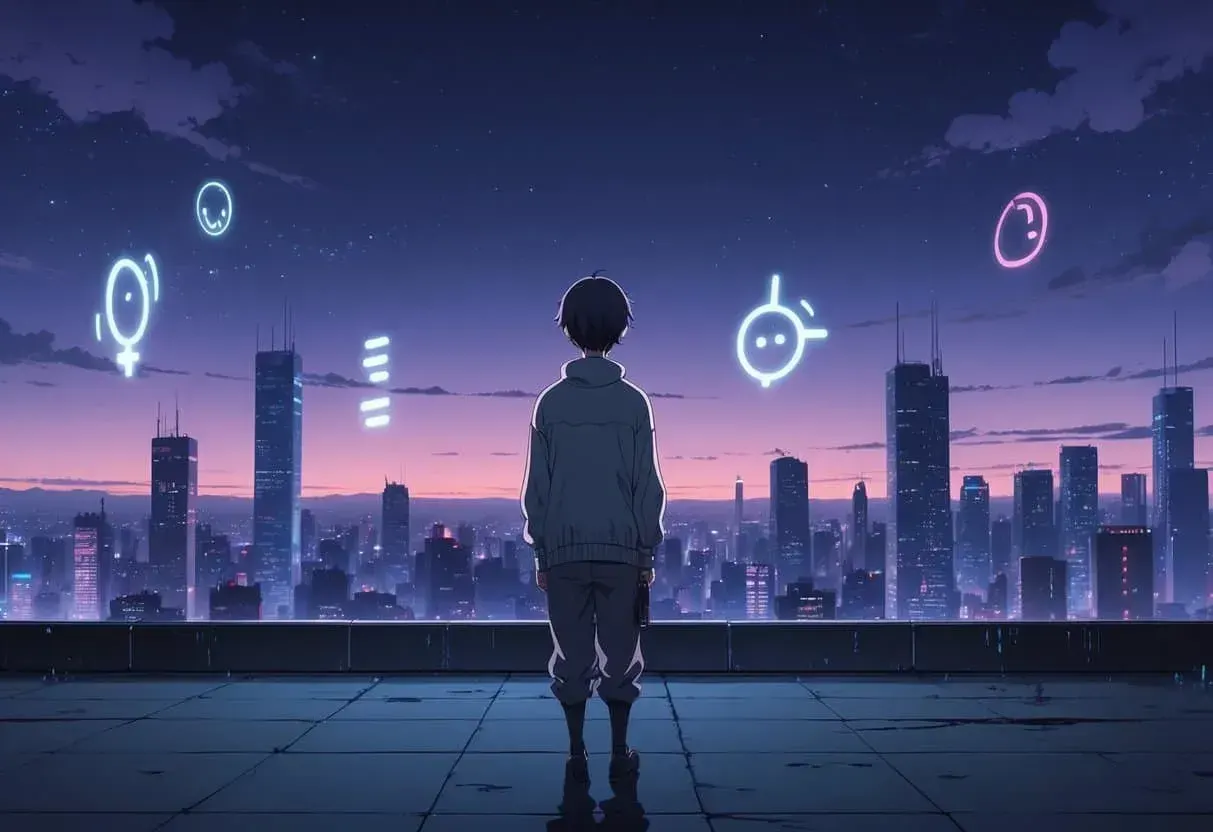
What makes these anime so potent isn't just their willingness to ask hard questions—it's their refusal to offer easy answers. They understand that the human condition is messy, contradictory, and often painful, and they respect you enough to sit in that discomfort rather than resolving it with a tidy conclusion.
The Philosophical Foundations: From Kierkegaard to Kusanagi
To understand existential anime, you need to understand the philosophical tradition it draws from—even when it's doing so unconsciously. Existentialism as a formal movement emerged in 19th and 20th century Europe, with thinkers like Søren Kierkegaard, Friedrich Nietzsche, Jean-Paul Sartre, and Albert Camus grappling with the collapse of traditional meaning systems. Their core insight was both liberating and terrifying: existence precedes essence. You aren't born with a preordained purpose. You have to create one yourself.
This idea would have resonated deeply in post-war Japan. The country had witnessed the destruction of its imperial ideology, the horror of atomic weapons, and a rapid modernization that left many feeling unmoored from traditional values. Japanese artists and writers—from Yukio Mishima to Kōbō Abe—had already been exploring existential themes when anime emerged as a serious artistic medium in the latter half of the twentieth century.
What anime added to the conversation was a visual language capable of rendering abstract philosophical concepts in concrete, emotionally devastating ways. You can read Sartre's Nausea and intellectually grasp the concept of existential dread. Or you can watch Shinji Ikari curled in a fetal position, unable to connect with anyone, and feel it in your bones.
The Core Question: What Makes Someone Human?
At its heart, existential anime circles one question obsessively: what is the irreducible core of human identity? Is it biological—the squishy matter of brains and bodies? Is it memory—the accumulated narrative of a life? Is it consciousness itself—the ineffable experience of being someone rather than something? Or is it connection—the relationships that tether you to others and to the world?
Different anime answer differently, and the best ones hold multiple answers in tension simultaneously.
Ghost in the Shell and the Ghost Question
Mamoru Oshii's Ghost in the Shell (1995) and its subsequent television series Stand Alone Complex remain the gold standard for existential inquiry in animation. The central concept—a world where human brains can be "cyberized" and consciousness can theoretically be copied or transferred—forces a confrontation with questions that philosophers have debated for centuries.
Major Motoko Kusanagi, the protagonist, has a fully cybernetic body. Only her brain—and perhaps something more—remains organic. She wonders aloud whether her memories, her personality, her very "ghost," might simply be an elaborate simulation. When she encounters the Puppet Master, an AI that claims to have achieved self-awareness, the question becomes sharper: if consciousness can emerge from code, what distinguishes her from it?
The anime refuses to settle the matter. By the film's end, Kusanagi merges with the Puppet Master, creating something that is neither purely human nor purely artificial. The implication is radical: identity may not be a fixed property but an ongoing process, a negotiation between self and other, organic and synthetic, past and future. You can read more about the philosophical implications in scholarly analyses of the franchise, which has been extensively studied in relation to theories of personal identity.
Neon Genesis Evangelion: The Hedgehog's Dilemma Made Flesh
Hideaki Anno's Neon Genesis Evangelion (1995) is often discussed in terms of its deconstruction of mecha anime tropes, but its true subject is something far more intimate: the excruciating difficulty of being a person among other persons.
The series takes its psychological framework from the philosopher Arthur Schopenhauer's concept of the "hedgehog's dilemma"—the idea that humans, like hedgehogs in winter, crave closeness but hurt each other with their spines when they draw near. Every major character in Evangelion embodies this paradox. Shinji Ikari desperately wants to be loved but is terrified of the vulnerability love requires. Asuka Langley Soryu projects confidence to hide a core of self-loathing. Rei Ayanagi exists as a manufactured being, uncertain if she even possesses a genuine interior life.
The Angels, the ostensible antagonists, aren't really the point. They're catalysts that force the characters into situations where their psychological defenses crumble. The climactic "Human Instrumentation Project" proposes dissolving all individual consciousness into a single unified being—an end to loneliness, but also an end to selfhood as you know it. The anime asks whether the pain of separation is worth the privilege of being an individual, and it trusts you to sit with the ambiguity.
Anno's own struggle with depression informed the series' raw emotional texture. The critical reception of Evangelion has evolved over decades, and its influence on subsequent anime is nearly impossible to overstate.
Digital Selves, Shattered Worlds
As the internet age dawned, existential anime found new territory to explore. The distinction between "real" and "virtual" identity—already fragile—began to dissolve entirely in works that anticipated the social media era with unnerving accuracy.
Serial Experiments Lain: The Wired and the Self
Yoshitoshi ABe's Serial Experiments Lain (1998) might be the most prescient anime ever made. Its protagonist, Lain Iwakura, is a quiet middle-school girl who becomes entangled in "The Wired," a global communications network that increasingly merges with physical reality. As Lain's presence in The Wired grows, the boundaries between her online and offline selves collapse. There are multiple Lains, or perhaps Lain was never singular to begin with.
The series draws heavily on the work of media theorists like Marshall McLuhan and philosophers of mind like Daniel Dennett, though it never names them explicitly. Its visual language—flickering power lines, shadowy figures, interfaces bleeding into physical space—creates a sustained mood of ontological unease. You're never quite sure what layer of reality you're watching, and that's precisely the point.
In an era where many people maintain multiple online personas, where algorithms shape identity, and where the distinction between "real life" and "online life" feels increasingly arbitrary, Lain has aged from science fiction into psychological realism. The question it raises—if your digital presence can act independently, feel independently, even exist after your biological death—is no longer hypothetical. It's the water we swim in.
Akira: Power Without Wisdom
Katsuhiro Otomo's Akira (1988) approaches existential questions through the lens of power and its corruptions. Set in Neo-Tokyo, a city rebuilt after a mysterious explosion decades earlier, the film follows teenage biker gang member Tetsuo Shima as he develops uncontrollable psychic abilities. His transformation from powerless delinquent to godlike being is not liberation but devastation—for himself and for everyone around him.
The existential horror of Akira lies in the gap between power and maturity. Tetsuo gains abilities that could reshape reality itself, but he remains emotionally and psychologically a child—insecure, impulsive, desperate for recognition. The power doesn't complete him; it consumes him. The manga, even more expansive than the film, explores how entire societies can be warped by forces they don't understand, making it a meditation on collective as well as individual responsibility.
The film's apocalyptic imagery and body-horror sequences externalize internal states: the terror of losing control, the agony of transformation, the vertigo of realizing you're not who you thought you were. These are existential concerns rendered in the most visceral visual language imaginable.
Immortality and the Meaning of Finite Life
A thread running through many existential anime is the question of mortality—not simply as something to fear, but as something that might actually define what it means to be human. If you cannot die, are you still fully alive?
To Your Eternity: Learning to Be Human
Yoshitoki Ōima's To Your Eternity approaches the question from a unique angle. Its protagonist, Fushi, begins as an immortal, shape-shifting orb with no identity, no emotions, no understanding of what it means to exist as a person. Sent to Earth by a mysterious being, Fushi gradually accumulates experiences, relationships, and—tragically—losses. Each death Fushi witnesses becomes a form he can take, a memory literally embodied.
The series functions as a kind of thought experiment: what are the minimum conditions for becoming a person? Fushi learns through pain, through attachment, through the irreversible nature of loss. The anime suggests that humanity isn't a starting condition but an achievement—something built slowly through connection and grief. Immortality, far from being a gift, is the obstacle Fushi must overcome to become truly alive.
Cyborg 009 and the Altered Body
Shotaro Ishinomori's Cyborg 009, first adapted as an anime in 1968 and revisited multiple times since, explores existential questions through the lens of bodily transformation. Nine humans are kidnapped and forcibly turned into cyborgs by a shadowy organization. Each struggles differently with their new existence: some embrace their powers, others mourn their lost humanity, all wonder whether they're still the same people they were before.
The series predates many of the more philosophically dense works that followed, but its questions are no less profound. If your body can be replaced piece by piece, at what point does "you" stop being you? The cyborgs' shared bond—their decision to fight against their creators rather than serve them—becomes an assertion of identity against those who would define them purely as weapons.
Artistic Language: How Form Becomes Content
Existential anime don't just explore their themes through dialogue and plot. The visual and auditory language of the medium is itself a vehicle for philosophical inquiry.
Animation as Ontology
The very fact that anime characters are drawn—constructed images rather than photographed bodies—creates an interesting resonance with questions about authenticity and constructed identity. Some directors lean into this. The minimalist, almost abstract character designs in works like Angel's Egg (1985) emphasize the fragility of identity. The jarring shifts in animation style during Evangelion's final episodes—from polished cel animation to rough line drawings to live-action footage—mirror the collapse of psychological defenses.
Color choices carry weight. The muted, often desaturated palettes of shows like Texhnolyze communicate existential exhaustion before a single line of dialogue is spoken. The hyper-saturated digital landscapes of Psycho-Pass suggest a world where the artificial has become more vivid than the real.
Voice and Silence
Japanese voice acting (seiyū) in existential anime often employs a particular register: quiet, restrained, with emotion leaking through the cracks rather than pouring out. This subtlety demands attention. A slight tremor in a line reading, a pause that stretches slightly too long—these micro-performances convey the weight of inner life more effectively than overt displays of feeling.
Silence itself is a tool. Long moments without dialogue, ambient sound taking over, characters simply existing in space—these passages create room for reflection that faster-paced anime foreclose. They invite you to inhabit the character's solitude rather than simply observe it.
Architecture of Alienation
The environments in existential anime are never neutral. They're statements. The labyrinthine apartment complexes of Evangelion's Tokyo-3, the sterile corridors of Ghost in the Shell's Section 9 headquarters, the sprawling digital void of Lain's Wired—these spaces externalize internal conditions. Characters move through worlds that feel too large or too small, too empty or too claustrophobic, and that spatial discomfort becomes a metaphor for existential dislocation.
Urban landscapes dominate the genre, and they're rarely comforting. Cities in existential anime tend toward the dystopian: Neo-Tokyo, the endless metropolis of Texhnolyze, the panoptic surveillance state of Psycho-Pass. These are places where individuals are dwarfed by systems, where the sheer scale of human construction paradoxically emphasizes individual insignificance.
Genre Boundaries and Unexpected Depths
Existential inquiry isn't confined to explicitly philosophical anime. Some of the most penetrating explorations of identity and meaning appear in genres that might seem, at first glance, to be about something else entirely.
The Existential Mecha
The mecha genre, with its giant robots and military conflicts, seems an unlikely vehicle for philosophy—yet it has produced some of the medium's richest existential texts. The connection makes sense on reflection. A pilot enclosed in a machine, experiencing the world through sensors and screens, is already in a liminal state between human and technology. The mecha amplifies human will while simultaneously raising questions about whether the human inside it is still fully autonomous.
Patlabor, particularly Mamoru Oshii's second film, shifts from police-procedural with robots to a brooding meditation on technology, memory, and the ghosts that haunt both machines and people. Bokurano places children in a giant robot and forces them to confront mortality with each battle. The mecha becomes a crucible, stripping characters down to their essential selves.
Horror as Existential Crisis
Horror anime tap into existential dread by making the abstract concrete. Paranoia Agent gives form to collective anxiety and self-deception. Perfect Blue dissolves the boundary between performance and identity until neither the protagonist nor the audience can tell where one ends and the other begins. Higurashi no Naku Koro ni uses temporal loops to explore whether people can change or are doomed to repeat their worst impulses.
These works understand that the most effective horror doesn't threaten your body. It threatens your sense of self.
Legacy and Ongoing Influence
The existential anime of the 1990s and early 2000s cast a long shadow. Contemporary works continue to explore similar territory, updated for new technological and social contexts. Psycho-Pass translates questions about free will into a society governed by predictive algorithms. Vivy: Fluorite Eye's Song traces an AI's century-long struggle to understand human creativity and purpose. Sonny Boy strands teenagers in a void between dimensions and watches them construct—and deconstruct—meaning from scratch.
The influence extends beyond anime. The Wachowskis explicitly cited Ghost in the Shell as inspiration for The Matrix. Evangelion's psychological intensity has influenced filmmakers from Guillermo del Toro to Denis Villeneuve. The visual language developed by Otomo and Oshii has become part of the global cinematic vocabulary.
For viewers willing to engage with difficulty, existential anime offers something rare: entertainment that doesn't just distract you from your life but sends you back to it with sharper questions and perhaps a strange kind of comfort. The comfort of knowing that confusion about who you are and what you're doing here isn't a personal failing. It's the human condition itself.
You can explore further analysis of these works through resources like MyAnimeList for comprehensive series information and community discussion, or academic databases for scholarly treatments of anime and philosophy. The Internet Encyclopedia of Philosophy also provides accessible introductions to the existentialist thinkers whose ideas animate these stories.
These anime endure because the questions they ask don't have expiration dates. Technology changes. Society changes. But the experience of being a conscious being, aware of your own finitude, struggling to find or make meaning in a universe that offers none ready-made—that hasn't changed, and probably never will. The best existential anime don't solve that puzzle.
They just make you feel less alone in facing it.