Table of Contents
In the dark and unforgiving world of Demon Slayer: Kimetsu no Yaiba, the boundaries between hunter and hunted seem absolute. Demon Slayers wield specialized Nichirin Blades and breathing techniques to exterminate the creatures of the night, while demons—former humans twisted by Muzan Kibutsuji’s blood—exist only to feast on human flesh and grow stronger. Yet the question lingers: can a demon cross that line and become a demon slayer? The answer is not a simple yes or no, but the very existence of an exception has captivated fans worldwide. This article dissects the possibility, explores the remarkable case of Nezuko Kamado, and examines five compelling reasons why a demon might turn its fangs against its own kind.
The Short Answer
Yes, a demon can functionally act as a demon slayer. The clearest proof is Nezuko Kamado, who not only resists her demonic craving for human blood but actively helps Tanjiro and his allies slay demons throughout the series. However, it is vital to distinguish between a demon who hunts demons and an official member of the Demon Slayer Corps. The Corps is an organization of humans bound by strict codes; no demon has ever been formally inducted wearing the standard uniform with rank. Nezuko operates alongside the Corps as a protected companion under the personal guarantee of a Hashira, not as a ranked slayer.
Still, in spirit and action, a demon who fights other demons in defense of humanity is effectively a demon slayer. This article explores why that paradoxical role is not only possible but dramatically rich.
Understanding the Demon Slayer Corps and Its Boundaries
The Demon Slayer Corps has existed for centuries, passing down breathing styles and swordsmanship to combat Muzan’s reign of terror. Entry requires passing the Final Selection, a brutal test where candidates survive seven nights on a demon-infested mountain. Only humans can participate because demons are automatically the enemy. Once a slayer, members receive a Kasugai Crow for communications and a Nichirin Blade—a sword forged from ore that absorbs sunlight, a key weakness of demons. The organizational structure, from Mizunoto to Hashira, is built on human physiology, ethics, and the shared trauma of demon attacks.
A demon, by its very nature, violates the most basic rule: it is what the Corps exists to annihilate.
Nezuko Kamado: The Exception That Proves the Rule
Nezuko is the lynchpin of this entire discussion. Transformed by Muzan’s blood during the massacre of the Kamado family, she retained her humanity to an unprecedented degree. Instead of devouring her surviving brother Tanjiro, she protected him. Several factors make Nezuko’s case extraordinary:
- Sunlight resistance: Nezuko eventually develops the ability to survive direct sunlight, a feat no demon—including Muzan—had ever achieved naturally. This makes her uniquely suited for daylight operations alongside slayers.
- Blood Demon Art tied to protection: Her pyrokinetic Blood Demon Art (always referred to as “Exploding Blood”) hurts only demons and can burn away poison without harming humans. It is a purely anti-demon power, perfectly aligned with a slayer’s purpose.
- Hypnotic suggestion: Urokodaki’s hypnosis installed a mental suggestion that all humans are her family and demons are enemies. While not the sole reason for her behavior, it reinforced her natural inclination to defend people.
- No human consumption: Nezuko replenishes energy through sleep, never by eating flesh. This completely bypasses the demon survival imperative that forces others into predatory patterns.
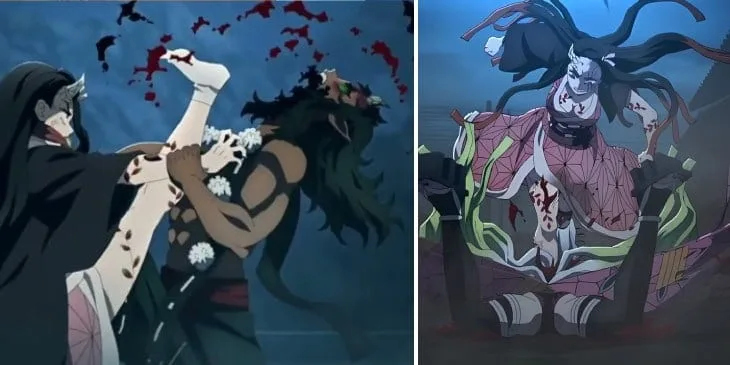
Because of these traits, the Hashira—after a tense trial in the Rehabilitation Training Arc—allow Nezuko to accompany Tanjiro under his responsibility. In every battle, from the Asakusa encounter with Susamaru and Yahaba to the confrontation with Upper Rank Six Daki and Gyutaro, she fights as a protective demon, effectively a slayer in all but official title. Nezuko’s existence answers the core question with a resounding yes, but it also underscores how rare and conditional such a case remains.
5 Reasons a Demon Would Turn Against Its Own Kind
Even beyond Nezuko’s unique protective drive, there are logical motivations within the series’ lore that explain why a demon might kill another demon. These reasons do not necessarily transform a demon into a noble slayer, but they demonstrate the internal fractures among demons and the scenarios in which a demon could function as a temporary slayer.
1. The Quest for Sustenance
The most primal motivation, though rarely acted upon, is hunger. Demons require human flesh and blood to survive and grow stronger; however, consuming another demon might theoretically provide a quick surge of nourishment in desperate circumstances. In practice, this is highly irrational. Demons are former humans, so their flesh offers similar nutritional value, but the act is explicitly forbidden by Muzan Kibutsuji. His cells inside every demon allow him to detect cannibalism, and he punishes such acts with instant disintegration or reabsorption.
The only demon known to engage in demon consumption without immediate reprisal is Kokushibo, Upper Rank One, whose position and power grant him a measure of immunity—but even he does so strategically, not for simple hunger. For most demons, eating another demon is a suicidal move that offers no guaranteed power boost and invites Muzan’s wrath.
2. The Violent Climb for Power
The hierarchy of the Twelve Kizuki is built on ruthless ambition. Upper Ranks hold their positions through combat superiority, and a lower-ranked demon can ascend by defeating a higher-ranked one in a blood battle sanctioned by Muzan. In these fights, demons kill demons legally. The victor absorbs some of the loser’s strength, and can even inherit fragments of their Blood Demon Art. This is precisely why Akaza, Doma, and others are so formidable: they have survived centuries of challenges.
This system creates a scenario where a demon may actively target another demon not out of any allegiance to humanity, but to climb the ranks. While this is not “demon slaying” in the moral sense, it is a demon destroying its own species for internal gain, and sometimes the target is a demon who later becomes a common enemy of both parties.
3. Personal Vendettas and Lingering Humanity
Demons do not lose all memory of their human lives. Some retain fragments of emotion—rage, betrayal, jealousy. This can spark grudges that predate their transformation. A demon might remember the one who wronged them in life, and if that person also became a demon, revenge becomes a driving force. Additionally, some demons, like the Hand Demon from Final Selection, harbor deep resentment toward specific slayers or even other demons who slighted them.
These vendettas, while personal, result in demon-on-demon violence that can momentarily align with the slayers’ objectives. The tragedy is that this motivation is rooted in the very humanity that Muzan tries to strip away, proving that even demons can be emotionally complex.
4. A Distorted Sense of Redemption
Not every demon is a willing monster. Some were forcibly transformed, tricked, or cursed, and upon regaining a sliver of awareness, they may seek atonement. The most poignant example in the series is the demon slayer Sabito, who was killed during Final Selection and later appeared as a spirit—but his living counterpart Giyu Tomioka witnesses many demons who express regret in their final moments. A demon that remembers its own family might try to undo its sins by destroying others of its kind. This redemption arc rarely succeeds because the demon’s nature wars against its intent, but there are instances where a demon sacrifices itself to kill a more powerful demon, acting as a temporary ally.
While such a demon would never be accepted into the Corps, its actions are effectively those of a demon slayer in their final breath.
5. Protective Bonds Transcending Nature
Nezuko’s case falls under this motivation, but she is not entirely alone in concept. The bond between a demon and a human loved one can override the predatory instinct. If a demon’s child, sibling, or friend is threatened by another demon, that protective bond can trigger lethal retaliation. This is why Nezuko attacks demons without hesitation; they threaten Tanjiro, whom she instinctively shields. Similarly, if a human turned into a demon retains a powerful emotional anchor, that anchor can direct violence exclusively toward other demons.
The demon slayer corps has no protocol for such situations, but individuals like Nezuko prove that love can literally rewire a demon’s purpose. In these moments, the line between monster and protector blurs completely.
The Role of Muzan Kibutsuji and the Prohibition
Any discussion about demon-on-demon conflict must center on Muzan. As the original demon and the progenitor of all others, Muzan’s blood flows through every demon and serves as a surveillance mechanism. He can read the thoughts of any demon that consumes human flesh, and he enforces a strict ban on demon cannibalism. The reason is simple: Muzan fears the emergence of a rival. If demons regularly consumed one another, their accumulated power might eventually challenge his supremacy.
He tolerates blood battles only because they serve his interest in filtering the strong from the weak, but even that is tightly controlled. This prohibition means that any demon who consistently hunts other demons, as a slayer would, would quickly be identified and eliminated by the Upper Ranks or Muzan himself. Nezuko evades this fate because she never consumed a human, so Muzan’s cellular link to her is weaker and she remains partially hidden. A demon slaying demons overtly would be marked for destruction, making the concept of an official demon slayer impossible without exceptional circumstances.
Could a Demon Officially Join the Corps?
Realistically, no. The Demon Slayer Corps is a human institution founded on the slaughter of demons. Its members have lost families, limbs, and friends to demons; the idea of welcoming a demon into their ranks, even as an ally, would be culturally repulsive. The Hashira meeting regarding Nezuko nearly ended in her execution despite her proven non-aggression. Only the intervention of the leader Kagaya Ubuyashiki and a spoken promise from Tanjiro kept her alive. The Corps accepts her utility only as a controlled exception, not as a policy change.
A demon cannot wear a uniform, receive a rank, or be assigned missions independently. However, the gray area exists: a demon who consistently aids slayers, as Nezuko does, becomes an unofficial asset whose contributions speak louder than her nature. In future generations, if more demons like Nezuko appeared—those who never tasted human blood and developed sunlight immunity—the Corps might theoretically adapt. But the series shows that such demons are virtually mythical.
Conclusion
The question “Can a demon be a demon slayer?” opens a fascinating window into the moral complexity of Demon Slayer. The short answer remains yes, but only in a conditional, non-traditional sense. Nezuko Kamado stands as the definitive example, proving that a demon can fight for humanity and slay its own kind while retaining the core of who it once was. The five reasons explored—sustenance, power, revenge, redemption, and protective bonds—show that demon-on-demon violence is not only possible but woven into the fabric of Muzan’s kingdom. Yet the institutional barrier is insurmountable under current lore.
The Corps cannot accept a demon as a formal member, but it can benefit from their extraordinary exceptions. In the end, the anime teaches that what you are matters less than what you choose to do. Nezuko chooses to fight like a demon slayer, regardless of the fangs in her mouth, and that choice is what makes her a true hero.
Frequently Asked Questions
Does a demon slayer become a demon?
Yes, several prominent characters in the series were once human demon slayers who later became demons. The most notable is Kokushibo, originally Michikatsu Tsugikuni, a Hashira and the twin brother of Yoriichi Tsugikuni. He accepted Muzan’s offer of immortality out of envy and a desire to surpass his brother. Another example is Kaigaku, a former student of Jigoro Kuwajima who betrayed the Corps and became Upper Rank Six after being forced into transformation by Kokushibo. These cases illustrate that even the highest-ranking slayers can fall, but they also highlight that such transformations are typically the result of deep emotional vulnerabilities, not simple infection.
A demon slayer does not automatically become a demon; it requires an explicit gift of Muzan’s blood or the blood of an Upper Rank demon and a willing acceptance, however coerced.
Can demons be good demon slayers?
In the context of combat effectiveness, absolutely. A demon’s physical regeneration, Blood Demon Arts, and superhuman attributes make them exceptionally capable fighters against other demons. Nezuko demonstrates this repeatedly, unleashing kicks that can decapitate lower-level demons and using her Exploding Blood to neutralize poisons. However, “good” is a double-edged word. Most demons lack the moral compass to slay for righteous reasons.
A demon slayer is defined not just by killing demons but by protecting humans. Only those who retain their human heart, like Nezuko, can be considered good in the ethical sense. Thus, a demon can be a phenomenally effective demon slayer in battle, but the goodness lies in their intent, not their biology.
Can you become a demon as a slayer in Project Slayers?
Project Slayers is a fan-made Roblox game inspired by Demon Slayer. According to its development roadmap and official Discord updates, the game allows players to choose between the human path (slayer) and the demon path at various stages. Once you are a slayer, you can later become a demon through specific quests or by consuming Muzan’s blood item, which triggers a transformation. This mechanic mimics the anime’s storytelling, letting players experience the fall from grace that characters like Kaigaku underwent. However, the game balances this by making demon players targets for slayers, and hybrid roles (demon-slaying demons) are possible if a player switches allegiances.
If you’re interested in how the game handles morality and faction switching, the Project Slayers Wiki is a solid resource for updates.
How do you become a Demon Slayer in the series?
Becoming a Demon Slayer is a grueling process governed by the Demon Slayer Corps. Aspiring slayers must first train under a cultivator—