Table of Contents
Anime as a Living Window into Japanese Tradition
For anyone curious about Japanese culture, anime offers more than entertainment—it provides a deeply textured, emotionally resonant view of traditions that have shaped Japanese society for centuries. Unlike dry textbooks or detached documentaries, the best anime embed cultural values into character arcs, visual storytelling, and everyday rituals, making them feel natural and compelling. When you watch a protagonist pause to offer gratitude before a meal, bow with precise formality, or consult a Shinto shrine for guidance, you are witnessing living customs that remain relevant in modern Japan. These stories reveal how ancient philosophies around harmony, impermanence, and respect for nature continue to guide behavior, relationships, and artistic expression. By immersing yourself in these narratives, you gain not just knowledge but genuine appreciation for the cultural depth woven into daily Japanese life.
The Philosophical Roots behind Japanese Anime Storytelling
Japanese animation frequently draws on spiritual and ethical frameworks that have persisted for generations. Rather than treating these elements as exotic decoration, the finest works integrate them into character development and plot structure, making abstract concepts tangible for global audiences.
Shinto Beliefs in Motion and Nature
Shinto, Japan’s indigenous spiritual tradition, centers on reverence for kami—spirits dwelling in natural features like mountains, rivers, trees, and even storms. Anime brings this worldview to life by showing characters interacting with sacred spaces, performing purification rituals, and acknowledging the divine in the everyday. Mushishi follows a wandering expert who studies primordial life forms called mushi, creatures existing between the material and spiritual realms. The series uses quiet, deliberate pacing to mirror Shinto’s emphasis on observing nature’s subtle rhythms. Each episode feels like a meditation on how unseen forces shape human experience.
For a practical introduction to Shinto practices, the Japan Guide entry on Shinto explains shrine etiquette, rituals, and seasonal celebrations.
Studio Ghibli’s Spirited Away offers perhaps the most widely recognized portrayal of a Shinto spirit world. The bathhouse where Chihiro works serves a host of kami, with intricate scenes of cleansing, offering food, and showing hospitality to divine guests. The film also incorporates the Shinto concept of kegare (impurity) through the Stink Spirit, whose cleansing restores harmony. These moments teach viewers that spiritual purity requires active maintenance—a value that extends into Japanese attitudes toward cleanliness in daily life.
Buddhist Perspectives on Impermanence and Compassion
Buddhism arrived in Japan in the 6th century and blended with Shinto to create a unique spiritual landscape. Anime frequently explores Buddhist themes of mujo (impermanence), suffering, and compassionate detachment. Natsume’s Book of Friends follows a boy who inherits a book of yokai names from his grandmother. As he returns each name to its spirit owner, the series gently examines attachment, memory, and the necessity of letting go. These episodes mirror Buddhist teachings that clinging to the past causes suffering, while compassion for all beings—human and supernatural—leads to peace.
The Ghibli film The Tale of the Princess Kaguya adapts Japan’s oldest surviving folktale with a distinctly Buddhist lens. Kaguya’s celestial origin and eventual return to the moon represent the transience of earthly life. Her joy and sorrow on Earth, rendered in expressive, sketch-like animation, underscore the beauty found in fleeting moments. The film invites viewers to appreciate what is temporary rather than mourn its passing.
Moral Frameworks from Confucian Ethics
Confucian thought, transmitted from China and adapted in Japan, heavily influences social values around hierarchy, filial piety, and group harmony. Anime that explore family dynamics, teacher-student relationships, and community obligations often reflect these principles. March Comes in Like a Lion portrays a young shogi professional rebuilding his life after trauma. The series emphasizes giri (social obligation) and ninjo (human feeling), showing how Rei navigates his duties to his adoptive family, his rivals, and himself. His growth comes not through individual triumph but through learning to accept support from others—a core Confucian insight that fulfillment arises within relationships.
Similarly, Barakamon follows a calligrapher exiled to a rural island after a professional setback. The villagers, especially the energetic child Naru, teach him humility, patience, and the value of imperfection. The series reflects the Zen-inspired belief that mastery of a traditional art requires not just technical skill but spiritual maturity, often achieved through simple, unassuming daily interactions.
Series That Deeply Explore Traditional Customs
Several acclaimed anime deliberately foreground specific cultural practices, ensuring these traditions remain accessible and meaningful for contemporary audiences. These works function both as entertainment and as educational resources.
Studio Ghibli and the Art of Cultural Storytelling
Hayao Miyazaki and Isao Takahata built Studio Ghibli on a foundation of Japanese folklore and environmental reverence. Princess Mononoke depicts the conflict between industrial expansion and forest guardians, featuring kodama (tree spirits) and a Great Forest Spirit that governs life and death. The film draws on Shinto animism while also engaging with Buddhist ideas about interdependence and the consequences of human greed. The kodama, with their distinctive rattling sounds, have become iconic symbols of Japan’s spiritual relationship with forests.
Pom Poko uses tanuki (raccoon dogs) from Japanese folklore to comment on urbanization and environmental loss. The tanuki’s shapeshifting abilities, including the traditionally humorous use of their scrotums (a motif from Edo-period art), are rooted in authentic folk tales. The film balances comedy with genuine mourning for disappearing rural landscapes. My Neighbor Totoro introduces children to the concept of forest spirits through Totoro, a gentle creature who embodies the kami of nature. The film’s depiction of country life, including scenes of planting rice, visiting shrines, and respecting the camphor tree, normalizes Shinto practices within a family narrative.
For a deeper look at Ghibli’s cultural influences, the Studio Ghibli official site offers production notes and interviews that reveal how traditional aesthetics shape their work.
Rakugo and the Preservation of Oral Tradition
Showa Genroku Rakugo Shinju stands as the definitive anime exploration of rakugo, a centuries-old form of comic monologue performed while kneeling with minimal props. The series traces the lives of two rakugo performers from the Showa era, showing how the art form survives through master-apprentice transmission. Viewers learn that rakugo requires extraordinary vocal control, the ability to voice multiple characters with only slight head turns, and deep understanding of Edo-period society where most stories are set. The show also examines the tension between preserving tradition and innovating for new audiences—a challenge relevant to all living cultural practices.
For a lighter take on rakugo, Joshiraku follows five female performers discussing their craft and daily lives, albeit with less narrative depth. Together, these series demonstrate that oral storytelling remains a vital, evolving art form rather than a museum piece.
Competitive Karuta and Classical Poetry
Chihayafuru centers on competitive karuta, a card game based on the Hyakunin Isshu (One Hundred Poems by One Hundred Poets), a classical anthology from the Heian period. Each match becomes a poetic duel requiring players to memorize poems, recognize the opening syllables, and swipe the corresponding card with lightning reflexes. The series educates viewers on waka poetry—its imagery, themes of love and nature, and historical context—while also teaching values of discipline, respect for opponents, and teamwork. Chihaya’s passion for the game inspires viewers to appreciate classical literature as something dynamic and exciting rather than dusty and academic.
Ainu Culture through Golden Kamuy
Golden Kamuy offers rare and respectful representation of Ainu culture, Japan’s indigenous people who have distinct language, traditions, and spiritual beliefs. Set in early 20th-century Hokkaido, the series follows a former soldier and an Ainu girl searching for hidden gold. The anime integrates Ainu hunting rituals, cooking methods, clothing, and concepts like kamuy (divine beings residing in natural elements). Asirpa, the Ainu protagonist, demonstrates survival skills, respect for animal spirits, and oral traditions that have sustained her people for generations. For more information on Ainu heritage, the Nibutani Ainu Cultural Museum provides extensive resources on history, crafts, and contemporary life.
| Anime Title | Cultural Element | Core Theme |
|---|---|---|
| Spirited Away | Shinto kami, bathhouse customs | Spiritual hospitality, personal growth |
| Pom Poko | Tanuki folklore, rural landscapes | Environmental stewardship |
| Showa Genroku Rakugo Shinju | Rakugo oral storytelling | Artistic legacy, sacrifice |
| Chihayafuru | Karuta, classical waka poetry | Literacy, discipline, community |
| Golden Kamuy | Ainu language, hunting, spirituality | Indigenous identity, survival |
| Natsume’s Book of Friends | Yokai, spirit contracts | Empathy, impermanence, compassion |
| Barakamon | Calligraphy, rural community | Humility, mastery through practice |
Everyday Rituals That Reveal Deeper Values
Beyond grand narratives, many anime excel at depicting the small, repeated actions that define Japanese cultural identity. These everyday moments often carry more philosophical weight than dramatic plot points.
Food as a Vehicle for Tradition
Japanese food scenes in anime are rarely mere filler. They embody the concept of shun—eating ingredients at their seasonal peak—and reinforce values of gratitude, hospitality, and family connection. Sweetness and Lightning follows a widowed father learning to cook for his daughter, with each episode centered on homemade dishes like simmered kabocha, miso soup, or handmade udon. The ritual of saying itadakimasu before eating and gochisosama deshita after expresses gratitude to everyone involved in the meal—cook, farmer, ingredient, and nature itself.
Ramen Daisuki Koizumi-san appears to be a light comedy about a ramen enthusiast, but it systematically educates viewers on regional ramen varieties. Each episode explores how local ingredients, climate, and history shaped different styles—tonkotsu from Kyushu, miso from Hokkaido, shoyu from Tokyo. The show demonstrates that even a bowl of noodles carries regional identity and cultural heritage. Food Wars! Shokugeki no Soma takes a more dramatic approach but still respects culinary traditions, showing how techniques like dashi-making, knife skills, and presentation reflect centuries of refinement.
Tea Ceremony in Motion
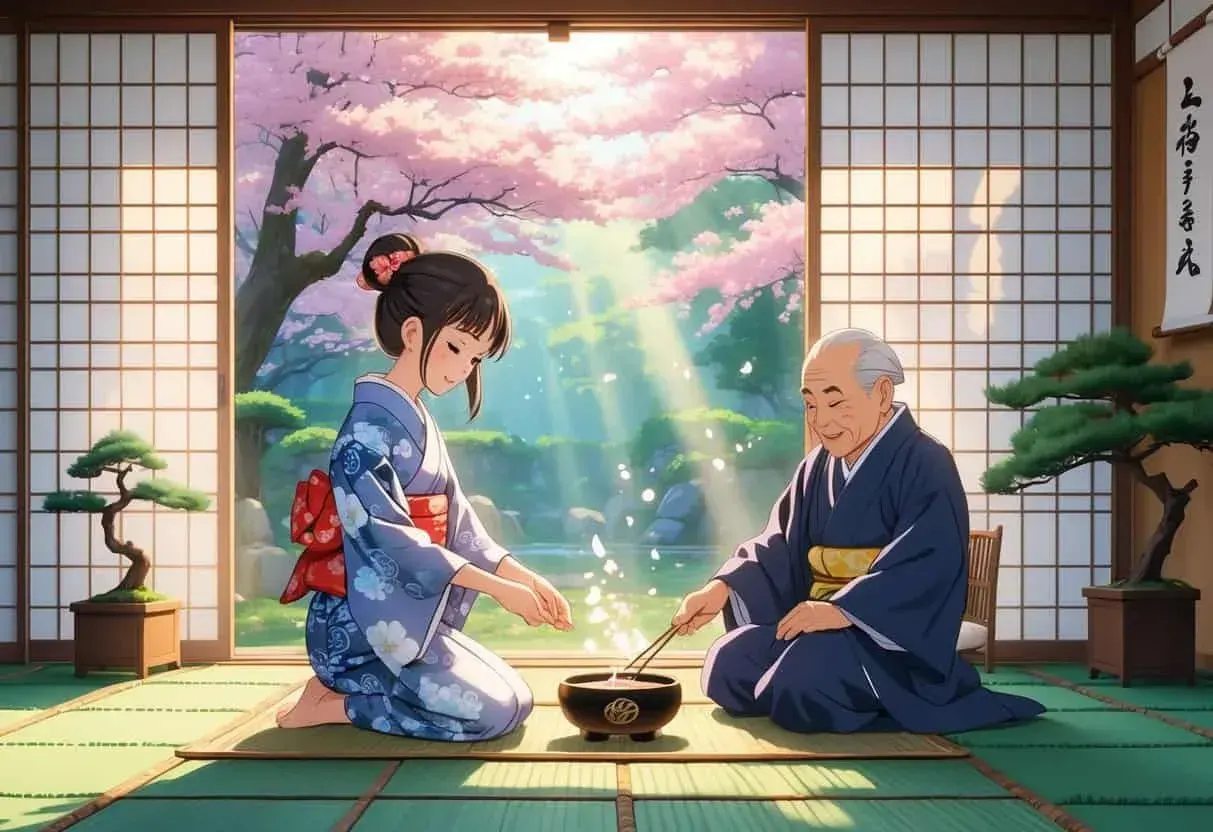
While fewer anime center entirely on tea ceremony, several series incorporate sado (the way of tea) as a meaningful practice. In Hyouka, the protagonist’s sister performs tea ceremony at a school festival, and the precision of her movements—the way she folds the fukusa cloth, whisks the matcha, and bows before serving—illustrates the discipline and grace required. Tea ceremony scenes in anime emphasize that every gesture has purpose, reflecting the Zen principle that mindfulness transforms ordinary actions into art.
Martial Arts and the Warrior Ethos
Even action-heavy shonen anime transmit core values of bushido (the warrior’s way), including loyalty, self-discipline, and respect for opponents. Naruto, despite its supernatural elements, consistently rewards perseverance, teamwork, and protection of one’s village. The series also incorporates elements of ninja folklore and historical references to clan warfare. More grounded works offer authentic portrayals of specific martial arts. Bamboo Blade follows a high school kendo team, teaching viewers about dojo etiquette, the significance of the shinai (bamboo sword), and the psychological discipline required to face an opponent without aggression.
Hajime no Ippo uses boxing as a vehicle for exploring perseverance, humility, and mentorship. The grueling training routines mirror the repetitive, meditative nature of kata practice in traditional martial arts. In all these cases, the physical practice becomes a path to character development—a principle deeply rooted in Japanese educational philosophy.
Anime as a Bridge for Global Audiences
Anime’s worldwide popularity has made it an informal cultural ambassador. When international viewers watch Your Name, they encounter not only a body-swap romance but also Shinto shrine rituals, the significance of kuchikamizake (sacred sake made from chewed rice), and the visual poetry of a comet inspired by real celestial festivals such as the Orionid meteor shower. Director Makoto Shinkai’s meticulous depiction of Tokyo’s Suga Shrine staircase and the fictional Itomori landscape has sparked real-world tourism, demonstrating anime’s power to motivate cultural exploration.
Beyond tourism, anime familiarizes viewers with Japanese social norms. The use of honorifics, the importance of bowing, the nuances of indirect communication—all appear naturally in dialogue and character interactions. Fans often develop intuitive understanding of these customs through repeated exposure, which facilitates deeper appreciation when they encounter Japanese culture in other contexts. Many viewers have taken up calligraphy, tea ceremony, or even Japanese language study after seeing these practices portrayed with reverence in anime.
For those inspired to experience Japanese traditions firsthand, the Japan National Tourism Organization’s guide to Japanese culture offers itineraries, festival schedules, and tips for engaging respectfully with temples, shrines, and local customs. Anime has the unique ability to create emotional connection before you ever set foot in Japan, making the actual experience richer and more meaningful.
Recommended Anime for Cultural Exploration
For readers ready to immerse themselves in traditional Japanese values through anime, the following titles offer exceptional starting points. Each has been chosen for its commitment to authentic representation and storytelling quality.
- Mushishi – A meditative series exploring Shinto reverence for nature through a traveler who studies primordial beings called mushi. Each episode offers a lesson in coexistence with unseen forces.
- The Tale of the Princess Kaguya – A Ghibli masterpiece based on Japan’s oldest surviving folktale, rendered in watercolor-inspired animation that evokes classical sumi-e painting.
- Showa Genroku Rakugo Shinju – A decades-spanning drama that captures the soul of rakugo and the sacrifices required to preserve an oral tradition.
- Golden Kamuy – An adventure series set in early 20th-century Hokkaido that respectfully portrays Ainu language, hunting practices, and spiritual beliefs.
- Chihayafuru – A competitive coming-of-age story centered on classical poetry, demonstrating how traditional literature can inspire passion and discipline.
- Barakamon – A heartfelt slice-of-life about a calligrapher rediscovering his art and humanity through interactions with rural villagers.
- Natsume’s Book of Friends – An episodic journey into Yokai folklore that teaches empathy, loss, and the quiet beauty of rural Japan.
- Spirited Away – Perhaps the most internationally recognized introduction to Shinto spirituality, set in a bathhouse for the gods.
Each of these works reveals that tradition is not a frozen relic but a living, adaptive force that continues to shape identity. Through vivid animation, authentic settings, and layered storytelling, they invite you to see Japanese customs not as static rituals but as dynamic expressions of a culture that values harmony, respect, and the profound connection between people and the natural world. Anime offers something that guidebooks cannot: the experience of tradition felt through character, emotion, and story.