Table of Contents
The Art of Blending Dimensions in Modern Anime
For decades, the debate between 2D and 3D animation in anime has been fueled by purists and innovators alike. But the most exciting works don’t choose sides—they fuse both. When done right, the combination of hand-drawn expression and computer-generated depth doesn’t just look good; it rewires your sense of immersion. You’re not watching a flat picture. You’re inside the frame, carried by motion that feels simultaneously fluid and emotionally precise.
Anime studios have quietly turned this hybrid approach into a craft all its own. What began as an awkward marriage of clashing aesthetics has evolved into a deliberate, sophisticated tool for storytelling. The best series today hide the seams so well that you might only notice the extra dimensionality when a camera swoops through a battlefield or a character’s tears catch the light in a way pure 2D never could.
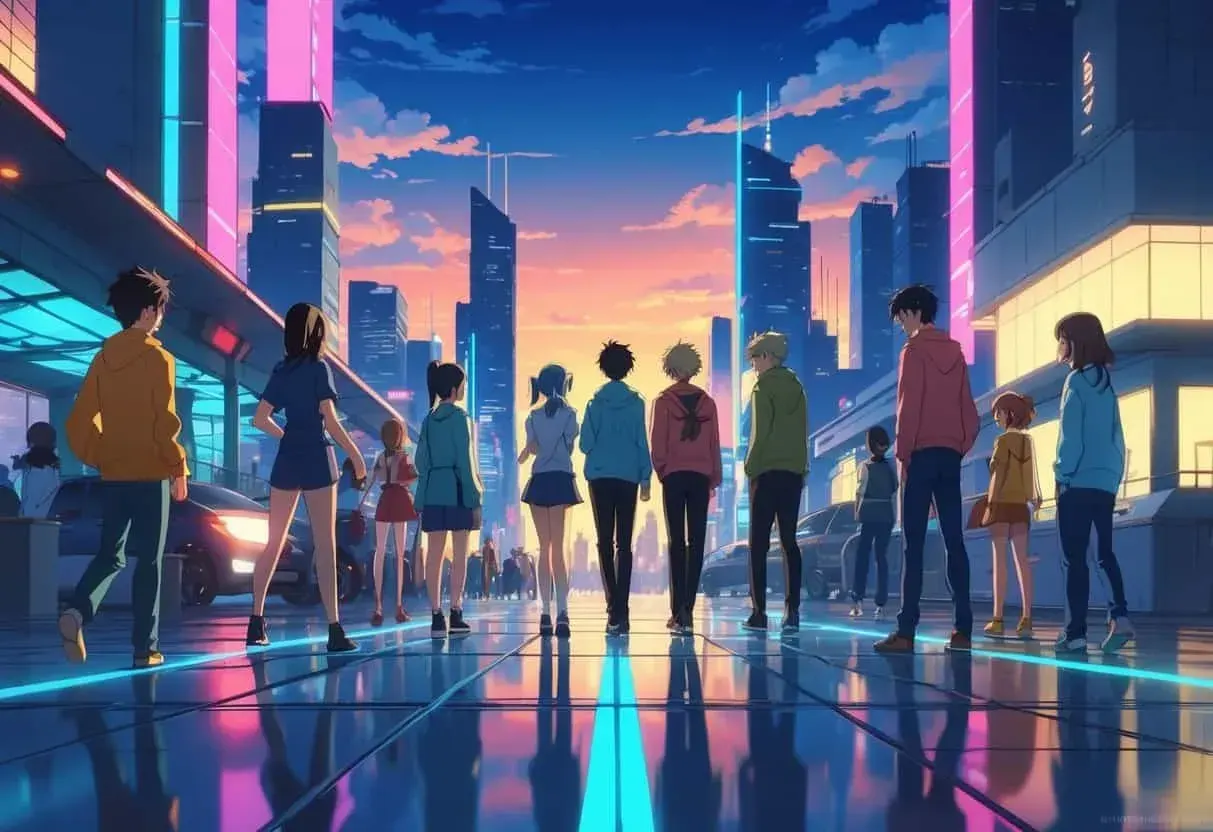
This isn’t about replacing traditional animation with cheaper shortcuts. It’s about strategic enhancement—using 3D models for complex crowd scenes, intricate machinery, or sweeping architectural shots while preserving the hand-drawn soul in faces, hair, and expressions. The result is a visual language that speaks directly to how we perceive motion and emotion in the 21st century.
Why Hybrid Animation Works So Well Right Now
The rapid improvement of real-time rendering and cel-shading technology has closed the gap between 2D and 3D aesthetics. Tools like Blender, After Effects, and in-house plugins allow artists to apply 2D-style outlines and flat color fills on 3D geometry, making CG elements indistinguishable from drawn art under many lighting conditions. At the same time, 2D animation pipelines have absorbed 3D layout systems that give directors unprecedented control over virtual camera moves, depth of field, and parallax effects.
What used to take weeks of painstaking background painting and multiplane camera setups can now be handled with a single 3D environment. The time saved gets reinvested where it counts: expressive character acting, striking keyframe poses, and those tiny micro-expressions that make anime faces so magnetic. Studios that understand this balance are the ones pushing the medium forward.
Essential Techniques for Blending 2D and 3D
Merging two fundamentally different animation disciplines demands more than just dropping a 3D model into a 2D scene. Animators rely on a tight set of compositional principles to keep the illusion intact:
- Cel-shading with Custom Toon Lines: 3D objects are rendered with flat shading, rim lights, and variable-width outlines that mimic ink strokes. Artists often paint over rendered frames to adjust line weight and add smear frames.
- Hybrid Layout (3D Layout + 2D Character Animation): DGP or other layout tools build 3D environments with designated “hero” areas where 2D characters will be composited. Camera paths are pre-visualized so that 2D angles match 3D perspective precisely.
- Normal Map Painting: 2D artists paint shadow and highlight guides directly on 3D models, giving characters a hand-inked appearance from any angle. Studios like Orange have perfected this technique for shows like Land of the Lustrous.
- Smear and Cloning in Post: When 3D motion feels too smooth, animators add in-between smear layers or duplicate frames to mimic the “thump” of limited traditional animation.
- Integration of 2D Effects: Fire, water, smoke, and magical auras are almost always drawn in 2D and tracked onto 3D surfaces. This ensures the organic, fluid quality that remains a hallmark of anime.
These methods aren’t just technical fixes—they’re creative choices that shape the mood of a series. A slightly painterly cel-shader can make a fantasy world feel like a living canvas, while a meticulous 3D pipeline with hand-drawn textures can give sci-fi machinery the weight it needs. Understanding these techniques helps you appreciate why certain shows “click” visually and others fall flat.
Advantages and Challenges of the Hybrid Approach
The hybrid model opens doors that were previously locked for traditional anime. Dynamic camera movements, complex architectural fly-throughs, and synchronized large-scale battle choreography become achievable without astronomical budgets. Animation studios report that integrating 3D pipelines can reduce repetitive asset creation by up to 40%, allowing more time for directorial refinement.
But the path isn’t without pitfalls. Inconsistent frame rates between 2D and 3D layers can cause a jittery, weightless feel—a criticism often leveled at early CGI-heavy productions. Maintaining consistent lighting across drawn and rendered elements requires obsessive compositing. And perhaps most critically, the staff must be bilingual in both animation philosophies; a brilliant 2D key animator may struggle to communicate with 3D modelers, and vice versa. The studios that excel invest heavily in cross-training and integrated software pipelines.
Standout Series That Perfected the 2D-3D Fusion
Some anime don’t just use hybrid techniques—they redefine what’s possible. These series stand as benchmarks for visual integration and storytelling ambition.
Demon Slayer: Kimetsu no Yaiba — The Sword that Bends Reality
Ufotable’s adaptation of Koyoharu Gotouge’s manga set a new standard for television anime when it first aired in 2019. The studio’s signature is barely-there 3D integration: they model elaborate sets and camera rigs that allow them to swing around characters mid-combat while keeping the fighters themselves firmly 2D. The famous “Hinokami Kagura” dance in the Entertainment District Arc isn’t just a gorgeous sequence; it’s a masterclass in hybrid cinematography. Flames flicker as 2D stylized effects, the background rotates in 3D, and the character movement blends sharp keyframes with motion-capture-like fluidity.
The water breathing and thunderclap flash techniques are aided by 3D particle systems that are then rotoscoped and repainted to look entirely hand-drawn. Ufotable’s compositing team applies custom bloom, lens flares, and color grading that unify the 2D and 3D sources. The result is a visual tapestry where you can feel the weight of every swing without ever spotting a polygon edge. It’s a masterwork that pushed the franchise to become one of the highest-grossing anime films of all time.
Arcane — A Painterly Rebellion Against Convention
Though not Japanese in origin, Arcane (produced by Fortiche Production for Riot Games) heavily influenced the anime industry’s hybrid conversation. Every frame is a marriage of 3D character models with hand-painted 2D texture passes. Backgrounds are a mix of digital matte paintings and perspective-aware 3D geometry. The animation style—which mimics 2D smear frames, impact bursts, and limited animation holds—uses full 3D rigs as its foundation. It’s a reverse hybrid: the characters are 3D, but they move and feel 2D.
What makes Arcane a landmark for anime enthusiasts is its emotional nuance. Vi’s subtle jaw clench or Jinx’s unstable eye movements rely on 3D facial capture tools enhanced by 2D-style texture work that emphasizes hand-drawn imperfections. The result is a series that many consider a blueprint for future anime co-productions. It proves that 3D animation doesn’t have to look sterile—it can feel raw, expressive, and unmistakably human.
Land of the Lustrous (Houseki no Kuni) — Gemstone Souls in Three Dimensions
Studio Orange’s adaptation of Haruko Ichikawa’s manga is arguably the purest demonstration of a fully 3D anime that successfully mimics 2D sensibilities. The secret lies in their proprietary “2D-look” system: all 3D models are adjusted frame by frame to maintain hand-drawn silhouette integrity, even when characters rotate or move through space. Gem hair fragments are rendered with iridescent shaders, but the lighting always respects cel-shading constraints.
The story’s philosophical themes—the identity of the self in a changing body—are mirrored by the visual techniques. Phosphophyllite’s gradual transformation isn’t just a narrative arc; it’s literally reflected in the shifting complexity of the 3D model and the way it interacts with 2D composited backgrounds. The result is so seamless that many first-time viewers don’t even realize the entire anime is CG. This is the show widely credited with changing the perception of 3D anime among skeptics.
Beastars — Animal Instincts, Human Emotions
Also from Studio Orange, Beastars tackles a world of anthropomorphic animals created entirely in 3D, with a crucial twist: the character animation is so meticulously crafted that it captures the subtleties of 2D acting. The studio applied a technique of “limited 3D” where characters move with the intentional choppiness of hand-drawn animation during dramatic moments, then transition to smooth 3D for action. This dynamic frame rate approach prevents the “floaty” look that plagues many CG anime.
Backgrounds in Beastars are often hand-painted 2D plates projected onto 3D geometry, maintaining a painterly aesthetic. The contrast between Legoshi’s internal struggle and the detailed 2D cityscapes creates an atmosphere of loneliness that would be harder to achieve with full CGI or traditional 2D alone. The show’s critical acclaim and strong MyAnimeList ratings demonstrate that audiences now eagerly embrace well-executed 3D anime as legitimate works of art.
Attack on Titan — Giants Among Us
Wit Studio (seasons 1–3) and MAPPA (Final Season) both relied heavily on 3D animation for the colossal Titans and the Omni-Directional Mobility (ODM) gear sequences. The ODM scenes in particular are a feat of 3D camera choreography that would be nearly impossible to animate convincingly with traditional 2D alone. Characters swing through 3D-modeled cities with trajectories plotted in a virtual space, then the key poses are drawn over the rendered motion as guides.
The Colossal Titan is a fully 3D model with real-time muscle simulation and steam particle effects, but it was always composited into 2D backgrounds with careful attention to perspective and shadow alignment. The Beast Titan’s throwing scenes combine 2D debris with 3D rock trajectories. This hybrid approach gave the large-scale action a terrifying realism that matched Hajime Isayama’s intricate worldbuilding, solidifying the series as a modern classic.
How Hybrid Animation Transforms Genre Storytelling
Blending 2D and 3D isn’t just an aesthetic upgrade; it fundamentally shifts how stories are told across different genres. The extra dimension opens up new possibilities for pacing, atmosphere, and emotional resonance.
Action and Fantasy: Where the Impossible Becomes Visible
Action-heavy genres benefit most obviously, but the nuance is in the details. In Fate/stay night: Unlimited Blade Works (Ufotable), the Reality Marble scene uses 3D background rotation to simulate an endless field of swords under a rotating sky, while the character duel remains entirely 2D. This spatial disorientation puts you inside the character’s mental landscape. Fantasy series like Made in Abyss use 3D-modeled environments with hand-painted textures to sell the scale of the titular chasm, making the descent feel genuinely dangerous.
Drama and Mystery: Atmosphere Through Dimensionality
In dramatic works, 3D backgrounds can create a palpable sense of isolation. Violet Evergarden (Kyoto Animation) layers 3D camera moves over meticulously painted 2D backdrops, using shallow depth of field to draw your eye to a character’s smallest gesture. The integration is so subtle that most viewers perceive it as purely 2D—testament to the studio’s compositing prowess.
Mystery anime like ID: INVADED use hybrid techniques to construct impossible architecture. The “well” sequences are 3D spaces with 2D characters navigating Escher-like dreamscapes. The clash between flat drawing and volumetric depth mirrors the protagonist’s fractured psyche. This kind of visual metaphor simply isn’t achievable with a single animation style alone.
Comedy and Slice-of-Life: Exaggerated Realities
Even lighthearted series benefit. Kaguya-sama: Love Is War occasionally inserts brief 3D-animated cutaways or uses 3D models for background crowds during festival episodes, freeing up time to polish the crucial comedic character reactions. The Dragon Maid series (Kyoto Animation) uses 3D for flying sequences and magical effects while keeping character interactions strictly 2D, preserving the warmth of the hand-drawn expressions.
Production Studios Leading the Hybrid Movement
A handful of studios have become synonymous with top-tier hybrid animation. Understanding their internal cultures helps explain why certain shows look the way they do.
- Ufotable: Known for digital compositing and bespoke 3D integration. Their policy of keeping 3D and 2D departments in constant communication during layout phase prevents last-minute mismatches.
- Orange: The only major studio dedicated almost entirely to 3D animation that mimics 2D. They employ a full-time team of 2D-look advisors who review every cut from a hand-drawn perspective.
- Wit Studio / MAPPA: Both studios under the IG Port umbrella have pushed 3D background integration aggressively, especially for fast-paced action. MAPPA’s work on Jujutsu Kaisen Season 2 demonstrates a remarkable ability to blend 2D close-ups with 3D environment destruction.
- Kyoto Animation: Their approach is lighter on overt 3D but heavy on 3D-assisted layout and camera work, achieving a naturalistic feel that hides the hybrid nature entirely.
- Fortiche Production: Though French, their influence on Netflix anime co-productions and the broader industry is undeniable. Their 2D-texture-on-3D pipeline has been studied by Japanese studios seeking a more painterly CG look.
Community Reception and the Evolution of Taste
Anime fandom has undergone a dramatic shift in how it perceives 3D animation. A decade ago, any hint of CGI could tank a show’s reputation on forums and rating sites. Today, audiences are more discerning. They praise smooth integration and savage poor execution with equal fervor. On MyAnimeList, Land of the Lustrous sits near the top of its genre with an 8.4+ average, while poorly executed CG-heavy series languish in the 5s.
The conversation has matured. Fans now debate the nuances of frame modulation, texture work, and compositing quality rather than simply dismissing all CG as soulless. This shift mirrors the industry’s own growth; as more animators cross-train in both 2D and 3D, and as real-time tools become more accessible, the barrier between the two worlds continues to dissolve.
The Future of Hybrid Animation
The line will only blur further. Real-time engines like Unreal Engine 5 are already being used for background production and virtual cinematography in anime. Emerging AI-assisted tools can generate 2D-style line art from 3D models, allowing small teams to achieve what previously required massive studios. We’re approaching a point where the distinction between “2D” and “3D” will become irrelevant—what matters is the intent and emotional impact of the final image.
The anime that will be remembered aren’t those that choose one style over the other. They’re the ones that understand that visual storytelling is about orchestrating all available tools toward a single, cohesive vision. Whether it’s the glint on a sword in Demon Slayer or the shattered gemstones in Land of the Lustrous, the future of anime is a fusion of dimensions, and the best is yet to come.