Table of Contents
Understanding the Symbolism-First Approach in Anime
Anime that lean heavily into symbolism rather than high-octane action offer a distinctly contemplative viewing experience. Instead of relying on explosive battle sequences and kinetic choreography, these series and films embed their narratives with visual motifs, layered metaphors, and thematic undercurrents that reward attentive and repeated viewing. If you find yourself drawn to stories that explore identity, existential dread, memory, or the fragile boundaries between reality and illusion, symbolism-heavy anime can become an endlessly fascinating rabbit hole.
This approach transforms spectators into active interpreters, asking you to piece together meaning from imagery, dialogue, and atmosphere rather than simply following a linear plot. Where an action anime might resolve conflict with a triumphant fistfight, a symbolic work might resolve it through a quiet revelation, a recurring dream, or a single, loaded glance. The result is an art form that lingers in the mind long after the screen goes dark.
Why Symbolism Matters: The Shift from Spectacle to Subtext
Symbolism-driven anime prioritize meaning over momentum. They are built on a foundation where every character design, background detail, and narrative beat can carry secondary significance. This doesn't mean they lack plot or motion; rather, the "action" is often internal, psychological, or philosophical. The real conflict takes place inside the mind or within the fabric of society itself, demanding a different kind of engagement from the audience.
Beyond Surface-Level Storytelling
In a conventional action series, a sword fight is typically just that: a clash of blades with clear winners and losers. In a symbolic anime, a similar confrontation might represent repressed guilt battling the desire for forgiveness, or the tension between tradition and modernity. The physical movement becomes secondary to what it stands for. You learn to read the language of the frame: how a character is positioned, what colors dominate a scene, whether an object appears repeatedly in different contexts. This indirect storytelling makes every rewatch a new discovery, as you catch details that slipped past on a first viewing.
Thematic Consistency and Recurring Motifs
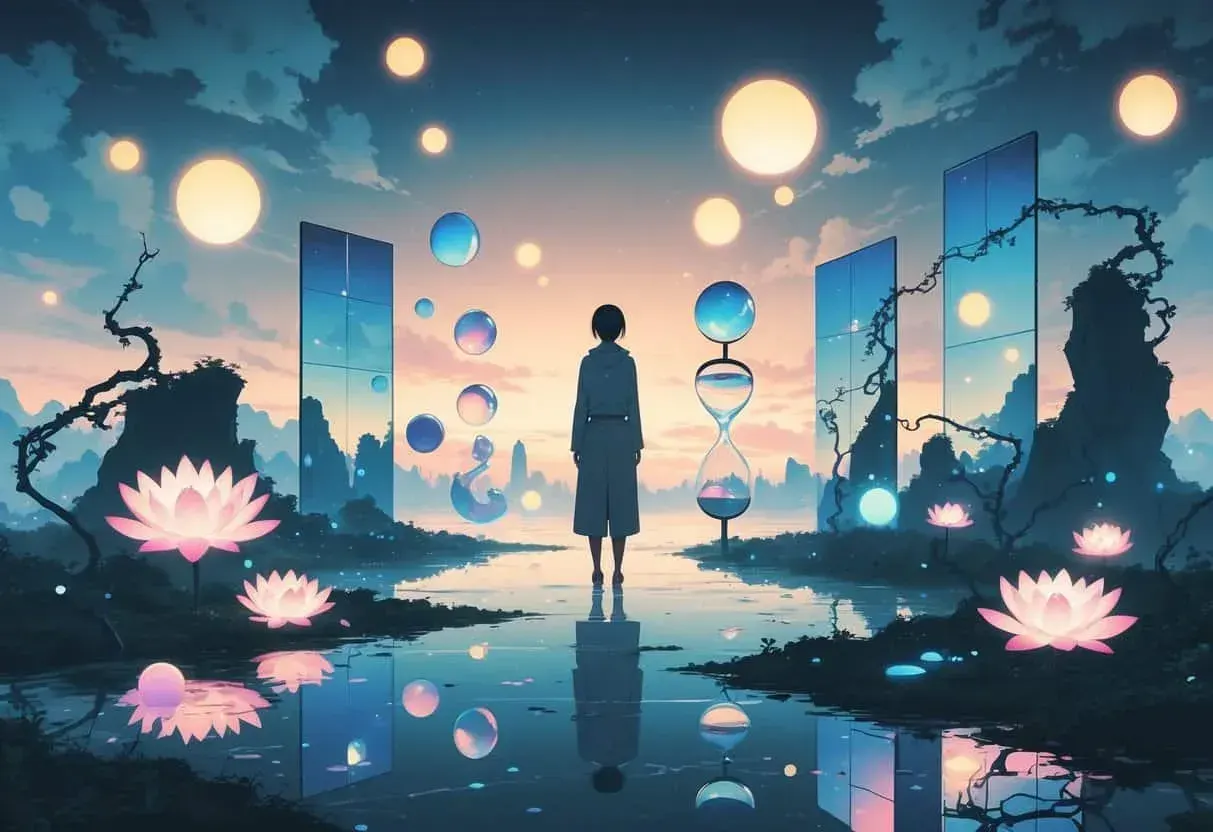
Symbolic works often feel cohesive because they are built around a central thesis. You will encounter recurring elements—water as a boundary between life and death, clocks marking the tyranny of time, mirrors exposing fractured identities—that reinforce the core theme without stating it outright. These motifs function like a visual vocabulary. The more you watch, the more fluent you become, until the entire narrative language clicks into place and you see how seemingly disparate pieces connect.
Key Characteristics of Symbolism-Heavy Anime
Identifying a series that fits this mold goes beyond simply noticing a lack of fight scenes. Several structural and stylistic choices typically signal that the work intends to operate on a deeper symbolic level. Recognizing these traits can help you find exactly the kind of cerebral, emotionally resonant anime that appeals to you.
- Indirect Exposition: Instead of characters explaining their feelings through internal monologue, their emotional states are externalized through the environment, weather, or surreal visual shifts.
- Deliberate Pacing: Scenes are allowed to breathe. Long, silent sequences invite reflection and give weight to subtle gestures and shifting lighting.
- Ambiguous Morality: Clear heroes and villains often give way to morally grey characters, each representing different facets of a larger philosophical argument rather than simply being "good" or "evil."
- Open-Ended Resolutions: Conclusions may not tie up every loose thread. Instead, they offer a final symbolic image that encapsulates the emotional journey, leaving interpretation open to the viewer.
- Nonlinear or Fragmented Narrative: Stories may jump between timelines, dream states, or subjective realities, forcing the audience to reconstruct meaning from symbolic fragments.
Standout Titles That Favor Meaning Over Mayhem
Several celebrated anime have made their mark not by dazzling with combat, but by inviting audiences into labyrinthine worlds of thought. While there are dozens of worthy examples, a few stand as masterclasses in symbolic storytelling.
Cowboy Bebop: Space as Existential Canvas
Though Cowboy Bebop contains its fair share of martial arts and spaceship dogfights, those sequences serve the larger purpose of exploring isolation and the struggle to escape one's past. The empty expanse of the solar system is a metaphor for the characters' internal voids. Jazz music becomes a symbol of improvisation and the unpredictability of life, a genre-bending expression of the series' core theme: "You're gonna carry that weight." Each bounty head reflects a facet of the main crew's unresolved trauma, making the show a poetic meditation on whether people can truly move on or merely drift until the past catches up. The recurring image of a reflection in water—be it Spike staring into a puddle or Vicious seeing his own face in a shattered mirror—reinforces the inability to fully escape one's identity.
Spirited Away: The Bathhouse as a Crucible of Growth
Hayao Miyazaki's Spirited Away is a dense allegory about the loss of innocence and the courage to navigate a corrupt adult world. The bathhouse itself is a microcosm of capitalist society, where spirits come to be cleansed of the filth accumulated from their environments. Chihiro's journey from timid, clinging child to resourceful, empathetic individual is marked by symbols of consumption (turning into pigs), identity (Yubaba stealing her name), and environmental degradation (the polluted river spirit). There is hardly any traditional "action"; the tension comes from social navigation, psychological pressure, and quiet acts of kindness that ripple outward. The train ride across the sea—a silent, meditative sequence—is one of the most powerful symbolic moments in all of animation: it represents the irreversible passage of time and the necessity of letting go.
Mononoke: Unraveling Truth Through Folklore
Mononoke is a visually distinct, almost theatrical anime that uses traditional Japanese horror motifs to dissect human emotions. The Medicine Seller, an enigmatic figure clad in colorful garb, must uncover the "Form, Truth, and Reason" behind malevolent spirits known as Mononoke before he can draw his sword. The real battle is a psychological investigation into the lies, regrets, and cruelties that birth these entities. With its ukiyo-e inspired art style and disorienting camera angles, the show demands full attention; almost every frame is a symbolic puzzle box. A deeper look into its structure can be found in this analysis.
The series uses color as a direct indicator of emotional truth: red for anger, blue for sorrow, and gold for revelation are not arbitrary choices but part of a consistent visual grammar.
Serial Experiments Lain: The Dissolving Boundary of Self
Few series embody the "symbolism over action" ethos as radically as Serial Experiments Lain. Set in the early days of the internet's public expansion, it presents the Wired, a virtual realm, as a murky mirror of collective consciousness. Lain Iwakura's fragmented identity—her shy real-world self, her assertive online persona, and an even more transcendent version—symbolizes the way technology fractures our sense of self. Power lines humming ominously in the background, constantly shifting shadow patterns, and the recurring image of a spectral godlike figure turn a philosophical essay on connectivity and loneliness into a haunting audiovisual experience. Action is nearly non-existent; the story progresses through cryptic conversations, bizarre visual metaphors, and a decaying grip on reality.
The series' famous "rice cooker" scene, where Lain stacks objects into an unstable tower, is a direct visual metaphor for the precarious construction of digital identity.
Mushishi: The Ecology of the Soul
Few anime are as meditative as Mushishi. Each episode follows Ginko, a traveling expert who studies and sometimes negotiates with primordial life forms called Mushi that exist at the boundary between the spirit and natural worlds. The Mushi themselves are not monsters to be defeated; they are neutral forces that symbolize the hidden, often inconvenient aspects of existence—grief, obsession, cyclical patterns of behavior, or the longing for lost connections. The show's visual style emphasizes luminosity and silence, with natural landscapes becoming characters in their own right. The absence of traditional conflict makes the symbolism stand out even more sharply: a character's inability to hear certain sounds becomes a metaphor for emotional numbness; a forest that blooms only at twilight represents the fleeting nature of happiness.
The Craft of Character as Symbol
In symbolic anime, a character's entire design and arc often serve the central idea. They are less likely to be fully rounded individuals with arbitrary quirks and more likely to be embodiments of a single, powerful theme. This does not make them flat; rather, it makes their journey an exploration of that theme from every possible angle.
Archetypes Made Flesh
A girl who cannot leave her room might represent society's retreat into digital isolation. A blind swordsman might embody the triumph of spiritual clarity over physical strength. A shape-shifting monster might personify the fear of the unknown within oneself. These archetypes are then given enough human texture that their symbolic weight never feels preachy. Their internal conflicts become the viewer's own, transformed into a universal struggle.
As they grapple with the idea they represent—be it revenge, forgiveness, or the hunger for purpose—the audience is invited to do the same. In The Girl Who Leapt Through Time, the protagonist's time-leaping ability is not a superpower to be used for action; it is a symbol of the desperate desire to fix past mistakes, and the eventual lesson that some changes cannot be undone without consequence.
Dialogue as a Key to the Subtext
Words in these anime are carefully chosen. A single line of dialogue can unlock an entire episode's meaning. Characters often speak in aphorisms or reveal their worldview through parables. These memorable quotes function as anchor points that crystallize the themes, turning abstract concepts into emotional touchstones. When a character says, "I have no home; I am a snail that carries its home on its back," the line isn't just about physical shelter—it's a declaration of a self-contained identity, a burden and a freedom wrapped into one.
Collecting these lines and reflecting on them is part of the participatory nature of the genre. In Haibane Renmei, the simple phrase "Forgive yourself" carries the entire weight of a narrative about guilt and redemption.
Contrasting Symbolism with Action-Driven Storytelling
Neither approach is inherently superior, but understanding the fundamental differences can help viewers choose the kind of experience they crave at any given moment. Where one seeks to ignite adrenaline, the other seeks to spark introspection.
Visual Language: Stasis vs. Motion
Action anime rely on fluid animation, impact frames, and dynamic camera sweeps to convey power and excitement. A fight in an Evangelion unit, for example, while laden with psychological weight, is still a visceral spectacle. Symbolic anime, in contrast, often use tableau-like compositions, minimalist movement, and surreal shifts in reality. A character standing still while the world distorts around them can carry more narrative weight than a dozen explosions. This stylistic choice forces the viewer to slow down and absorb the atmosphere, reading the environment as carefully as any book.
The long, still shots of a corridor in Perfect Blue create a sense of paranoia and fragmented identity without a single fight scene.
Plot Structure and Viewer Engagement
With action-oriented shows, the plot often follows a clear arc: a threat emerges, training or planning ensues, and a climactic battle resolves the immediate crisis. Engagement comes from the buildup and release of tension. Symbolic narratives can feel more like a spiral or a series of concentric circles, returning to the same thematic questions with increasing depth. They demand a different kind of patience; the satisfaction comes not from seeing a villain defeated, but from witnessing a character finally understand a painful truth about themselves or the world. This kind of storytelling can feel abstract, but for those who enjoy peeling back layers, it is uniquely fulfilling.
The looping narrative of The Tatami Galaxy uses repetitive structure to symbolize the protagonist's trapped mindset, and the eventual resolution is an emotional breakthrough rather than a physical victory.
Production and Fandom Reception
The market reception for these two modes differs sharply. High-action shows often receive multiple English dubs, wide Blu-ray releases, and a broad merchandise push because their fanbase is large and vocal. Symbolism-dense works tend to cultivate smaller but intensely devoted cult followings. Their home video releases, like the special edition sets for Haibane Renmei or Paranoia Agent, often include essays, director commentaries, and art books that unpack the dense symbolism, appealing directly to collectors who want to study every frame. While they may not get the same marketing budget, their critical acclaim and longevity in academic and critical circles is often far greater.
For example, Angel's Egg, a 1985 film by Mamoru Oshii, is rarely discussed in mainstream anime circles but is frequently cited in film schools for its deeply layered biblical and existential symbolism.
How to Watch Symbolic Anime: A Viewer's Guide
Approaching a symbolism-heavy anime requires a shift in mindset. Here are practical tips to get the most out of these works:
- Watch in a quiet environment: Background noise can break the spell of atmospheric storytelling. Headphones help you catch subtle audio cues that often carry symbolic weight—a faint humming, a distant bell, the rustle of leaves.
- Pause and reflect: If a scene feels deliberately composed, pause and examine it. What is in the frame? What is absent? How does the color palette shift? This active viewing turns you into a co-creator of meaning.
- Embrace ambiguity: Not every symbol needs a clear, one-to-one interpretation. Some are emotional rather than logical. Let the feeling wash over you first; analysis can come on a second viewing.
- Read supplementary material: Many symbolic anime are based on novels, short stories, or historical events. Understanding the source material can deepen your appreciation of the symbolism. For instance, knowing that Mushishi draws on Japanese folk beliefs about kami and natural spirits enriches every episode.
- Engage with the community: Online forums and video essays can reveal interpretations you missed. However, always form your own reading first before seeking others' opinions.
The Role of Music and Sound Design in Symbolic Storytelling
Sound in symbolism-heavy anime is often as carefully designed as the visuals. Recurring musical motifs, ambient noise, and even silence can become symbols themselves. In Serial Experiments Lain, the sound of a dial-up modem is transformed from a mundane technical artifact into a symbol of connectivity and fear—each time you hear it, a boundary between reality and the Wired is being crossed. In Mushishi, the composer Toshio Masuda uses traditional Japanese instruments (shamisen, shakuhachi) to ground the supernatural in the natural world. The music doesn't just accompany the action; it tells the story.
The absence of sound is equally powerful. In 5 Centimeters per Second, long silences during train journeys underscore the loneliness and distance between characters. When music finally arrives, it carries an emotional force that no battle cry could match.
Why Symbolism-Heavy Anime Deserve Your Attention
Investing your time in these slower, more deliberate works can fundamentally change how you consume all media. They sharpen your ability to read visual language and pick up on subtext. More importantly, they treat heavy subjects—grief, identity crisis, societal decay—with the gravity and nuance they deserve. In a media landscape often dominated by instant gratification, sitting with an anime that asks you to interpret rather than just react is a quietly rebellious act of deep engagement. Works like Paprika, Angel's Egg, and The Tatami Galaxy each offer a window into the extraordinary potential of the medium when it trades spectacle for significance.
They reward patience, curiosity, and a willingness to sit with discomfort. If you are ready to watch with your mind as much as your eyes, the world of symbolic anime awaits. Start with one of the titles listed above, turn off your notifications, and let the image speak.