Table of Contents
Anime music artists have transformed from behind-the-scenes soundtrack contributors into headline-grabbing pop sensations. Not so long ago, songs from anime series largely appealed to devoted otaku circles. Today, they routinely top mainstream charts, rack up hundreds of millions of streams, and shape the sound of global pop. The shift signals a deep cultural crossover, with anime’s storytelling and Japanese musical flair converging to create hits that resonate far beyond any one fandom.
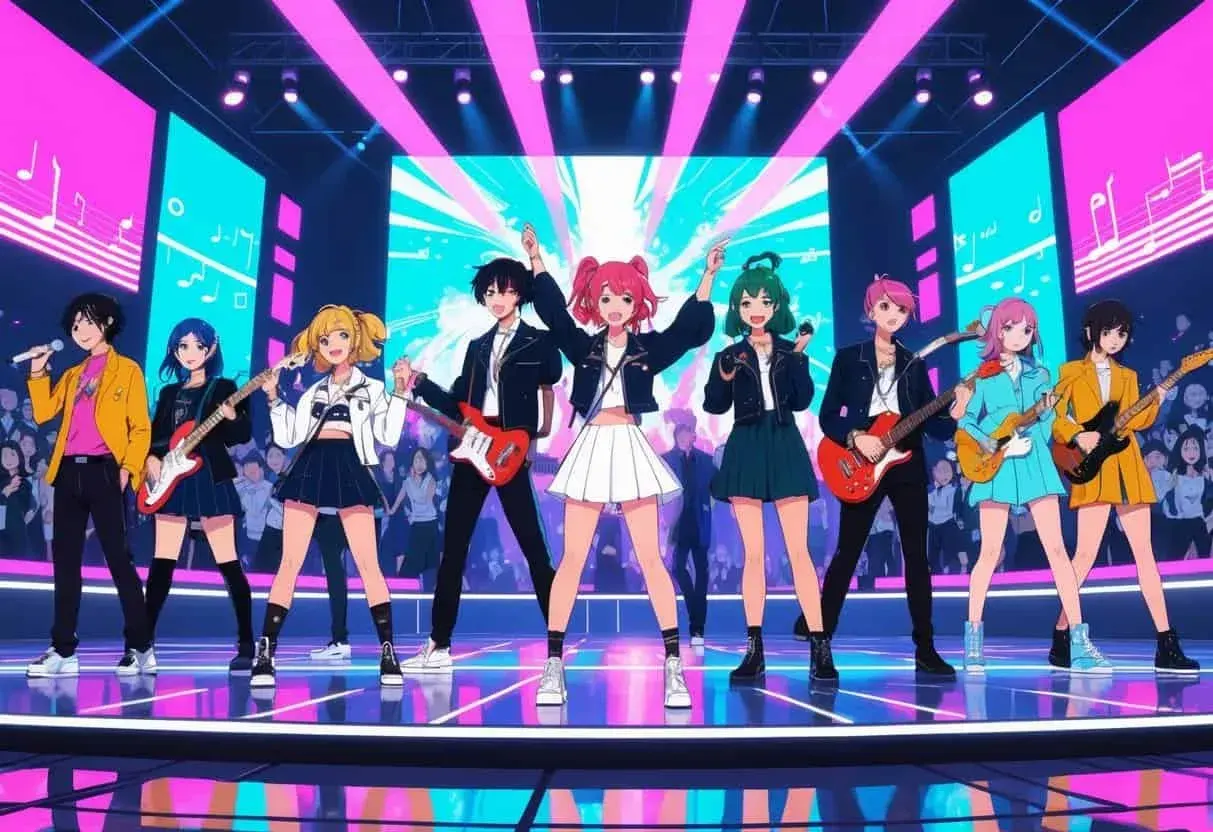
Powerhouse acts like LiSA, Kenshi Yonezu, and Hikaru Utada didn’t just ride anime’s popularity—they helped build it while also cracking the upper reaches of the Oricon charts, Billboard Japan, and even the Spotify Global Top 50. Their crossover shows how anime soundtracks have become a legitimate launchpad for mainstream careers, bridging emotional depth with radio-ready hooks and bringing Japanese pop culture into millions of daily listening habits worldwide.
How Anime Music Conquered the Mainstream
The journey from niche soundtrack to chart-topper wasn’t overnight. Several forces aligned over decades, pushing anime music out of its comfort zone. A mix of cultural export, the rise of Japanese pop (J-Pop) as a global genre, and pivotal shifts in the 1980s all played a part. Together, they built the foundation that lets today’s anisong artists fill arenas from Los Angeles to Taipei.
Anime Music as a Cultural Bridge
Anime soundtracks often carry distinctively Japanese melodies, instrumentation, and emotional tones, but they connect internationally because the themes are universal. Love, loss, and personal growth are expressed in ways that transcend language, especially when paired with the visual drama of the shows. In the 2000s, platforms like YouTube became accidental ambassadors—fans uploaded opening and ending themes, while reaction videos and lyric translations drew in curious listeners who had never watched the source material.
As social media evolved, TikTok turbocharged the effect. Clips set to anime songs—whether a LiSA chorus or a Kenshi Yonezu refrain—exploded in virality, pushing tracks onto trending charts. A single 15-second snippet could turn a decade-old song into a fresh streaming smash. The traditional instrumental touches—shamisen, taiko drums, or koto—blended with pop-rock arrangements offered something genuinely different from Western pop, making the genre feel both exotic and accessible. That unique hybrid aesthetic helped anime artists become cultural ambassadors, showing that a song written for a demon-slaying anime could resonate with someone commuting in London or studying in São Paulo.
J-Pop’s Deep Impact on Anime Soundtracks
Mainstream J-Pop and anime music have always been intertwined, but the relationship deepened significantly in the 2010s. Major J-Pop stars like Namie Amuro, Arashi, and Official HIGE DANDism contributed theme songs that brought their massive fanbases into the anime fold. That collaboration economy meant anime productions no longer had to rely solely on in-house or niche talent; instead, they could tap artists who already commanded top spots on Japanese radio and television.
LiSA’s trajectory is illustrative. She built her reputation through anime tie-ups like “crossing field” from Sword Art Online and later exploded globally with “Gurenge” from Demon Slayer, a song that topped the Billboard Japan Hot 100 for weeks and cracked digital charts across Asia and beyond. Kenshi Yonezu, already a respected singer-songwriter, saw “Lemon” become a cultural phenomenon after its use in the drama Unnatural, and his subsequent anisong “Peace Sign” from My Hero Academia sealed his status as a cross-genre titan. The Japanese record industry learned that an anime tie-in could be more than promotional content—it could be the spearhead of an international rollout.
The 1980s: The Decade That Built the Bridge
The 1980s were a watershed for anime music’s eventual mainstream acceptance. During this period, anime began to be seen as more than children’s entertainment; shows like Mobile Suit Gundam and films like Akira attracted older audiences, and their soundtracks demanded a sophistication that mirrored the storytelling. Synth-pop and rock became the go-to palettes, establishing a sonic identity that later generations would evolve. Hayao Miyazaki’s collaborations with composer Joe Hisaishi for Studio Ghibli further elevated anime music’s artistic standing, with orchestral pieces that stood on their own as concert works.
These 80s soundtracks traveled abroad through VHS tapes and laser discs, often as fans’ first encounter with Japanese lyrics. The distinct basslines and arpeggiated synths of tracks like “Ai Oboete Imasu ka” from Macross built a nostalgic yearning that later artists would sample and reinterpret. This era planted the seeds for the global curiosity that blossomed when digital distribution arrived, proving that anime music could command respect outside the fan convention circuit.
Trailblazing Artists Who Crossed Over
Many anisong performers have achieved mainstream success, but a handful redefined what that success could look like. Their chart positions, album sales, and international tours blazed a trail for the wave that followed, demonstrating that language barriers were not insurmountable when the emotion hit hard enough.
Hikaru Utada: The Crossover Blueprint
Hikaru Utada’s story is practically the origin myth of anime music’s mainstream potential. Born in New York and fluent in English and Japanese, Utada embodied a bicultural identity that mirrored the music itself. Her debut album First Love (1999) remains Japan’s best-selling album of all time, with over 7 million copies sold. But it was her contributions to the Kingdom Hearts franchise that turned her into a global icon for anime and gaming communities. Tracks like “Simple and Clean” and “Sanctuary” were re-recorded in English, playing over ending credits for millions of Western players.
Utada’s ability to blend R&B with tender J-pop ballads made her sound both familiar and fresh to international ears. In 2022, her album BAD MODE drew on house and electronic influences while still housing anime tie-ins, and it charted on multiple territories’ digital lists. Her enduring appeal shows how anime music can be a vehicle for a full-fledged pop career rather than a pigeonhole. Utada’s career is often cited as proof that language need not limit global reach.
KYO and the Emotional Intensity of Rock
On the heavier end of the spectrum, KYO—frontman of the visual kei metal band Dir En Grey—brought a theatrical, emotionally raw vocal style to anime-associated rock. While Dir En Grey’s music stretches far beyond anime tie-ups, songs like “Yokan” (used in Kuroshitsuji II) introduced a new level of intensity to anisong. KYO’s ability to shift from guttural shrieks to fragile falsetto in seconds turned heads everywhere from Wacken Open Air to the Oricon rankings.
Dir En Grey’s international tours and appearances at major Western festivals like Download and Coachella gave them a visibility that few Japanese rock acts had achieved. Their fan base extended well beyond anime enthusiasts, pulling in metalheads, goth subculture followers, and curious music critics. The band’s mainstream traction, driven by KYO’s singular voice, helped solidify the idea that an artist associated with anime imagery could command enormous, genre-agnostic stages. Their success influenced later visual kei acts to seek overseas markets and consider anime collaborations a gateway rather than a limit.
Kenshi Yonezu and the New Songwriting Standard
Kenshi Yonezu’s rise redefined what an anisong creator could mean in the pop ecosystem. Originally known as a Vocaloid producer under the name Hachi, Yonezu transitioned into a solo artist whose introspective songwriting and self-produced tracks resonated deeply. Song “Peace Sign” from My Hero Academia captured the yearning of youth with a crisp guitar-driven arrangement, and it became a radio staple. However, “Lemon,” although not an anisong, became a monumental hit whose success spilled over into everything Yonezu touched thereafter, including his anime features.
Yonezu’s 2023 single “Kick Back” served as the opening for Chainsaw Man and debuted at No. 1 on the Oricon Digital Singles chart while racking up tens of millions of streams within days on Spotify. Its chaotic energy and genre-blending production mirrored the anime’s manic feel, proving that artful, slightly unconventional pop could thrive in the commercial mainstream. Yonezu’s visual artistry in music videos and album art also spoke to anime fans, creating a multimedia brand that felt authentic rather than calculated. He represents a new wave of artists who control their entire creative output, using anime as a creative partner rather than just a promotional vehicle.
Chart-Topping Anthems and Their Lyrical Reach
Many anime songs that break into the mainstream do so because their lyrics tackle emotions that transcend the plot they accompany. Consider “Gurenge” by LiSA: its message about pushing through darkness and finding inner strength resonated during a time of global anxiety, making it the first song by a female Japanese artist to reach 100 million streams on the Oricon streaming chart. Similarly, “Unravel” by TK from Ling Tosite Sigure (used in Tokyo Ghoul) became a karaoke phenomenon across Asia for its desperate, searching lyrics about identity and loss.
Other tracks like “Silhouette” by KANA-BOON (from Naruto Shippuden) tapped into themes of growth and determination, forging an emotional connection that sent it straight to the Oricon top ten. The pattern is clear: when an anime song’s lyrics feel universal, fans want to carry it beyond the screen—into playlists, ringtones, and concert sing-alongs. Labels began commissioning lyric videos with subtitles in multiple languages, acknowledging that the storytelling in the words was a primary driver of chart success. Billboard Japan regularly tracks how anime tie-ups directly correlate with spikes in digital sales and streaming, confirming the commercial power of this deep lyrical connection.
Collaborations That Expanded Anime Music’s Horizon
No genre evolves in a vacuum, and anime music’s journey into the mainstream owes much to strategic cross-genre collaborations and stylistic fusions. When artists step outside the expected anisong formula, they pull new listeners into the orbit of anime.
Cross-Genre Experiments with Western and Electronic Artists
Collaborations between anime music veterans and Western pop or electronic producers have increasingly blurred the lines between markets. In 2019, Porter Robinson’s partnership with Japanese vocalist Rachie for the anime-inspired single “Something Comforting” highlighted how electronic music and anime aesthetics could coexist in a global festival circuit. Meanwhile, Steve Aoki’s remix of ONE OK ROCK’s song (a band with numerous anime tie-ups including Rurouni Kenshin and Beyblade) showcased to millions of electronic fans that Japanese rock had serious crossover appeal.
More recently, producers like Zedd and Alan Walker have tapped Japanese vocalists for anime-adjacent tracks, while Japanese acts like RADWIMPS (composers of Your Name. and Weathering With You soundtracks) embarked on world tours selling out venues in Europe and North America. RADWIMPS’ frontman Yojiro Noda even collaborated with Western artists like Awich, further knitting anime music into the fabric of global pop. These collaborations created entry points for listeners who might have never engaged with an anime soundtrack directly, normalizing Japanese lyrics on Western radio waves.
Shibuya-kei’s Lasting Influence on Anisong
Originating in Tokyo’s Shibuya district in the late 1980s, Shibuya-kei blended J-pop with bossa nova, French lounge, and electronic music, championed by acts like Pizzicato Five and Cornelius. Its quirky, sophisticated aesthetic seeped into anime music throughout the 1990s and 2000s. Tracks influenced by Shibuya-kei’s breezy melodies and eclectic instrumentation appeared in series like Lupin III: The Woman Called Fujiko Mine and Eureka Seven, bringing a cosmopolitan cool that attracted listeners who disdained typical high-tempo anisong.
The genre’s experimental ethos encouraged anime composers to break free from formula. Cibo Matto’s involvement in Jet Set Radio and later anime-adjacent projects proved that a lo-fi, sample-heavy Shibuya-kei approach could capture global indie audiences. Even today, you can hear Shibuya-kei’s fingerprints on artists like Gen Hoshino and the modern city pop revival, both of which frequently appear in anime tie-ups and chart alongside mainstream pop. This legacy shows that genre fluidity—mixing pop, jazz, and electronic—can turn an anime theme into a sleek, timeless listening experience that transcends its original medium.
The Role of Digital Platforms in Chart Domination
The mechanics of how anime music reaches listeners have shifted dramatically. The dual potency of physical media fandom and the explosive reach of streaming has supercharged artists’ ability to land on mainstream charts.
Physical Collecting Meets Streaming Numbers
In Japan, the CD still reigns as a vehicle for fan devotion. Anime fans often purchase multiple editions of a single—each containing unique covers, bonus DVDs, or lottery tickets for live events. This behavior pushes opening-week sales high enough to secure top Oricon positions, a feat that then garners free media coverage and attracts casual listeners via streaming playlists. The physical collectability of anisong releases keeps labels invested in high production values and limited-run items, which in turn feeds a cycle of hype.
Yet these same releases now live simultaneously on Spotify, Apple Music, and Line Music. The direct pipeline from a CD purchase to a playlist add creates a chart presence that platform algorithms amplify. Tracks by Official HIGE DANDism (who provided themes for Tokyo Revengers and Spy x Family) routinely rack up hundreds of millions of streams because they are playlisted not only on anime hubs but also on pop and chill-out compilations. This dual-revenue model has proven remarkably resilient, allowing artists to chart in both physical and digital domains simultaneously. According to the Recording Industry Association of Japan, streaming revenues for domestic music, much of it anime-connected, have grown exponentially since 2018, reflecting the seamless integration of anisong into everyday listening.
Yahoo Japan and the Search-Powered Fan Economy
Digital portals like Yahoo Japan have become crucial discovery engines for anime music. Through curated news articles, exclusive artist interviews, and video features, Yahoo Japan funnels mainstream web traffic directly to anisong content. A user searching for a popular drama might stumble on a tie-in music article, bridging the gap between general entertainment and anime soundtracks.
Yahoo’s auction and shopping services further fuel the collector market, driving engagement for special editions and concert tickets. This creates a feedback loop: as collector buzz spikes online, so do searches, which in turn boosts the song’s visibility on the platform’s recommendation modules. For emerging anisong artists, being featured in a Yahoo article can mean sudden discovery by demographics that never frequent anime-specific forums. The platform’s integrated music video channels and lyric databases become a low-friction on-ramp for curious listeners, helping songs like “Kaikai Kitan” by Eve or “Cry Baby” by Official HIGE DANDism find footholds in the mainstream consciousness.
Anime Music’s Ripple Effect on Pop Culture
Mainstream chart success is just one measure of how anime music has reshaped pop culture. The vibe and visual language of anisong have seeped into fashion, live event culture, and artist branding globally.
Cosplay music festivals, such as those organized by Anisong World Matsuri, bring tens of thousands of attendees to venues like the Microsoft Theater in Los Angeles, where fans sing along in Japanese without hesitation. Non-anime pop stars like Doja Cat and BTS have incorporated anime-inspired visuals and musical motifs, acknowledging the subculture’s aesthetic clout. Meanwhile, Western alt-pop acts like Grimes have cited anime composers as inspirations, eroding the barrier between “anime music” and “serious music.”
Major Japanese bands like King Gnu, whose songs for Jujutsu Kaisen became monstrous hits, now headline festivals outside Japan on the strength of a catalog that straddles anisong and experimental rock. This integration suggests that anime music isn’t merely a genre; it’s a launchpad for cultural influence that reaches into mainstream cinema, gaming, and streetwear. As anime becomes a default entertainment option for Generation Z and Alpha, its music will only continue to rewrite the rules of global pop stardom.
What Comes Next for Anime Music in the Mainstream
The future looks borderless. Virtual artists like Hatsune Miku have already played Coachella, while VTuber musicians such as Mori Calliope sign with major labels and tour worldwide. AI-generated vocals and hyper-digital productions are likely to further blur distinctions between anime soundtracks and pop hits. Streaming data from Spotify Japan consistently shows anime songs driving listeners to create bilingual playlists that mix Japanese and English hits, signaling a normalization of cross-lingual fandom.
Labels are investing in simultaneous global releases and multilingual promotions, aware that a song featured in a hit anime can debut on charts in over 30 countries within 24 hours. Studios are also commissioning original songs for Western dubs, bridging the language gap for casual viewers. As the industry matures, the line between anisong specialist and global pop star will likely vanish altogether—leaving only the music, and the massive audiences that love it, regardless of how they first found it.