Table of Contents
How Each Medium Shapes the Narrative Core
When a story travels from a creator’s original vision into the hands of a new team, the medium itself becomes a co-author. Anime, manga, and game adaptations all wrestle with the same challenge—delivering a compelling tale—but the tools at their disposal set wildly different expectations. Manga usually gives you the fullest, most detailed version of the story. Anime brings it to life with motion and sound, and games add interactivity, changing how you get pulled into the plot. Understanding how each format handles pacing, visual language, and audience participation reveals why no single adaptation can claim universal superiority.
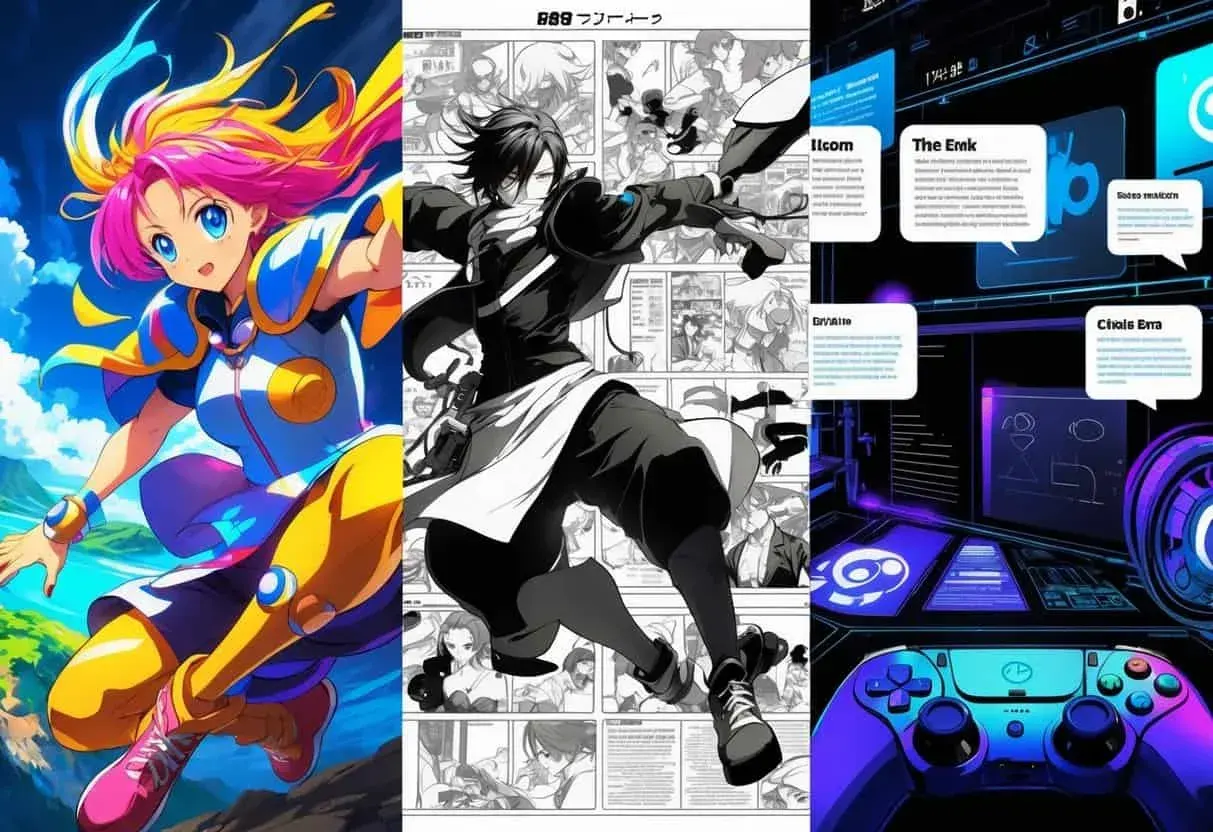
A printed page invites you to linger, to absorb every brushstroke and silence between panels. Animation thrusts you forward with sound and motion, turning internal monologue into performance. Interactive experiences hand you the controller, asking you to live inside the story rather than observe it. Each approach has its own genius—and its own blind spots. The deeper you look, the clearer it becomes that “best” depends entirely on what you value in a storytelling experience.
Anime leans heavily on sensory immersion. The combination of voice acting and a crafted score can make a story feel immediate in ways that silence on a page cannot. Meanwhile, manga rewards patience and rereading, offering a level of textual and visual detail that screen adaptations often prune away. Games fight an entirely different battle, balancing narrative coherence against the freedom of player agency, and sometimes the mechanics swallow the story whole. By examining these dynamics across all three forms, you can build a sharper instinct for when an adaptation succeeds—and when it falls short.
Key Takeaways
- Every format—visual spectacle, reader-paced paneling, or interactive play—hits your emotional brain through a different pathway.
- Anime excels at layering emotion through voice and music, but often truncates or rearranges source material.
- Manga typically offers the most authorial control and narrative depth, preserving details that other adaptations sacrifice.
- Game adaptations struggle to translate open-ended interactivity into a linear story, but when they click, they create a uniquely personal bond.
Core Differences Between Anime, Manga, and Game Adaptations
Each medium arrives with its own grammar: how it moves through time, how it shows rather than tells, and how much it asks from you. These differences are not superficial tweaks; they can fundamentally reshape what a story means.
Storytelling Methods
Anime harnesses motion, color, voice, and music to build a seamless emotional current. A single cut from a character’s tear-streaked face to a swelling orchestral swell can convey what ten pages of internal monologue might labor to explain. But this immediacy often forces trade-offs. Budget limits, episode counts, and broadcast schedules push studios to condense, relocate, or outright invent scenes. Entire arcs can vanish, and secondary characters sometimes fade into background decoration.
For an example of these pressures in action, look at how Monster was adapted—a famously faithful translation that still needed to adjust its sprawling pacing for television.
Manga delivers its story through still panels, word balloons, and the white space between them. As a reader, you control tempo. You can flip back to catch a missed clue, study a silent reaction shot for half a minute, or blaze through a breakneck fight sequence. Because the original artist usually writes and draws the manga, the final page represents a vision that hasn’t been filtered through a committee. That cohesion often yields deeper character nuance.
In the Dragon Ball manga, for instance, Goku’s goofy innocence and quiet growth unfold through small, patient beats that later animated versions either rush or bury under flashy filler.
Game adaptations occupy an entirely different space. Here, the narrative is not just presented but inhabited. Through exploration, dialogue trees, and consequence systems, you become a participant in the unfolding plot. The trouble for adaptation is that this interactivity dissolves the moment the story moves to a passive screen. Developers face the delicate puzzle of picking which route through a branching narrative becomes canon—if any—and how to turn puzzles, combat, and inventory management into drama that doesn’t rely on a controller in your hand.
Visual Styles and Artwork
Manga’s black-and-white aesthetic is not a limitation but a tool. Without color to guide emotional temperature, artists lean on line weight, shading, and panel composition to direct your eye and mood. You might spend extra moments on a single intricately drawn background, something the anime version often simplifies to keep animation fluid. The Akira manga, for example, uses staggering metropolitan detail that the revolutionary 1988 film had to streamline—yet the film’s hand-painted color palette and kinetic lighting created a visual language all its own.
Anime adds dimension and atmosphere through color design, lighting, and camera movement. A sunset fight scene can glow with symbolic warmth; a character’s trembling hand gains weight through frame-by-frame motion. However, to hit weekly deadlines, animators frequently reduce line complexity and background detail. Long-running shonen series like Naruto or One Piece sometimes stretch limited animation budgets, substituting dynamic stills and repeated motion cycles for true fluidity.
Game adaptations blend these traditions with 3D modeling, real-time rendering, and interactive cinematography. Titles like Persona 5 wrap turn-based combat inside a hyper-stylized anime aesthetic, while Final Fantasy VII Remake reinvents polygonal heroes as cinematic actors. The visual identity shifts based on what the engine can deliver without breaking performance, so you’ll often see a careful dance between expressive character models and softer environmental details.
Imagination and Viewer Experience
The gap between manga panels forces your mind to fill in motion, sound, and even smell. It’s an active, almost collaborative act of creation. You supply the voice for the hero, the rhythm of the footsteps, the temperature of the air. Anime takes over that role entirely, and that can be both a relief and a surrender. When the voice cast and sound design are exceptional, the trade feels worthwhile.
When they aren’t, the adaptation erodes the delicate personal imagery you’d built.
Games intensify this dynamic to the extreme. Here, you aren’t just imagining the protagonist’s choices—you’re making them. That ownership creates a powerful sense of investment. Yet it also introduces a risk: if you spend an hour grinding levels or solving inventory puzzles, the narrative momentum can evaporate. The best game adaptations learn to weave storytelling into the mechanics themselves, so that every jump, conversation, and missed save file becomes part of a coherent emotional arc.
Evaluating Anime Adaptations Under a Microscope
Anime adaptations don’t just translate a story; they reinterpret it through a director’s lens, a composer’s ear, and a voice actor’s breath. When these elements align, you get something transcendent. When they misalign, even a beloved source can feel hollow.
Faithfulness to Source Material
Fidelity sounds straightforward—just follow the panels, right? But animation demands its own rhythm. A manga’s silent stare-down might need a swelling score, which can shift its tone. Monster is often held up as the gold standard of faithfulness, replicating Naoki Urasawa’s meticulous paneling nearly shot-for-shot while using voice acting to amplify psychological tension. On the opposite end, Saint Seiya made early alterations that muddled the story’s mythology, altering character introductions and rearranging fights to suit a younger broadcast demographic.
When you notice a missing scene or a redesigned character motivation, it’s usually because the production committee decided the original plot wouldn’t “work” for a wider audience in a timed format.
Faithfulness isn’t a binary switch. Some changes—like expanding a minor character’s backstory or adding an original arc with creator input—can enrich the experience. The critical test is whether the adaptation preserves the emotional truth of the source, even if the surface details shift.
Pacing and Narrative Flow
Pacing can make or break an anime. If an action series sprints through its fights, the build-up that made the stakes feel real vanishes. Dragon Ball’s early anime is infamous for this, compressing training montages and skipping character interactions that the manga used to ground Goku’s relationships. Conversely, a series with too much filler—original episodes not found in the manga—can suffocate momentum. Naruto’s endless filler arcs are the textbook example of a production overtaking its source material and padding the run time until the main plot feels like an afterthought.
The best-paced adaptations know when to breathe and when to accelerate. Yu Yu Hakusho is frequently praised because its tournament arcs don’t overstay their welcome; emotional beats land hard without over-explanation. When transitions feel jarring or entire chapters are crammed into a single episode, you can sense the budget clock ticking in the background.
Voice Acting and Soundtrack
A voice can define a character for millions. Yūki Kaji’s raw screams as Eren Yeager or Megumi Ogata’s layered fragility as Shinji Ikari don’t just deliver lines—they etch personalities into cultural memory. On the flip side, a flat or miscast performance can pull you out of the story no matter how beautiful the animation. Soundtracks carry equal weight. Hiroyuki Sawano’s bombastic orchestral rock has become synonymous with Attack on Titan’s apocalyptic scope, while the melancholic piano of Your Lie in April threads music directly into the narrative’s emotional core.
Without these auditory layers, even faithfully adapted scenes can feel like pale imitations.
Notable Examples in Anime Series
Few adaptations balance fidelity and artistic growth as well as the Akira film. It condenses a multi-thousand-page epic into a two-hour fever dream, yet its neon-drenched visuals and iconic soundtrack—courtesy of the Geinoh Yamashirogumi collective—created an experience that stands completely on its own. Akira’s film adaptation did not try to be the manga; it became a different beast, one that now defines cyberpunk aesthetics worldwide.
Another standout is Hunter x Hunter (2011), which remade the earlier 1999 series with tighter pacing, richer animation, and a more faithful adherence to Yoshihiro Togashi’s increasingly dark story arcs. It demonstrates how a second adaptation can correct the missteps of the first and eclipse it entirely. When you compare these triumphs to adaptations that struggled—like Tokyo Ghoul’s rushed second season—the line between failure and brilliance often comes down to how much time and money the studio was given to respect the source.
Exploring Manga as the Original Narrative Blueprint
The manga is often the creative wellspring. It’s where an author first tests out characters, builds a world, and learns what the story actually wants to say. By the time an adaptation arrives, many of the hardest creative decisions have already been made on paper.
Manga’s Approach to Storytelling
A manga chapter is a tight, self-contained narrative unit, usually twenty pages that must hook you, develop something, and leave you needing the next installment. This serialized pressure produces an intensity that longer-form adaptations sometimes dilute. You get the author’s unfiltered narrative pacing: a slow-burn psychological thriller like Death Note lets Light’s descent into madness stretch over dozens of meticulously plotted chapters, every mind game given room to twist. Anime versions often compress these internal battles, which can sharpen the tension but may also sacrifice the slow accumulation of dread.
Character interiority thrives in manga. Thought bubbles, inner monologue boxes, and reaction panels let you slide directly into a character’s mind. In the Vagabond manga, Takehiko Inoue uses entire pages of silent, brush-like art to convey Musashi’s spiritual transformation—an approach that an anime would struggle to replicate without feeling like a screensaver. The reader’s ability to pause and absorb means that a single expression can carry the weight of an internal novel.
Artistic Expression in Manga
The artist’s hand is visible in every line. In a weekly serial like One Piece, Eiichiro Oda’s crowded, chaotic panel compositions mirror the sprawling, unpredictable world of pirates. In Berserk, Kentaro Miura’s impossibly detailed crosshatching and monstrous designs communicated a darkness that no animation studio has ever fully captured—because the horror lived as much in the stillness as in the action. Black-and-white art forces you to engage with texture and contrast, and flipping a page to reveal a full-splash illustration that halts your breath is a reading experience no screen can duplicate.
Impact on Adaptations
Adaptations walk a tightrope between the manga’s blueprints and their own creative ambitions. When Demon Slayer’s anime exploded in popularity, it wasn’t because it invented new story beats—it took the manga’s already emotionally resonant framework and saturated it with fluid combat choreography and a haunting musical score. In contrast, the Berserk 2016 anime series attempted to use CGI to animate Miura’s intricate art and largely failed, because the soulless character models stripped away the very texture that gave the manga its power. A successful adaptation respects the spirit of the art even when it must translate the medium.
Game Adaptations: Translating Story Across Mediums
Games are built on choice, repetition, and failure states—none of which translate neatly to a passive viewing format. When a game adaptation works, it often does so by ignoring fidelity to gameplay and instead excavating the emotional core of the player’s journey.
Adapting Interactivity to Narrative
The central challenge is turning verbs into scenes. In a game, you might spend hours exploring an abandoned town, reading diary entries, and piecing together lore at your own pace. An adaptation must condense that into a single, directed moment. The Last of Us HBO series succeeded by treating the game’s key beats as a script foundation, while using the expanded runtime to add depth to side characters and relationships that the game only hinted at. In anime, Persona 4: The Animation cleverly wove the protagonist’s social link mechanics into a cohesive personality, giving the silent game hero a warm, charismatic presence without betraying the source’s tone.
Not all adaptations land this softly. When interactivity is stripped away, player-driven tension disappears. A boss fight that required fifty attempts in the game becomes a thirty-second animated clash, robbing it of the grinding desperation that made victory feel earned. Translators must find new narrative engines to replace the lost dopamine of input.
Challenges in Plot and Character Development
Game narratives are often modular, with side quests and optional lore piled high. Adaptations must choose a definitive path, which inevitably alienates players whose own choices led elsewhere. Final Fantasy VII Advent Children pleased fans of Cloud’s character design but confused many with its compressed timeline and new threats that had no equivalent in the game’s deep lore. Writers frequently need to invent connective tissue—a through-line that explains why the chosen scenes matter. Without careful character work, protagonists who were once vehicles for player agency can feel hollow on screen.
Lore simplification is another hurdle. Games can bury deep mythology in item descriptions and optional books; an anime season doesn’t have that luxury. Castlevania’s animated series on Netflix leaned hard into character banter and dark political drama, reshaping the game’s sparse plot into a rich, dialogue-driven tragedy. It succeeded precisely because it didn’t try to replicate the gameplay loop—it built new pillars of character motivation to carry the story.
Hollywood and Global Adaptation Trends
When Hollywood adapts a game, the pressure to reach non-gamers often flattens nuance. Studios inject familiar templates: the hero’s journey, a love interest, a third-act CGI spectacle. Some projects, like Detective Pikachu, merge Pokémon’s creature charm with noir mystery and succeed as standalone entertainment. Others, like the early Resident Evil film series, jettisoned the games’ deliberate survival horror in favor of action-hero theatrics—a choice that pleased some moviegoers but alienated the core fanbase. Meanwhile, Japan’s approach to anime game adaptations tends to hew closer to the original pacing and visual style.
Fate/Grand Order anime specials assume the audience already knows the sprawling lore, which can feel impenetrable to newcomers but deeply rewarding for players. This divergence highlights a simple truth: every adaptation is a negotiation between fidelity to the source and accessibility to a new audience.
Which Medium Tells the Story Best?
The question doesn’t have a single answer because “best” is not a fixed metric, but a reflection of what you need from a story in that moment. If you crave a complete, unhurried narrative with the creator’s hand visible on every page, manga remains the definitive experience. Its depth and pacing reward long-term investment and re-examination. If you want to be swept up in a world that feels alive, where music and voice turn static panels into breathing moments, a well-crafted anime adaptation can transport you in ways the page never could.
For those who want to feel like the story belongs to them, to see their choices ripple through a fictional world, games offer a relationship no passive medium can match. The trade-off, of course, is that the story’s coherence often takes a backseat to player agency. Understanding these trade-offs transforms you from a passive consumer into an informed explorer—someone who can pick up a manga, click play on an anime, or launch a game adaptation with clear eyes about what will be gained and what might be lost along the way.