Table of Contents
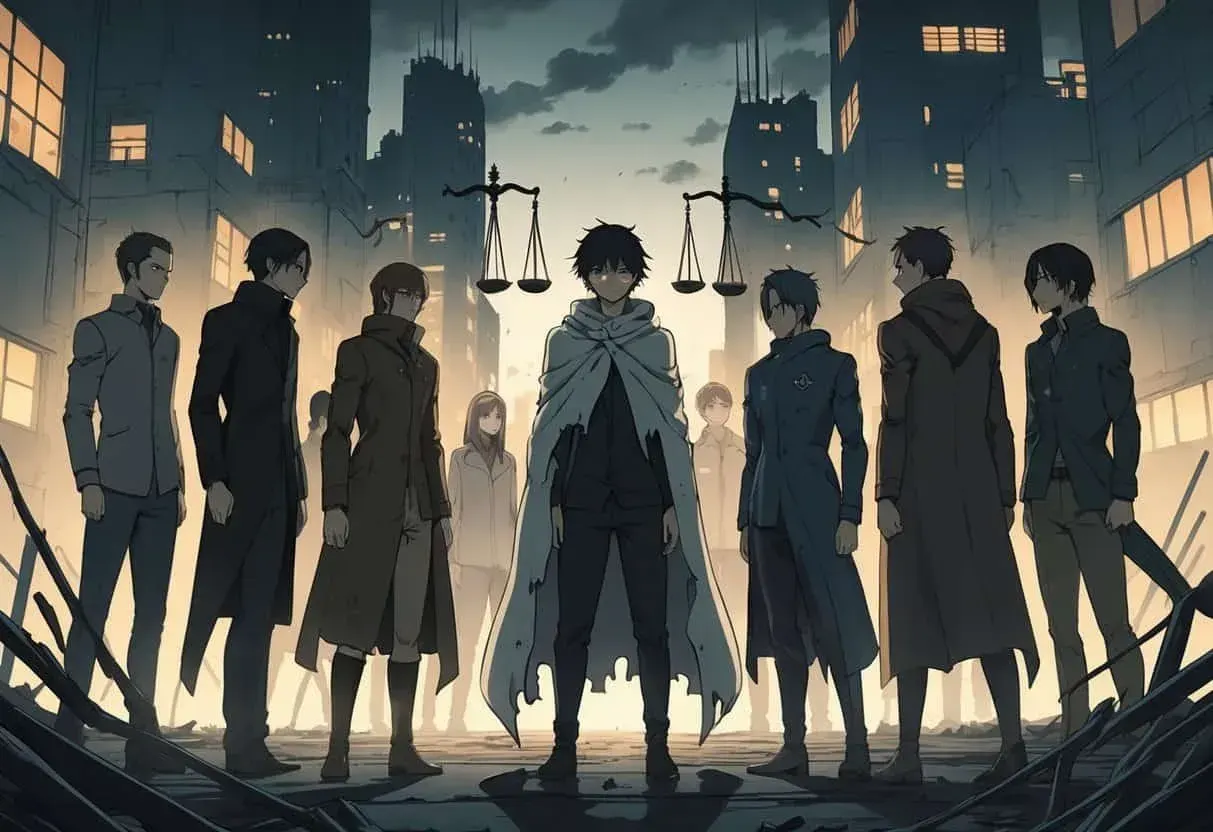
The most compelling stories in anime refuse to hand you a moral compass with a fixed needle. They drop you into a storm of conflicting ideologies where the horizon between heroism and villainy vanishes, and the only thing you can trust is the unsettling feeling that you might agree with the so-called monster. These are the narratives where a protagonist’s righteous quest leads to mass suffering, and an antagonist’s cruelty is rooted in a love that was twisted into despair.
A significant portion of animated entertainment still relies on a binary clash—pure-hearted champions of light versus cackling embodiments of shadow. Breaking away from this template, the works discussed here operate on a different frequency. They understand that the greatest battles are not fought for the fate of the world, but for the validation of a personal truth. They replace the destructive beam clash with a psychological confrontation, asking not "who is stronger?" but "who has the right to decide?"
These shows do not simply blur the line; they erase it and redraw it as a labyrinth. By forcing the audience to sit in discomfort, to sympathize with the unforgivable, and to question the saintly, these anime offer a viewing experience that is not just passive consumption but active ethical excavation.
The Philosophical Anatomy of a Moral Gray Zone
Moral ambiguity in narrative art is not about refusing to take a stand. It is the deliberate construction of a universe where the traditional reward system of karma is broken. In classic hero tales, a morally correct choice yields a positive outcome. In complex anime, the most selfless choice often leads to the greatest tragedy, while a selfish act might save a civilization. This narrative design shakes the foundation of cause and effect, a technique that challenges the audience's cognitive bias toward "just-world" thinking.
The architecture of these stories is built on the principle of conflicting rights. A character is not fighting "evil"; they are fighting an opposing version of "good." This framing requires a high level of narrative intelligence. The writer must create a diegetic reality where the moral code of the aggressor is as logically sound as that of the defender. When a viewer watches a character commit an atrocity and thinks, "I understand why this is necessary to them," the anime has successfully simulated the fractured nature of real ethical conflicts.
This subversion often manifests through the removal of the "God’s-eye view." The audience is denied a universal arbiter of truth. Instead, the narrative is filtered through unreliable narrators, propaganda, and historical revisionism. You are left to piece together the ethical truth from the debris of biased testimony, forcing an active participation in the judgment of the fictional world.
Guiding Lights and Fallen Saints: Reimagining the Protagonist
The classic hero possesses moral clarity. The hero in a morally ambiguous narrative possesses a psychological wound that acts as a distorting lens. Their quest is not to save the world from an alien threat, but to impose their internal order onto an external chaos. This makes them volitional, dangerous, and profoundly human. You are not watching a paragon of virtue navigate temptation; you are watching a rational person assemble a justification for destruction.
The Tyranny of Intellect: Light Yagami and the Death Note
No examination of moral decay via conviction is complete without Death Note. Light Yagami does not begin as a hidden monster. He begins as a prodigious, bored, and deeply alienated young man who stumbles upon the power to kill anonymously. The genius of the series lies in the slope of his descent. He does not snap; he slides.
His initial targeting of violent criminals feels, to a frustrated populace, like a form of divine justice. The narrative traps the viewer by appealing to a base desire for simplified justice.
Light’s adversary, the enigmatic detective L, is not a beacon of virtue. L is a recluse who admits that he only solves puzzles for the thrill of the game, and he is willing to sacrifice innocent lives to trap his quarry. The battle is not between good and evil. It is a battle between two distinct brands of narcissism and control. The question the series asks is terrifying: in a world without a functional judicial system, is a supernatural dictatorship with a 99% accuracy rate better than chaotic freedom?
The series ultimately becomes a case study in Nietzschean morality. Light transcends the slave morality of the masses to create his own values, but in doing so, he becomes the very monster he claimed to destroy. His god complex does not alienate the viewer immediately because we are privy to the internal logic that maintains his self-image as the sacrifice necessary for global peace.
The Mask of the Liberator: Lelouch vi Britannia and Code Geass
Where Light sought godhood, Lelouch vi Britannia in Code Geass seeks a bloody form of atonement disguised as revolution. Lelouch is a disinherited prince who dons a mask not just to hide his face, but to psychologically negotiate the dark deeds required to dismantle a global empire. He does not just fight soldiers. He lies, manipulates, and betrays his closest allies, believing the emotional cost he pays is a currency that buys victory.
The show's most brutal moral lesson is revealed in the destruction caused by unintended consequences. Lelouch’s strategic genius often triggers retaliatory massacres, most notoriously the incident involving Princess Euphemia, where a slip of control causes a slaughter that Lelouch is forced to weaponize. This moment reveals the core theme: one cannot conduct a "clean" war. The blood does not wash off.
His final gambit, the Zero Requiem, redefines the concept of a heroic sacrifice. It is not a battle against a villain; it is Lelouch engineering his own villainy to a global scale to unite the world in hating him. It is a messianic death drive, a suicidal redemption that argues that a lie agreed upon is a more stable peace than a truth fought over. Lelouch forces the universe to view him as absolute evil so that the concept of evil can be temporarily vanquished.
Institutionalized Morality and the Deconstruction of Justice
Beyond the actions of single prodigies, some anime attack the concept of moral absolutism by exposing the systems that enforce it. These stories argue that the ultimate evil is not a person but a process: a law, a government, or a scientific apparatus that strips individuals of agency and labels them inhuman for the convenience of the majority.
The Psychopass Paradox: The Crime of Potential
No anime examines the surrender of moral choice to a machine better than Psycho-Pass. The series posits a future where the Sibyl System scans citizens' biometrics to produce a "Crime Coefficient," a number that dictates their psychological propensity for evil. If your hue clouds, you are a latent criminal, regardless of whether you have committed a visible act. This is a society that has traded moral liberty for the safety of a predictive algorithm.
The character of Shinya Kogami embodies the return of repressed human judgment. He abandons the system to hunt down Shogo Makishima, a hyper-rational anarchist who seeks to liberate humanity by returning it to a state of raw, violent free will. The conflict here is a philosophical fork in the road: is a peaceful, ignorant, and controlled society superior to a violent, free, and chaotic one? Makishima, the antagonist, is not clinically insane; he simply refuses to accept a quantitative value as a substitute for a qualitative soul. The Sibyl System itself is eventually revealed to be a collection of clinically psychopathic brains—the ultimate irony that the standard of justice is maintained by the very people who cannot be judged.
Persecution and Empathy in Ajin
Ajin: Demi-Human turns a supernatural premise into a brutal commentary on medical ethics and the dehumanization of the "other." The immortal Ajin are not dead monsters; they are biographical humans who happen to resurrect. The government, rather than integrating them, declares them non-human. This linguistic trick—removing the word "person" from a creature—unlocks a Pandora's box of torture.
The narrative follows Kei Nagai, a coldly logical student whose entire survival strategy is to run away. His detachment is not heroic; it is a survival mechanism against a world that refuses to see him. The true disruption of the moral binary comes from the antagonist, Sato. Sato is a terrorist who commits acts of mass murder with a childlike grin. Yet, you cannot fully condemn him because his madness is the direct product of inhumane military experimentation.
The state creates Sato, and then the state declares itself the victim when he retaliates. The series leaves no clean space; if you side with the humans, you condone vivisection. If you side with Sato, you condone the indiscriminate crashing of passenger planes for personal amusement.
The Narrative Mechanics of Ambiguity
A story cannot simply state that it is morally complex; it must engineer this complexity through specific narrative devices. The most effective tactic is perspective paralysis, where the narrative radically shifts allegiance. An audience may spend ten episodes rooting for a faction only to discover the buried atrocity that faction was built upon.
Another technique is the normalization of the monstrous. In a show like The Saga of Tanya the Evil, the protagonist is a man reincarnated as a little girl in a magic-infused World War I scenario. Tanya von Degurechaff is a cold-blooded corporate climber trapped in a soldier’s body. Her total adherence to the logic of rational choice—firing on civilians if they violate a legalistic technicality, sending conscripts to die for a statistical advantage—is hard to argue against within the sealed logic of her world. The show uses her voice, a high-pitched child’s tone, to deliver the most chilling sociopathic logistics, creating a cognitive dissonance that disorients the viewer.
The use of historical allegory also complicates morality. Legend of Galactic Heroes pitches a corrupt, decaying democracy against an efficient, benevolent autocracy. The constant narrative shifting prevents you from planting a flag. You see Reinhard von Lohengramm’s imperial ambition not as a power grab, but as a necessary cleaning of a goldenbaum septic tank of decadence. Conversely, the Free Planets Alliance captains like Yang Wen-li fight to preserve a democracy that is actively voting itself into oblivion.
The show argues that good governance, not "good guys," is the highest virtue, and that a good man serving a bad system is more tragic than a ruthless man creating a meritocracy.
The Thematic Vault: Dystopia, Power, and Psyche
Several titles take the erasure of moral absolutes to such an extreme that they redefine the genre itself. They present worlds where the act of growing up, or the existence of power, is inherently a sin.
The Bones of Reality in Shinsekai Yori
Shinsekai Yori (From the New World) is perhaps the most devastating gradual unraveling of a moral center in anime. It begins with a pastoral group of children studying psychic powers, and slowly reveals that their peaceful society is built on a foundation of eugenics, memory manipulation, and the genetic engineering of a sentient slave race. The "Queerats" are not monsters; they are forced into a subhuman existence by the Cantus users. When Squealer, a Queerat revolutionary, rises against the human overlords, his final scream of defiance is a harrowing mirror held up to the audience. The series destroys the distinction between the rebellion of a hero and the tantrum of a beast, forcing the viewer to realize that one person’s utopia is another’s living hell.
Atmospheric Morality in Kara no Kyoukai
The Garden of Sinners (Kara no Kyoukai) transports moral ambiguity into the realm of high art and broken psychology. Shiki Ryougi is a protagonist whose body houses multiple personalities and who stalks supernatural threats in a floating, depressive aesthetic. The villainy here is not about power, but about philosophy. The antagonist, Souren Araya, seeks to destroy the world's inherent limitation to reach the Root of existence, a spiritual goal that has absolutely no malice. His murder of innocent bodies becomes a side effect of a metaphysical experiment.
The series uses a fractured, non-linear timeline to simulate the impossibility of objective truth. You are forced to watch the events out of order, recognizing that intent and outcome only align in retrospect, if they align at all.
Cultural Reception and the Legacy of Uncomfortable Art
The cultural legacy of these series is a more demanding audience. By deconstructing the hero-villain template, these anime have trained a generation of viewers to be skeptical of the "chosen one" trope. The critical and fan reception often focuses on the lingering sensation of unease, the discussions that break out in forums long after the credits roll, debating whether a character’s fall was tragic or merely pathetic.
This approach has influenced global media far beyond the bounds of manga. Western serialized dramas have increasingly adopted "hard choices" storytelling, though anime often remains more philosophically explicit thanks to its willingness to pause an action scene for a ten-minute internal monologue about utilitarianism. The legacy is a shift in what audiences perceive as depth. Suffering is no longer a sign of a tragic hero; it is a consequence of a complex world.
However, the path to nuance is not without its pitfalls. There is a risk of creating a protagonist who is so morally gray that they become philosophically inert—a wet, nihilistic puddle of indecision. The anime discussed here avoid this by ensuring that while their morality is unreadable, their agency is absolute. They act, and they take the weight of those actions. The viewer is left not to excuse them, but to weigh their soul on a scale that has no zero point.
Ultimately, to watch these stories is to practice a form of empathy that is dangerously lacking in reflexive judgment. It requires you to hold the perspective of the abuser and the abused in your mind simultaneously, not to justify the action, but to prevent the cycle from becoming a mystery. These anime do not offer an escape from morality; they offer a deeper, more chilling, and infinitely more honest exploration of it.