Table of Contents
The Allure of Sci-Fi Fantasy Anime
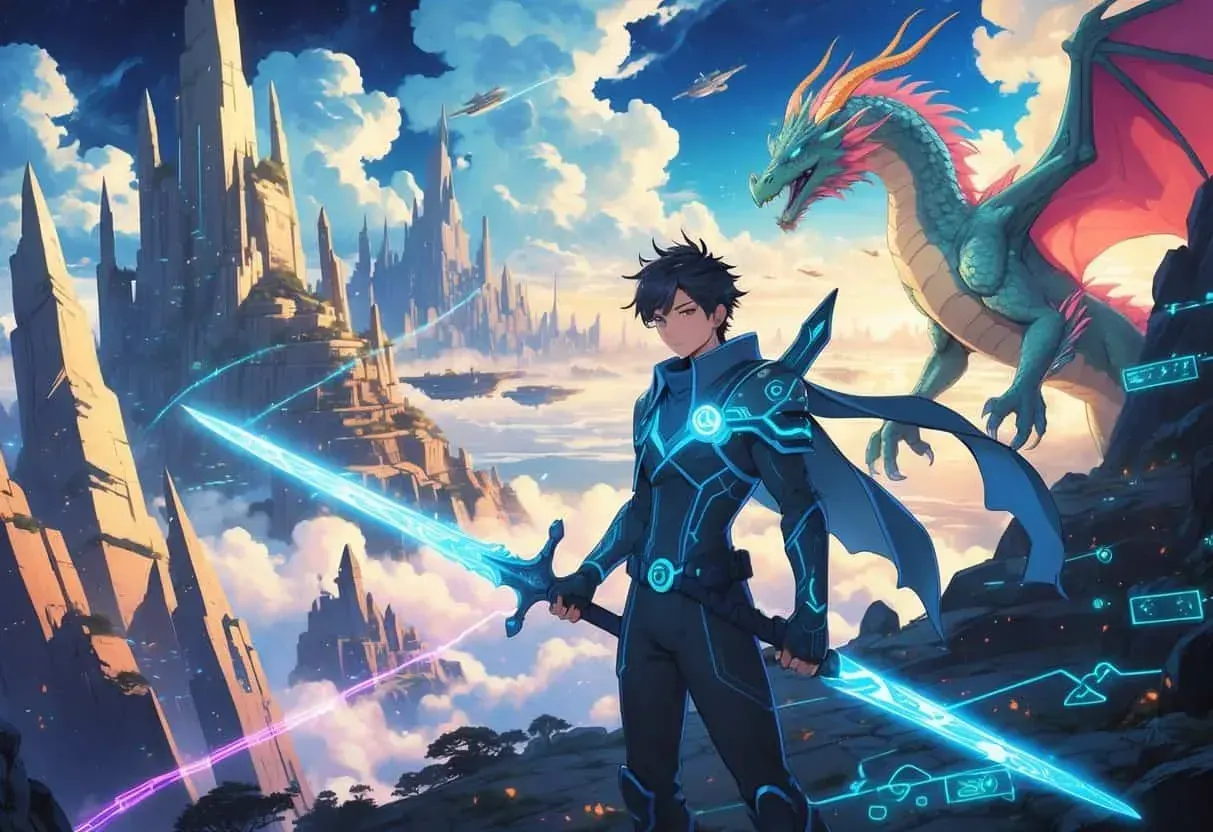
Anime that blend science fiction and fantasy deliver worlds where glowing circuit boards sit beside ancient spellbooks, and starships hum with magic-infused engines. These hybrid stories break away from rigid genre boundaries, letting you experience futures shaped by both technological breakthroughs and the inexplicable power of myth. The result feels fresh, unpredictable, and often more emotionally resonant than either genre working alone. Shows like Made in Abyss treat lost relics as somewhere between machine and miracle, while Neon Genesis Evangelion pits biomechanical giants against entities that blur the line between alien and angel. If you find comfort in logical systems but crave the wonder of the supernatural, these anime invite you into a narrative sweet spot that few other mediums deliver so naturally.
This fusion isn’t just about spectacle. It opens doors to complex questions about identity, progress, and the limits of human understanding. When a character wields a laser rifle and a magical ward side by side, the story can explore how we reconcile empirical truth with belief. It’s a creative playground where the rules of physics can be bent by a spell, and where an enchanted sword might be forged from a fallen satellite. The genre encourages you to stay curious, to accept that the unknown might be both scientifically explainable and deeply mystical.
And that curiosity keeps viewers hooked episode after episode.
What Makes the Blend Work So Well
Defining the Tropes of Each Genre
Science fiction tends to anchor itself in technology, futurism, and speculative extrapolation. You'll encounter starships, artificial intelligence, cybernetics, and temporal mechanics. The genre asks “what if?” about the trajectory of human innovation. Fantasy, on the other hand, draws from folklore, magic systems, and worlds that operate on supernatural logic. You’ll find elemental powers, enchanted objects, mythical creatures, and quest narratives steeped in destiny.
When these two collide, anime often treats advanced tech as a form of magic—post-apocalyptic societies might view ancient machinery as sacred relics, while a futuristic city could be powered by a sleeping dragon sealed beneath the metropolis. The tropes don’t just coexist; they interlock to create layered storytelling.
Seamless Integration Through Shared Ideas
What makes the blend feel effortless is that both genres ask similar philosophical questions in different costumes. Sci-fi explores what it means to be human through the lens of machinery and data; fantasy does the same through the concept of the soul or a divine spark. Anime like Ghost in the Shell tackle consciousness using cyberbrains and “ghosts,” yet the language often dips into metaphysical territory reminiscent of Shinto animism. The result is a narrative where a robot’s AI can be interpreted as a spirit, and a hacker’s intrusion feels like possession. By framing high-tech events in mystical terms—and vice versa—creators sidestep the coldness of pure sci-fi and the vagueness of pure fantasy.
You get grounded stakes wrapped in awe-inspiring mystery.
Cultural and Mythological Roots
Japan’s cultural landscape is particularly fertile ground for this mash-up. Shinto tradition imbues everything from rocks to rivers with spiritual essence, which aligns easily with sci-fi narratives about sentient machines or data ghosts. Folklore about yokai and celestial beings slips into cyberpunk alleys, while bushido codes of honor manifest in mecha pilots who treat their giant robots as extensions of their own warrior spirits. The influence runs so deep that many series don’t even acknowledge a boundary between the scientific and the supernatural. It’s simply how their worlds function—a perspective that feels organic and invites you to reconsider your own assumptions about technology and myth.
Essential Anime That Master the Sci-Fi Fantasy Fusion
Neon Genesis Evangelion: Mecha as Metaphysical Battlegrounds
Neon Genesis Evangelion radically reinterprets the giant robot genre by turning its mecha into psychological prisons. The Evas are biomechanical constructs piloted by teenagers who must synchronize their minds with the machines, blurring the line between pilot and weapon. The enemies they face, Angels, arrive with geometric perfection and destructive capabilities that read as both alien attack and apocalyptic prophecy. Hideaki Anno’s series uses cutting-edge science—cloning, neural links, energy weapons—while layering in Kabbalistic symbolism, religious iconography, and existential dread. The blend makes every battle feel like a crisis of the soul, forcing you to question whether the real threat is the monster outside or the trauma within.
The show’s legacy is a masterclass in how sci-fi infrastructure can channel deeply fantasy-infused, mythological storytelling without losing its hard edge (watch on Crunchyroll).
Ghost in the Shell: Digital Ghosts and Spiritual Code
Masamune Shirow’s Ghost in the Shell envisions a future where full-body cyberization is commonplace, yet the central mystery revolves around the “ghost”—the elusive essence of consciousness that dwells within a prosthetic frame. Major Motoko Kusanagi hunts cyber-criminals while wrestling with her own identity: if memories can be hacked and bodies swapped, what remains of the self? The series answers that question by drawing on Buddhist and Shinto concepts of a spirit that transcends physical form. Mamoru Oshii’s 1995 film amplifies this by pacing the police procedural through long, contemplative sequences that feel more like a philosophical treatise than a sci-fi thriller. The resulting atmosphere is both futuristic and ancient—a world where data streams might carry ancestral whispers, and AI can evolve into something resembling a god.
Akira: Psychic Children and Crumbling Megacities
Katsuhiro Otomo’s Akira exploded onto screens with a vision of Neo-Tokyo that is as much a hellscape of urban decay as it is a showcase of technological excess. Secret government experiments unlock psychic abilities in test subjects, leading to telekinetic rampages that warp reality itself. The science is portrayed as military hardware, cryogenic containment, and laser rifles, yet the story feels lifted from a dark myth—a terrifying genesis of a new kind of being that topples skyscrapers with a thought. Otomo merges hard-edged cyberpunk with cosmic body horror, leaving you to grapple with the notion that the most advanced science might be indistinguishable from divine—or demonic—power. The film’s hand-drawn animation remains a staggering visual achievement, its themes of unreliable systems and unchecked evolution still influencing creators worldwide.
Made in Abyss: Ancient Technology in a Supernatural Chasm
At first glance, Made in Abyss seems like a whimsical journey into a giant, mysterious pit. Orphan Riko descends with her robot friend Reg, armed with relics that function like high-tech salvage gear. Yet the Abyss itself operates on magical logic: strange force fields, unpredictable curses, and creatures that defy evolutionary explanation. The deeper they go, the more the line between natural law and fantasy blurs. Reg’s gadgets—extendable arms, an energy cannon—are technological in design, but the narrative treats them as inherited gifts from a lost civilization whose science was so advanced it became indistinguishable from sorcery.
The series’ real punch lies in its contrast between innocent curiosity and the brutal costs of discovery, making every artifact a potential key to both wonder and tragedy (read more on the fusion).
The Vision of Escaflowne: Dragons, Destiny, and Mechanized Knights
The Vision of Escaflowne catapults high schooler Hitomi to the planet Gaea, where she lands amid feudal kingdoms, sorcerers, and mythical beasts—and also giant suits of armor called Guymelefs. These mecha aren’t cold steel robots; they’re powered by dragon hearts and shaped like medieval knights, complete with capes and enchanted weaponry. The story seamlessly folds tarot reading, fate manipulation, and dragon-slaying into a world that also features scientific trappings such as floating fortresses and energy engines. Hitomi’s own latent psychic ability becomes a tactical tool, bridging prophecy with military strategy. The show’s sprawling epic never feels chaotic because it grounds every supernatural twist in character-driven stakes, proving that romance and combat are both elevated when mecha feel like mythical allies.
Code Geass: Rebellion Fueled by Forbidden Power
In Code Geass, a teenage revolutionary named Lelouch receives a supernatural ability—the power of absolute command through eye contact—and uses it to wage war against a militaristic empire that dominates the globe with advanced Knightmare Frames. The series constructs a world riddled with political intrigue, mecha engineering, and tactical mind games, then introduces “Geass” abilities that rewrite free will. Magic steps into a science fiction theater, turning every chess-like maneuver into a question of ethical consequence. The juxtaposition feels exhilarating: one moment you’re studying energy shields and mind-machine interfaces, the next you’re pondering whether a cursed power can ever be used for justice. Lelouch’s journey interrogates the messianic archetype through a lens of cold strategy and supernatural burden.
A Certain Magical Index: Academy City’s Dual Reality
Set in a metropolis dedicated to scientific research, A Certain Magical Index divides its citizens into espers—whose abilities arise from brain development and quantum theory—and magicians who chant incantations rooted in religious tradition. Protagonist Touma Kamijou’s right hand, Imagine Breaker, negates both science-based psychic effects and magical spells, forcing a constant confrontation between worldviews. The series treats magic and science as parallel systems that rarely interact until they violently collide in the streets. Its real strength lies in worldbuilding that meticulously explains esper rankings next to the principles of Kabbalistic magic, inviting you to see each faction’s logic before the inevitable chaos ensues. The show’s sprawling cast and interlocking arcs keep the tension between rationality and wonder crackling across every season.
Hybrid Anime at a Glance
| Title | Sci-Fi Elements | Fantasy & Mythical Features | Why the Blend Resonates |
|---|---|---|---|
| Neon Genesis Evangelion | Biomechas, neural interfaces, cloning | Angels as biblical entities, soul mechanics | Psychological horror meets apocalyptic prophecy |
| Ghost in the Shell | Cybernetic bodies, hacking, AI | Ghost as spirit, philosophical dualism | Consciousness explored through scientific and spiritual lenses |
| Akira | Military experimentation, dystopian tech | Psychic power as transcendence, body horror | Technological hubris with mythic fallout |
| Made in Abyss | Relic gear, robots, curious science | Abyssal curse, creatures akin to spirits | Discovery as a layered descent into dark fantasy |
| The Vision of Escaflowne | Guymelefs, floating fortresses, energy tech | Dragons, tarot, fate-warping powers | Chivalric romance threaded with mecha warfare |
| Code Geass | Knightmare Frames, global surveillance | Geass abilities, immortal beings | Strategic rebellion with a magical moral core |
| A Certain Magical Index | Esper phenomena, Academy City tech | Grimoires, saint lore, church militants | Clash of scientific and religious power systems |
Narrative Techniques That Fuse Two Worlds
Worldbuilding Through Contrast and Consistency
The most successful sci-fi fantasy anime build internal logic that honors both sides. You’ll notice careful detail: a spell might need a power cell to activate, or a spaceship’s navigation system might rely on star charts inscribed with runes. This isn’t just decorative; it creates a coherent reality where characters must weigh technical specs against ancient pacts. Creators often map out the exact ways magic interfaces with electronics—sometimes they nullify each other, sometimes they amplify—to avoid hand-waving. That rigor lets you invest in the stakes, because you understand the limitations and costs.
When a character in Made in Abyss loses an artifact to a curse field, it hurts because you’ve seen the item’s scientific value as well as its sentimental magic.
Character Arcs That Cross the Genre Divide
Protagonists in these hybrids often undergo transformations that are both psychological and physical, blurring genre lines. A mecha pilot might absorb a mystical energy source and begin to perceive data as visions, or a magician might surgically implant a machine that enhances spellcasting at a terrible personal price. These shifts keep character growth unpredictable. The inner conflict typically mirrors the external clash: a character struggling to reconcile a logical mind with an inherited gift embodies the larger theme of technology meeting myth. By rooting the fusion in a person’s journey, the series makes abstract ideas feel immediate.
You care whether Shinji reconciles his sense of self with the Evangelion because the mecha itself feels like a spiritual conduit, not just a war machine.
The Power of Everyday Moments
Even in chaotic worlds, slice-of-life interludes give you breathing room. A series might pause an intergalactic conflict for a scene of characters cooking together with both replicated ingredients and herbs infused with protective charms. These quiet moments deepen attachment to the cast and highlight the everyday normality that persists despite cosmic strangeness. They also serve as subtle worldbuilding: you learn that a futuristic city still observes ancient seasonal festivals, or that a magical academy has a tech support department. This balance prevents the setting from feeling like a sterile sandbox and reminds you that the characters are still people navigating lives shaped by dual forces.
It’s often these small, human details that linger longest after the credits roll.
Lasting Influence and How to Dive In Today
Directors Who Defined the Hybrid
A handful of visionary creators cemented the sci-fi fantasy blend as a mainstay. Mamoru Oshii infused his cyberpunk works with meditative pacing and thematic echoes of spiritual isolation, proving that existential questions could weave seamlessly into police procedurals. Katsuhiro Otomo’s Akira demonstrated how meticulous world-building and hyper-detailed animation could make psychic cataclysm feel both scientifically plausible and mythologically weighty. Their influence persists in modern directors who aren’t afraid to let magic seep into steel corridors or to give a robot a soul that you can feel. Recognizing their contributions helps you spot the lineage in newer titles—when a series treats data archives like holy scripture, you’re seeing Oshii’s fingerprints.
Modern Series Carrying the Torch
Today’s anime continue pushing the fusion in bold directions. Shows like 86: Eighty-Six place drones operated with psychic resonance on a battlefield that feels like a cursed realm, while Deca-Dence literally builds a fantastical fortress atop a colossal moving city, blurring digital avatars with gearpunk critters. These series don’t just replicate the formula; they reimagine it for contemporary audiences, using updated animation techniques to render spells as data streams and gods as hyper-advanced algorithms. The result is a living genre that feels as experimental as it did decades ago, proving that the appetite for stories where magic and machinery coexist won’t fade.
Streaming and Physical Media Guide
Accessing these titles has never been easier. Major platforms like Crunchyroll and Funimation carry extensive catalogs, often adding classic films and complete series in remastered quality. Netflix hosts select exclusives and international releases, while HIDIVE and Amazon Prime occasionally offer rare gems. For collectors, Blu-ray editions frequently include insightful documentaries and artbooks that delve into the design philosophy behind the hybrid worlds. A physical copy of Akira or the Ghost in the Shell anniversary set can be a rewarding investment, offering crisp picture quality that streaming compression can’t always match.
Whether you prefer the convenience of a subscription or the tactile joy of a disc, there’s a path to explore the best of sci-fi fantasy anime on your terms.
Why This Fusion Keeps Evolving
The sci-fi fantasy hybrid endures because it mirrors our own reality: we live in an age of smartphones and space telescopes, yet still celebrate solstices and tell ghost stories. Anime that marry technology and magic reflect an intuitive truth—that human beings rarely draw harsh lines between what can be measured and what can be felt. These series invite you to embrace uncertainty, to find logic in myth and wonder in machinery. Each time a new show spins up a world where a spell requires a circuit board, or where a starship’s heart is a captive spirit, it reminds you that storytelling’s greatest power is to collapse artificial boundaries. The best sci-fi fantasy anime don’t just entertain; they reshape the way you see the very categories you use to make sense of a beautifully messy world.