Table of Contents
A Window Into Japanese Work Culture
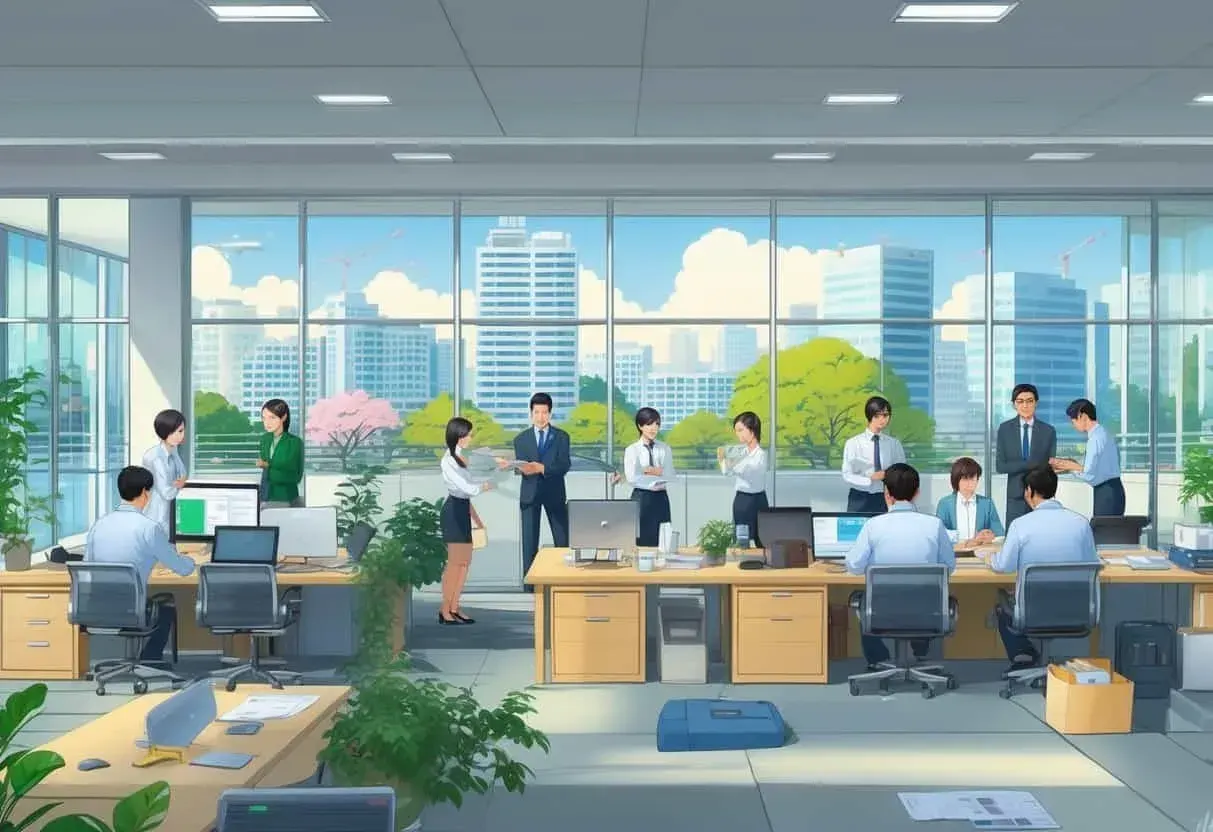
Anime is often associated with fantastical narratives, but a number of series offer an unflinchingly raw look at Japanese work culture. These anime dig into the daily grind, the unique challenges, and the unspoken rules that shape Japanese workplaces. They provide a window into the pressures, the profound dedication (sometimes to a fault), and the subtle social choreography of office life in Japan. From the temporary worker counting minutes until her shift ends to the middle manager navigating office politics with a strained smile, the emotional landscape is meticulously rendered.
Watching these stories, you begin to understand how work bleeds into nearly every aspect of life. Themes like collective responsibility, marathon shifts, and the constant tug-of-war between personal identity and career success appear again and again. The narratives don’t exoticize the system; they expose its cracks—showing how the expectation to prioritize the group over the self can corrode spirit and health. If you’re curious about Japanese society or simply crave something more grounded than typical high-concept anime, these titles are essential viewing.
Key Takeaways
- Some anime accurately capture the systemic realities of Japanese work environments, from entry-level insecurity to burnout.
- They reveal social and job-related challenges—power dynamics, communication nuances, and the weight of unseen expectations.
- Realistic details, from train commutes to business etiquette, add depth and cultural insight that transcend mere entertainment.
The Anatomy of the Japanese Workplace in Anime
Anime doesn’t shy away from the granular texture of office life. Whether it’s a traditional corporation, a public sector team, or a makeshift postwar economy, the portrayals consistently highlight long hours, vertical hierarchies, and a necessary sense of humor just to survive the grind. What emerges is a composite picture of a system that prizes harmony and hard work, yet often at the cost of individual well-being. These narratives function almost as documentary fiction, holding up a mirror to real-world practices that millions navigate every day.
The Salaryman: A Symbol of Devotion and Exhaustion
The “salaryman” is an enduring character archetype—the male white-collar worker whose loyalty to the company often eclipses everything else. You see him in countless series, suit slightly rumpled, riding a packed commuter train, working late into the night. He isn’t just a stereotype; he reflects the real stories of overtime, mandatory socializing, and the slow erosion of work-life balance. Scenes of salarymen grabbing a quick standing meal, nodding off on the train, or stealing a few minutes with family make it tangible: the relentless demands of a system that expects total dedication. The nomikai (after-work drinking party) becomes a second office where true hierarchies are reinforced over glasses of beer.
For a deeper look at this cultural fixture, see Nippon.com’s analysis of the salaryman.
Vertical Hierarchy: Respect, Language, and Power Plays
Japanese offices are steeped in hierarchy, and anime translates this visually and linguistically. Characters bow, use honorific speech (keigo), and carefully choose words when addressing a superior. The term senpai (senior) isn’t just a label—it defines a relationship of mentorship and deference. Power struggles simmer beneath polite surfaces; younger employees must navigate a labyrinth of unspoken rules. Sometimes they clash openly with a rigid boss, other times they learn by observing.
Even the arrangement of seats in a meeting room can signal one’s standing. This dance of authority and submission shapes everything from project assignments to who pours the drinks at after-work gatherings, painting a complex picture of organizational life where a misstep in protocol can carry lasting consequences.
Finding Humor in the Grind
Stress is a constant companion, but anime frequently wields humor as a coping mechanism. There’s comedy in endless meetings that could have been an email, in mandatory karaoke sessions with the boss, and in the absurd clash between corporate formality and human spontaneity. Some series lampoon the “work until you drop” ethos with exaggerated visual gags, yet beneath the laughter lies a sharp critique of an unsustainable culture. The humor acts as a release valve, allowing characters—and viewers—to process the frustration and exhaustion that come with the territory. This blend of levity and commentary makes the heavier themes palatable and even relatable, turning a grim reality into something that can be examined without despair.
Four Anime That Unpack Japan’s Labor Landscape
To appreciate the breadth of these portrayals, it’s worth examining specific titles that tackle work from vastly different angles—postwar survival, fantasy service industries, high-tech policing, and dystopian urban chaos. Each one uses its unique setting to magnify a particular dimension of Japan’s relationship with labor.
Grave of the Fireflies: Postwar Survival and the Meaning of Work
Grave of the Fireflies (Isao Takahata, 1988) is not a traditional “workplace” anime; it’s a devastating portrait of two siblings struggling to survive in the waning days of World War II. Here, work is stripped bare: scavenging for food, bartering belongings, doing whatever it takes when social systems collapse. The protagonist, Seita, attempts odd jobs and relies on rationed handouts, a stark contrast to the structured employment of peacetime. The aunt with whom they briefly stay embodies a harsh, transactional view of familial obligation—her increasing coldness mirrors an economy where resources are scarce and sentiment an unaffordable luxury. The film’s unflinching realism shows how economic breakdown redefines labor as sheer subsistence.
It’s a sobering reminder that the very concept of a “job” is a fragile social construct, and that the loss of infrastructure turns every waking hour into a fight for existence.
Spirited Away: The Bathhouse as a Corporate Microcosm
In Hayao Miyazaki’s Spirited Away (2001), the bathhouse run by the witch Yubaba operates exactly like a Japanese company. There’s a clear chain of command, rigid roles, and a probationary period for new hires like Chihiro. She starts at the bottom, stripped of her name—symbolizing the loss of personal identity often experienced by new recruits. She must earn her place through hard work, learning to serve even the most difficult customers (spirits). The bathhouse buzzes with teamwork, but also with petty rivalries, exploitation, and the constant pressure to perform.
The stink spirit episode, where Chihiro must clean a disgustingly polluted river god, mirrors the reality of entry-level workers tackling the messes that seniors avoid. Miyazaki’s fantastical setting is universally recognized as a metaphor for Japan’s labor market, something explored in detail by The Conversation.
Ghost in the Shell: High-Tech Professionalism and Human-Machine Teams
Ghost in the Shell (Mamoru Oshii, 1995) projects workplace dynamics into a cyberpunk future where Public Security Section 9 operates as an elite, tech-integrated unit. The team exhibits a flat hierarchy in action, yet the chain of command remains ironclad when decisions are made. Specialists work with cybernetic enhancements, blurring the line between human intuition and machine efficiency. The anime delves into the ethics of such a workforce: how much augmentation is acceptable before one loses humanity? Despite the sci-fi trappings, the office politics, inter-departmental friction, and the weight of bureaucratic oversight feel thoroughly contemporary.
The emergence of the Puppet Master as a new form of artificial intelligence hints at a future where the “employee” might not even be biological—raising questions about loyalty, autonomy, and the very definition of work. It’s a prescient study of how professionalism and collaboration function when your body can be upgraded like software.
Akira: Urban Chaos and Employment Insecurity
Katsuhiro Otomo’s Akira (1988) paints a Neo-Tokyo rife with social unrest, where work is precarious and often tied to the black market or military-industrial complex. The teenage protagonists, members of a bike gang, aren’t clocking in at offices; they’re navigating a crumbling city where legitimate jobs are scarce. The pervasive atmosphere of instability—riots, government corruption, psychic mutations—seeps into every economic interaction. Labor here is a means of survival, but also a path into danger. The film resonates strongly with the post-bubble generation’s anxieties about a world where secure employment seems like a mirage.
Akira doesn’t just show unemployment; it conveys the emotional toll of living in a society where the future is a giant question mark, mirroring the pervasive precarity that many real workers felt during Japan’s lost decades.
Each of these works exposes a different facet of labor: from the personal toll of economic collapse to the psychological strain of conforming to a rigid corporate identity. They refuse to offer easy solutions, instead holding up a mirror to a society where work defines self-worth and stability is never guaranteed.
Myth, Folklore, and Otaku Identity: Deeper Cultural Threads
Beyond the surface of daily tasks, many work-themed anime weave in traditional beliefs, folk narratives, and the contemporary otaku subculture, adding layers of meaning to the labor narrative. These elements ground the stories in something older and often more visceral than modern corporate jargon.
Supernatural Beings as Workplace Metaphors
Anime frequently populates the office with gods, spirits, and mythological creatures that act as stand-ins for real-life pressures. In Pom Poko, tanuki (raccoon dogs) use shape-shifting abilities to navigate a world of human encroachment—an apt metaphor for how workers must constantly adapt to shifting corporate strategies and office politics. Trickery and sudden upheaval become embodied in these mischievous beings. Traditional ghost stories (kwaidan) are repurposed to represent fear, uncertainty, or the haunting presence of failure in the workplace. By wrapping mundane anxieties in supernatural garb, these stories give viewers a safe way to examine the invisible forces that govern their professional lives—the boss who seems omniscient, the colleague who sabotages from the shadows, the arbitrary policy that looms like a vengeful spirit.
Folk Heroes and the Values of Perseverance
Japan’s rich folklore—with its legendary figures of unyielding perseverance—casts a long shadow over the portrayal of work. Characters inspired by Mighty Atom (Astro Boy) embody the spirit of tireless effort and hope, even when the odds are catastrophic. This reflects the deeply ingrained cultural values of gaman (endurance) and giri (duty). In anime, the silent acceptance of overwhelming workloads and the refusal to quit can be traced directly back to these archetypes. The folkloric hero does not complain; he simply works harder, a message that resonates powerfully, for better and for worse, in the real world.
These narratives critique as much as they celebrate, exposing how such stoicism can enable exploitation while also acknowledging the dignity in dedicated effort.
Otaku Life Meets the Office: Passion vs. Professionalism
The intersection of otaku interests and standard office life is a rich seam of storytelling. Series like Wotakoi: Love is Hard for Otaku and Recovery of an MMO Junkie directly confront what happens when a person’s deep passion for anime, manga, or gaming bumps up against corporate expectations. Characters hide their hobbies to avoid stigma, or they find that their specialized knowledge gives them unexpected advantages—perhaps a knack for data visualization from years of MMO interface design. The tension between one’s “real” self and the professional persona is a universal theme, but in Japan, where conformity often feels mandatory, it takes on a particular poignancy. These narratives show both the friction and the occasional synergy between personal obsession and career identity, questioning whether true fulfillment can ever be found in a cubicle.
Global Influence and the Art of Translation
Anime that accurately reflects Japanese work culture doesn’t just inform domestic audiences; it shapes international perceptions. However, the journey across languages introduces significant nuance that can alter the intended meaning.
Lost in Translation: Navigating Nuance
Translating workplace anime is a delicate art. Subtle linguistic markers—changing verb forms to show respect, using a first name without an honorific—can carry the entire weight of a relationship shift but often evaporate in English. Dubbed versions tend to flatten hierarchies, while subtitles can preserve more context if the viewer is culturally literate. For instance, the distance between a brusque command and a politely couched request may be lost, altering the perception of a boss’s character. Scholars at MIT study how such translations shape cross-cultural understanding, noting that the best adaptations go beyond literal meaning to retain the social atmosphere of the original.
For those willing to learn a few key terms—senpai, salaryman, karōshi (death by overwork)—the insights deepen dramatically, turning passive viewing into active cultural study.
Japanese Work Concepts in International Pop Culture
Anime’s depiction of work has spilled over into global pop culture in surprising ways. The image of the exhausted but dedicated office worker has become a meme, the after-work drinking party a recognizable trope. Even small, authentic details—a character eating sushi from a convenience store during lunch, or the sight of meticulously organized desks—paint a vivid picture of daily life. Terms like “karōshi” have entered the international conversation, a topic examined in-depth by the BBC. Viewers across the globe find themselves reassessing their own work habits and organizational cultures, often with a newfound appreciation for the complexities of the Japanese model.
As a result, anime becomes more than entertainment; it’s a lens through which we examine our own relationship with work, ambition, and burnout.
What These Stories Teach Us About Work
Through their varied lenses—historical tragedy, fantasy allegory, cyberpunk thriller, and urban dystopia—these anime offer a nuanced education in Japanese work culture. They don’t romanticize the system; instead, they reveal its cracks and contradictions. They show that the pressure to conform, the weight of seniority, and the erosion of personal time are universal concerns dressed in culturally specific clothing. By engaging with these stories, we gain empathy for the salaryman, the junior employee, and even the magical bathhouse worker, because at the heart of it all is a very human struggle to find meaning in what we do—and to survive the hours in between. The anime remind us that a paycheck is never just a paycheck; it’s an identity, a source of pride, and sometimes a slow-burning crisis.
That realism, rendered with artful precision, is why these titles endure.