Table of Contents
The Dawn of Anime on Latin American TV
For generations of viewers across Latin America, anime was never just another import; it was a fixture of daily life, woven into the fabric of afternoon programming blocks and late-night broadcasts. While many fans trace the explosion of anime fandom to a single series in the mid-1990s, the seeds were planted decades earlier, when regional broadcasters discovered a cost-effective way to fill hours of airtime with Japanese animation. The story of anime on Latin American television is one of serendipitous discovery, passionate localization, and a cultural resonance that transformed what could have been disposable entertainment into a permanent pillar of pop culture.
Long before streaming platforms made thousands of titles available at the push of a button, the anime that reached Latin American homes arrived through a patchwork of local channels, cable networks, and public television stations. The journey from obscure import to mainstream sensation took years, shaped by economics, censorship (or the surprising lack thereof), and a generation of young viewers who would come to define their childhoods through the exploits of Saiyans, knights, and ninjas.
From Filler Content to Mainstay
During the 1960s and 1970s, many Latin American television stations operated on tight budgets. Imported animation from Japan was often substantially cheaper than producing original local programming or licensing high-profile American cartoons. This cost advantage led programmers to acquire series that, in many cases, had already been dubbed into English for other markets and could be redubbed locally with minimal investment. Early arrivals such as Kimba the White Lion (known as Kimba, el León Blanco), Speed Racer (Meteoro), and various Tatsunoko productions aired across countries like Mexico, Brazil, Argentina, and Chile, mostly in after-school or weekend morning timeslots.
These shows were presented to audiences with little fanfare or marketing. Most viewers had no concept of “anime” as a distinct category; they simply saw colorful cartoons that often featured more serialized storytelling and higher emotional stakes than their Western counterparts. The lack of heavy-handed censorship in many Latin American markets meant that themes of death, sacrifice, and moral complexity could remain largely intact, a characteristic that would set anime apart and help it build a loyal following over time.
By the mid-1980s, Robotech—a re-edited fusion of three unrelated Japanese series—had demonstrated that long-form animated narratives could captivate audiences beyond a single episode. Its broadcast in Mexico and Brazil, among other countries, introduced viewers to the idea that a cartoon could tell a continuous, dramatic story with evolving characters and real consequences. This was a pivotal shift in perception, laying the psychological groundwork for the phenomenon that was just around the corner.
Censorship and Authenticity
One of the defining features of anime’s early history in Latin America was the relative absence of the stringent editing and content removal that characterized its treatment in the United States during the same period. While North American broadcasts often scrubbed references to death, religion, or even romantic tension, Latin American versions typically kept these elements intact. This allowed shows like Sailor Moon to present its full cast of complex characters—including the openly lesbian relationship between Sailor Uranus and Sailor Neptune, which was frequently obscured or altered elsewhere—without significant distortion. The result was a viewing experience that felt more authentic, more emotionally mature, and more worthy of serious attention.
That authenticity paid dividends as audiences matured. Fans who grew up watching anime with its original narrative integrity intact became lifelong devotees, eager to share their passion with younger siblings and eventually their own children. The regional approach to content preservation wasn’t a deliberate cultural statement; often it was simply a byproduct of limited oversight and a lack of coordinated censorship policies. Whatever the reason, it cemented anime’s reputation as a medium capable of telling stories that other televised animation would not or could not touch.
The Golden Age: 1990s and 2000s
If the earliest decades planted the seeds, the 1990s and early 2000s brought a full-scale harvest. This was the era when anime transformed from a niche presence into a region-wide obsession, fueled by a handful of series that achieved near-mythical status. The explosion of cable television and the expansion of privately owned local channels gave programmers the bandwidth to experiment with more ambitious acquisitions, and the results were staggering.
Dragon Ball Z: The Catalyst
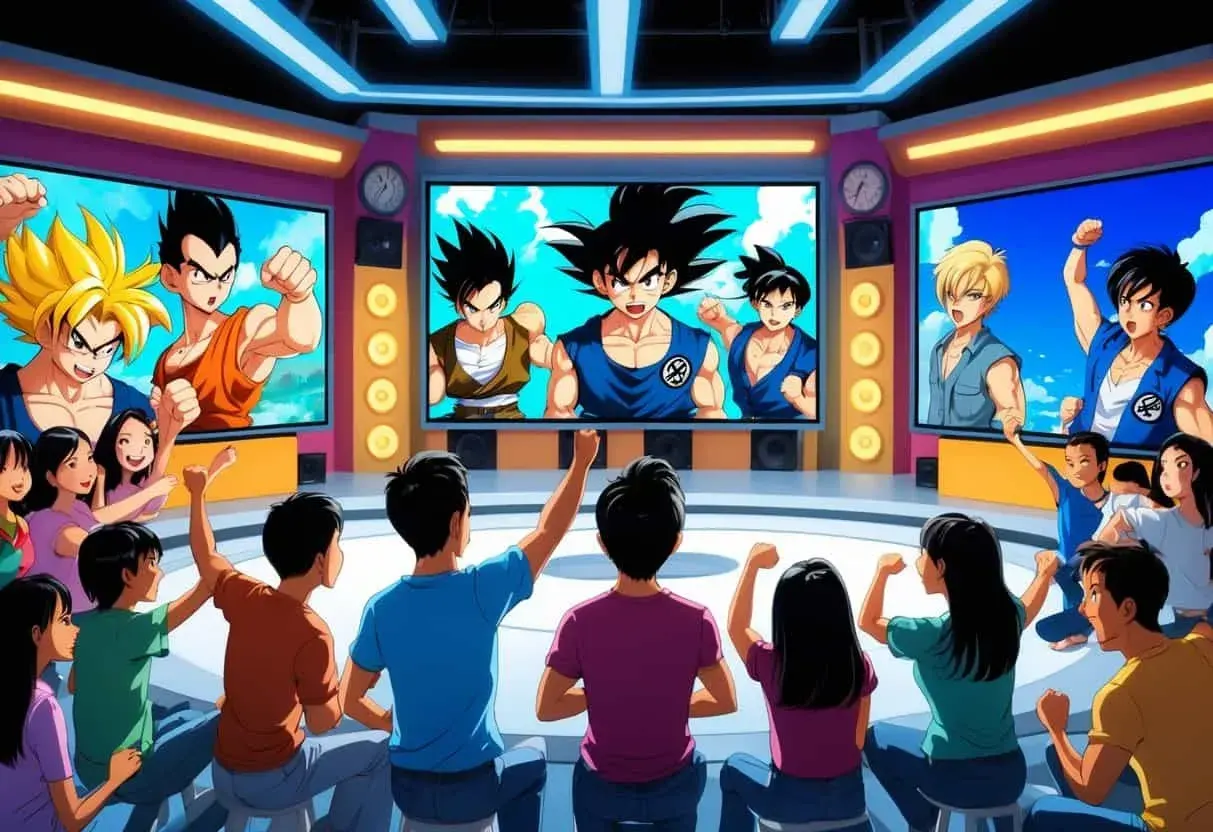
No single title defines the relationship between Latin America and anime more completely than Dragon Ball Z. Akira Toriyama’s martial arts epic, which premiered in Japan in 1989, began airing across Latin America in the early 1990s, and it didn’t merely attract viewers—it ignited a cultural movement. The story of Goku, a cheerful warrior with an unquenchable thirst for self-improvement, resonated deeply with audiences raised on tales of perseverance and underdog triumph. The series’ unprecedented run on channels like Mexico’s Canal 5 and Brazil’s Rede Globo turned afternoons into communal events, with children racing home from school to catch the latest episode.
The Latin American Spanish dub, produced at Intertrack in Mexico and featuring the legendary voice of Mario Castañeda as Goku, became iconic in its own right. Castañeda’s performance captured Goku’s blend of innocence and fierce determination so perfectly that many fans to this day consider it the definitive version of the character. The Brazilian Portuguese dub, too, developed a devoted following, with voice actors like Wendel Bezerra becoming household names. Dragon Ball Z was more than a show; it was a shared language. Its impact is still visible in street art, merchandise, and the frequency with which its signature power-up sounds are referenced in local comedy and conversation.
The franchise’s longevity has proven remarkable. Beyond the original series, Dragon Ball Super reignited interest among a new generation, and theatrical releases like Dragon Ball Super: Broly packed cinemas from Mexico City to Buenos Aires. The series demonstrated that anime could be a multigenerational bonding experience, with parents who once watched Goku’s adventures now introducing their children to the same tales.
Saint Seiya and Knights of the Zodiac
While Dragon Ball Z dominated ratings, another series carved out a profoundly loyal following that, in some countries, rivaled or even surpassed its popularity. Saint Seiya, known across the region as Los Caballeros del Zodiaco (Cavaleiros do Zodíaco in Brazil), combined Greek mythology with spectacular armored battles and heart-wrenching melodrama. The concept of young warriors swearing allegiance to constellation-inspired gods and risking everything for friendship and honor struck a chord that has never really faded.
In Brazil, Saint Seiya became a veritable institution. The manga’s release, followed by the anime’s broadcast on Rede Manchete in the mid-1990s, sparked a merchandise frenzy that included everything from action figures to school supplies. The series’ philosophical undertones, sacrificial themes, and intricate battle strategies appealed to older viewers who might otherwise have dismissed cartoons as childish. Its influence is evident in the generation of Brazilian creators who cite Saint Seiya as a primary inspiration, and in the enduring popularity of its soundtrack and character designs.
Naruto and One Piece Expand the Horizon
As the 2000s unfolded, two colossal shonen series arrived to widen anime’s demographic reach even further. Naruto, with its tale of an ostracized young ninja seeking acknowledgment, mirrored the adolescent struggles of millions of viewers. The series’ emphasis on hard work, emotional vulnerability, and the rejection of societal expectations gave it a relatable core that transcended language barriers. The Spanish dub, featuring voices like Isabel Martiñón as Naruto, became as beloved as any previous classic, and the story’s long arc—from childhood to adulthood—allowed fans to grow alongside the characters.
At the same time, One Piece began its epic voyage across Latin American television. Monkey D. Luffy’s unyielding optimism and his crew’s diverse dreams offered a sprawling, endlessly creative world that rewarded long-term commitment. While it took some markets longer to embrace the series fully, One Piece eventually cemented itself as a pillar of regional anime fandom, its themes of freedom and found family resonating across cultural lines. Both Naruto and One Piece demonstrated that the anime boom was not a passing fad but an ever-expanding frontier.
The Modern Era: 2010s to 2020s
By the early 2010s, the media landscape was already shifting dramatically. Piracy had long played a significant but unofficial role in anime distribution, as fan-subbed episodes circulated online within hours of their Japanese broadcast. But the arrival of legitimate streaming platforms began to restructure how anime was consumed, marketed, and monetized in Latin America. The region’s passionate fanbase became a proving ground for global streaming strategies, and new titles seized the opportunity to capture imaginations in a rapidly evolving environment.
Attack on Titan and the New Wave
When Attack on Titan first aired in 2013, it immediately signaled a paradigm shift. The series’ bleak, high-stakes narrative, stunning animation, and morally ambiguous world challenged the assumption that anime was primarily for younger audiences. Its broadcast on channels like Adult Swim (Latin America) and its subsequent availability on streaming platforms drew in viewers who had never considered themselves anime fans. Suddenly, discussions about the walls, Titans, and the ethics of survival were everywhere—on social media, in workplaces, and among friend groups that spanned age brackets.
The show’s popularity in Latin America matched its global success, but with a particular intensity born of the region’s established anime culture. Fans debated plot twists in Spanish and Portuguese, cosplayers recreated the Survey Corps’ uniforms at conventions, and the series’ soundtrack became a staple of fan videos. Attack on Titan proved that a dark, complex story with graphic violence and philosophical depth could become a mainstream phenomenon in a region that had long embraced emotional storytelling. Its final season, which concluded in 2023, cemented its legacy as a modern classic and a watershed moment for anime’s cultural legitimacy.
Streaming Services and Simulcasts
The proliferation of streaming services has fundamentally altered anime’s footprint in Latin America. Dedicated platforms like Crunchyroll and Funimation (now merged under the Crunchyroll brand) have built extensive catalogs with Spanish and Portuguese subtitles and, increasingly, dubs. Netflix and Amazon Prime Video have invested heavily in exclusive anime content, while Disney+ has entered the fray with titles like the Star Wars: Visions anthology and various simulcast acquisitions. The result is a viewing ecosystem in which fans are no longer bound by television schedules or the unpredictable whims of local programmers.
Simulcast availability—where new episodes appear with subtitles within hours of their Japanese premiere—has been a game-changer. It has dramatically reduced the piracy that once served as the primary means of keeping up with current series, offering a convenient and affordable alternative. The widespread availability of high-quality dubs in both Spanish and Portuguese has, in turn, drawn in audiences who might otherwise be deterred by subtitles, further expanding the fanbase.
The competition among platforms has also driven investment in local content and targeted marketing. Crunchyroll’s Latin American social media presence, for example, actively engages fan communities with region-specific content, while Netflix promotes its anime catalog through collaborations with local influencers. This level of engagement would have been unimaginable during the era when anime was simply cheap filler for afternoon TV.
Genre Explosion: From Isekai to Slice of Life
The modern era has been defined not just by blockbuster action series but by a dizzying expansion of genres accessible to Latin American viewers. The isekai genre, in which protagonists are transported to alternate worlds, has become particularly popular, with titles like Re:Zero, That Time I Got Reincarnated as a Slime, and Mushoku Tensei attracting massive followings. Meanwhile, romantic comedies, slice-of-life dramas, and horror series have found dedicated audiences who appreciate the medium’s versatility.
The diversity of content has helped anime shed any lingering perception that it is solely about fighting and superpowers. Wholesome series such as Spy x Family have charmed families, while emotionally devastating shows like Your Lie in April have proven that animation can deliver deeply human, tear-jerking experiences. This breadth has turned anime into a truly mainstream entertainment option, capable of satisfying almost any mood or taste.
Localization: Dubbing, Subtitles, and Cultural Adaptation
The connection between anime and its Latin American audience has never been solely about the visual spectacle or narrative ambition. The region’s dubbing industry has played a pivotal role in bridging the cultural gap, turning Japanese dialogue into locally resonant performances that often become as iconic as the original voice work. The care and creativity that go into these adaptations have elevated dubbing from a mere translation exercise to an art form in its own right.
The Art of Spanish and Portuguese Dubs
Latin American anime dubs are renowned for their quality, emotional investment, and occasional creative liberties that enhance the viewing experience. Unlike some other markets where dubs are perceived as inferior substitutes, a significant portion of the Latin American fanbase actively prefers them, having grown up with the familiar voices that shaped their childhoods. Dubbing studios like Mexico’s Intertrack and AF The Dubbing House, as well as Brazil’s Álamo and UniDub, have long histories of producing work that captures not just the literal meaning of the dialogue but its emotional subtext.
The localization process often involves adapting jokes, idioms, and cultural references to make sense in a Latin American context. This can mean replacing a Japanese pun with a locally understood wordplay or adjusting cultural metaphors so that they land without explanation. When done well, this practice makes the material feel written specifically for the region, deepening the audience’s sense of ownership and connection.
Notable Voice Actors and Their Impact
The voice actors behind anime characters have achieved celebrity status in many Latin American countries. Mario Castañeda’s Goku is perhaps the most celebrated example, but countless others have left lasting impressions. For Brazilian fans, Wendel Bezerra’s portrayal of Goku and later SpongeBob SquarePants created a unique cross-media legacy. Voices like Gerardo Vázquez, who brought to life characters in Dragon Ball Z and Saint Seiya, and the late Jesús Barrero, whose work spanned decades of anime dubbing, are revered as foundational pillars of the industry.
Conventions regularly feature dubbing panels, where veteran actors recount stories behind the microphones and interact with fans who have memorized their every line. These individuals are not just anonymous studio workers; they are the human link between distant Japanese studios and millions of Latin American living rooms, and their contributions are celebrated with genuine affection.
Subtitles for Purists
Alongside the dubbed tradition, a robust subtitling culture has flourished, particularly in the digital era. English-speaking fans long relied on fan subbing to access series before official translations were available, and this tradition spread quickly to Spanish and Portuguese communities. Today, virtually every streaming platform offers subtitled versions for viewers who prefer to experience the original Japanese voice performances. Subtitles are especially popular among purists who appreciate the nuances of seiyuu (voice actor) delivery or who wish to avoid any adaptation alterations.
The availability of both subtitled and dubbed versions has created a flexible viewing environment that caters to all preferences. A younger fan might enjoy a Demon Slayer movie in Spanish at a local cinema, while a longtime enthusiast rewatches Cowboy Bebop in Japanese with Portuguese subtitles. This dual approach has broadened anime’s appeal without alienating either camp.
Anime’s Cultural Footprint in Latin America
The influence of anime extends well beyond the screen. In cities large and small across Latin America, the impact of Japanese animation can be felt in fashion, language, art, and social life. What began as television programming has evolved into a sprawling subculture that shapes identities and fosters community.
Conventions and Fandom
Anime conventions have become major cultural events throughout the region. Gatherings like the Anime Friends in São Paulo, La Mole Convention in Mexico City, and Anime Expo Santiago in Chile draw tens of thousands of attendees dressed as their favorite characters, participating in karaoke contests, and spending significant sums on merchandise and original art. These events are not just fan gatherings; they are economic engines and showcases for local talent, including illustrators, cosplayers, and musicians who blend Japanese pop culture with Latin American flavors.
Cosplay, in particular, has become a highly respected craft. Skilled cosplayers spend months constructing elaborate costumes, often achieving viral fame on social media platforms. The cross-pollination between anime fandom and local traditions occasionally leads to delightful fusions, such as mariachi-styled anime covers or samba-infused remixes of opening themes.
Influence on Fashion, Slang, and Music
Anime’s stylistic influence is visible in clothing trends across Latin American youth culture, from graphic t-shirts featuring iconic imagery to streetwear collections inspired by series aesthetics. Phrases like “kamehameha” or “bankai” have entered casual slang, understood even by those who have never watched a single episode. The crossover into music has been equally significant: regional artists like Peso Pluma have referenced anime in their lyrics, while concerts dedicated to anime opening and ending themes routinely sell out major venues.
This seepage into everyday life underscores anime’s deep integration into the region’s cultural DNA. For many young Latin Americans, growing up with anime means that its references are as natural as those from local telenovelas or football. It is not exotic or niche; it is homegrown.
Merchandise and Gaming
The commercial ecosystem around anime has flourished alongside its cultural acceptance. Licensed merchandise—from premium figures at specialty stores to bootleg postcards at street markets—is ubiquitous. The video game industry has also benefited enormously, with titles like the Dragon Ball FighterZ and the Naruto Shippuden: Ultimate Ninja Storm series enjoying massive popularity on consoles and at competitive gaming events. Anime-inspired mobile games and gacha titles have found fertile ground in a region with high mobile device penetration, generating millions in revenue and further entwining anime IP with daily habits.
Looking Ahead: The Future of Anime in the Region
The trajectory of anime in Latin America points toward continued growth and deeper integration. Streaming competition shows no signs of abating, which will likely result in even more licensed titles, faster dubbing turnaround, and a greater presence of anime in mainstream advertising and partnerships. Local production studios are beginning to explore co-productions with Japanese studios, and a handful of Latin American creators have already contributed to anime projects or published manga-influenced comics that resonate regionally.
Events like the Latin American Anime Summit and the expansion of Crunchyroll’s local offices signal that the industry views the region not just as a consumer base but as a creative partner. As the lines between global and local continue to blur, the next generation of fans may well be watching anime that features stories inspired by Latin American folklore, voiced by the same actors who gave life to Goku and Naruto.
From the humble afternoons of Robotech to the streaming-fueled global phenomenon of Attack on Titan, anime’s journey through Latin American television has been nothing short of transformative. It has shaped childhoods, bridged cultures, and built a legacy that now spans half a century—and its story is far from over.