Table of Contents
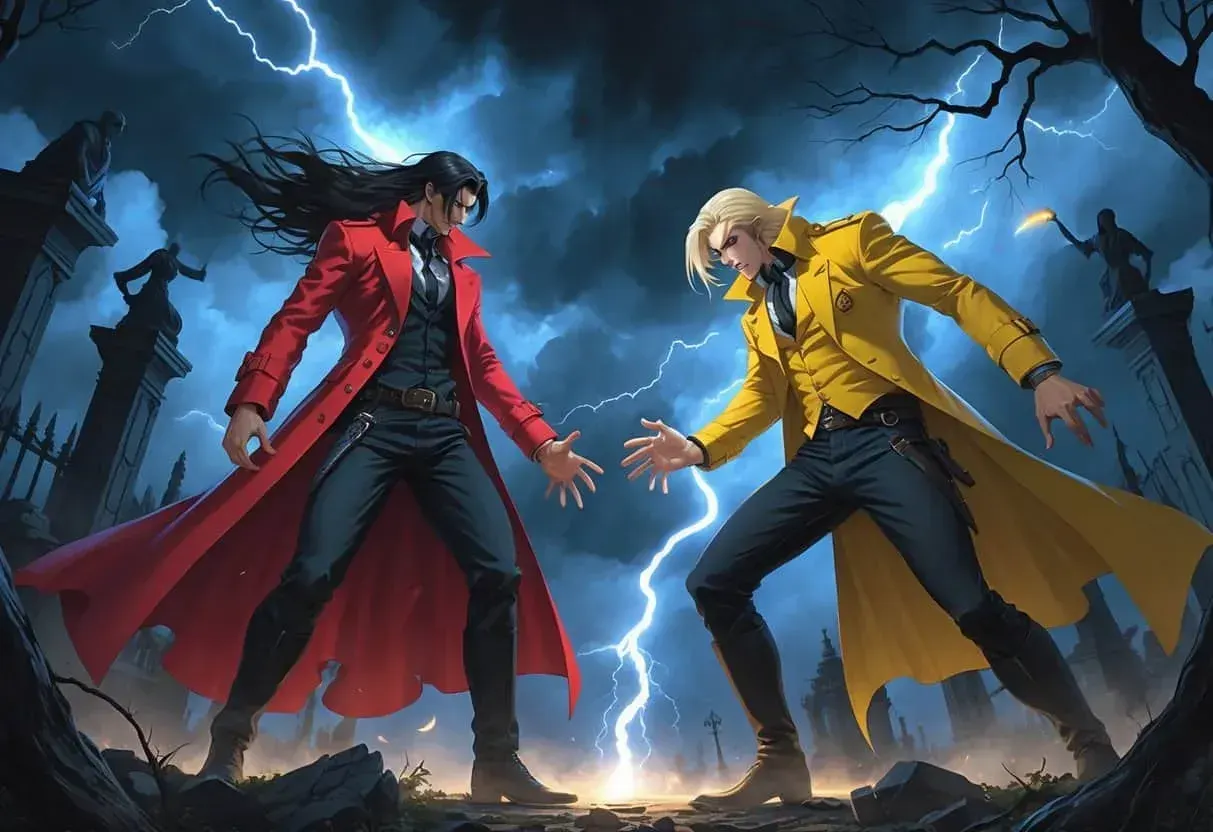
When two of anime’s most iconic vampires collide, the debate over who would win rarely reaches a clear conclusion. Alucard, the crimson-clad monster hunter of Hellsing, and Dio Brando, the time-stopping archvillain of JoJo’s Bizarre Adventure, represent opposite ends of the supernatural spectrum. One is a shapeshifting, soul-devouring immortal; the other is a charismatic human turned vampire with a reality-warping Stand. Their legacies are built on dominance, but a direct confrontation forces fans to examine speed, regeneration, versatility, and the nuanced rules of each universe.
Dio’s raw physical speed and ability to freeze time make him a terrifying first-strike threat, but Alucard’s layered immortality and monstrous adaptability prevent any quick knockout. This matchup is not just a brawl—it’s a collision of narrative philosophies, power ceilings, and the way each series defines “unbeatable.”
To unpack a potential victor, you have to weigh immediate offensive power against long-term resilience, supernatural restrictions against loopholes, and the mental games each fighter brings to the ring. Below we break down their origins, abilities, limits, and cultural weight, drawing from canonical feats and the vibrant fan discourse that keeps this showdown alive.
Origins and Lore of Alucard and Dio Brando
Grasping the full danger of these characters requires understanding where they come from. Their backstories are not just flavour text—they directly inform what each can withstand and how they think in combat. Alucard’s gothic roots tie him to European vampire myth, while Dio’s origin fuses Victorian ambition with alien artifacts. Together they showcase two radically different evolutions of the undead idea.
Historical Context and Mythology
Alucard’s very name is a reversal of Dracula, signalling his direct lineage to Bram Stoker’s novel. In the Hellsing universe, he is the historical Vlad the Impaler, transformed into a true vampire through a combination of battlefield horrors and occult ritual. This gives his character a weight that echoes real-world fears—he is the archetype of the aristocratic predator, a walking plague that cannot be ended by conventional holy weapons. His service to the Hellsing Organization is a form of penance, but also a master-servant bond that imposes specific restrictions; he can only unleash his full might when his master, Integra Hellsing, releases the control art restriction system. That dependency shapes any hypothetical fight where Alucard starts at his base level of power.
Dio Brando, by contrast, is a product of the JoJo’s Bizarre Adventure world, where vampires are created by a Stone Mask that unlocks latent brain potential. The mask’s origin is later tied to the ancient Pillar Men and a cosmic meteor, giving Dio’s vampirism a pseudo-scientific sheen. Set in late 19th-century England, Dio’s transformation is an act of desperate ambition, not ancient prophecy. He becomes a creature of pure ego, driven by a need to dominate all life. This psychological profile is critical: Alucard often toys with opponents, searching for a worthy death, while Dio fights to impose his supremacy absolutely.
Both characters bend vampire lore to serve their stories. Alucard drinks blood and commands darkness in ways that feel classic, but he also houses millions of souls inside his body, each one a replacement for any death he might suffer. Dio can freeze blood, fire high-pressure fluid jets from his eyes, and later, thanks to his Stand The World, stop time entirely—an ability far removed from traditional undead tropes. Recognizing these mythologies clarifies the gap between “vampire” as a label and the specific, rule-bound monsters they actually are.
Character Introductions
Alucard first appears in the Hellsing Ultimate anime as a seemingly invincible weapon. He wears a red coat and hat, carries two massive pistols, and grins through dismemberment. His loyalty to Integra is absolute because their contract binds his limitless existence to her bloodline. When he fights, he frequently lets enemies land catastrophic blows just to prove they cannot kill him. That theatrical cruelty is a deliberate psychological weapon.
Underneath the swagger, Alucard is profoundly tired of eternity and longs for a human to end him—a desire that makes him neither merciful nor predictable.
Dio Brando is introduced as a bitter, clever boy who becomes a monster through a mix of calculation and rage. After donning the Stone Mask in Phantom Blood, he slaughters the Joestar household and embarks on a century-long quest for power. In Stardust Crusaders, he resurfaces with a Stand, The World, having fused his vampire endurance with a time-manipulating spirit. Unlike Alucard’s resigned ennui, Dio is defined by an insatiable hunger for control. Every monologue, every sadistic pause, serves his goal of forcing others to acknowledge him as the ultimate being.
His charisma is so overwhelming that he commands fanatical followers, many of whom surrender their bodies to his flesh buds without question.
These introductions set the stage for conflict: Alucard seeks a glorious death, Dio refuses to accept any loss. Their personalities alone guarantee a fight that would spiral into extremes neither opponent initially shows.
Legacy in Anime Culture
The rivalry between these two characters isn’t just fan speculation—it’s embedded in the way anime fandom talks about power levels. Alucard’s portrayal in Hellsing Ultimate set a standard for overpowered protagonists who are also morally ambiguous antiheroes. His shadowy, gun-slinging aesthetic can be traced through later shows like Castlevania and even certain portrayals of demons in modern isekai. Dio’s influence is even more overt. “Za Warudo” and the road-roller finisher have become enduring memes.
More importantly, his Stand-based combat reshaped shonen battles, elevating tactical mind-games above straightforward ki blasts.
Streaming platforms like Crunchyroll and Netflix have kept both series accessible, introducing new generations to the matchup. Fan conventions regularly feature Alucard cosplayers doing hand-cannon poses next to Dio cosplayers in their signature yellow jackets. The JoJo’s Bizarre Adventure franchise alone has inspired countless spin-offs and artbooks that dissect every frame of Dio’s fights. Alucard’s legacy is quieter but no less permanent—he remains the benchmark for regenerating, gun-toting vampires in anime.
This cultural persistence means any analysis of who would win is automatically loaded with decades of fan passion. The debate isn’t sterile; it’s fuelled by people who have pored over frame-by-frame breakdowns of speed feats and regeneration limits. The rest of this article leans into that obsession, treating both fighters’ canonical showings as the only admissible evidence.
Power Comparison: Abilities and Limitations
A fight between Alucard and Dio hinges on a handful of critical capabilities: how fast they can strike, how much damage they can absorb, and whether either can land a truly final blow. The following subsections map their strengths, special techniques, and the narrow windows where they are actually vulnerable.
Supernatural Strengths
Dio’s vampire physiology grants him strength sufficient to punch through stone walls and lift vehicles. His speed, even without Stand enhancement, allows him to flicker across a room faster than the human eye can track. When he freezes blood, he can stop a target’s circulatory system on contact, an instant-kill technique against most organic beings. These traits are magnified by The World, a close-range Stand whose fists strike with enough force to shatter diamond-hard defenses.
Alucard’s physical stats are harder to quantify because he rarely operates at full effort. He has ripped apart SWAT teams and ghoul hordes with bare hands, and his bullets (from the Jackal and Casull) are designed to pierce supernatural targets. However, raw power is not his primary asset; it’s his regeneration. Alucard can rebuild his body from a puddle of blood, reconstitute missing heads, and walk through blessed silver bayonets as though they were drizzle. This healing draws on the lives stored within him—hundreds of thousands of souls absorbed over centuries, each one acting as an extra “hit point” that must be exhausted before he truly dies.
Additionally, Alucard’s intangibility lets him phase through solid matter, becoming a wraith that physical attacks cannot touch. He can also take forms ranging from a swarm of bats to a hellhound to a swirling mass of eyes and shadow. This shape-shifting makes him extraordinarily difficult to pin down; attacks that would splatter a normal body simply give him a new shape to play with. Dio’s blood-freeze might be partially countered if Alucard discards the affected flesh and regenerates around it, a tactic he has used against blessed blades and incendiary rounds.
Stand Powers and Combat Tactics
The centrepiece of Dio’s offence is his Stand, The World, which can freeze time for up to 9 seconds by the finale of Stardust Crusaders. In a typical anime battle, those seconds are an eternity. Dio can reposition, deliver a barrage of punches, throw a volley of knives, or simply monologue while the world is paused. The psychological shock of time suddenly stopping is a weapon by itself—most opponents cannot comprehend what is happening before they are dead.
Alucard has no equivalent to a Stand. However, his psychic and supernatural perception might give him some warning; in Hellsing, he senses killing intent and supernatural presences from across a city. Whether he could perceive the stopped time is ambiguous, but even if he cannot, his layered immortality means surviving the barrage is not the same as being defeated. A time-stop rush could obliterate his physical form, yet he would reform seconds later, likely grinning. The true danger is whether Dio can exploit the time stop to discover Alucard’s core vulnerability—his heart, where the mass of souls is anchored—or to attack his master, Integra, if the fight’s rules allow outside targets.
Alucard’s own tactics rely on attrition and psychological erosion. He summons familiars—the ghosts of those he has consumed—which can swarm the battlefield, deliver corrosive blood attacks, or simply confuse the enemy. His Level Zero release unleashes every soul he posseses as an army of undead, turning a one-on-one duel into a small war. Against an opponent like Dio, who relishes direct confrontation, this chaos could overwhelm even time-stop superiority. Alucard also has a habit of letting enemies exhaust their best moves while taunting them, gathering data on speed, range, and cooldowns before counter-attacking with precision.
Weaknesses and Vulnerabilities
Despite his godlike aura, Alucard is not without limits. His intangibility cannot be maintained indefinitely; he must materialise to attack, creating split-second vulnerabilities. Sustained damage over a very long period could theoretically deplete his soul stock, though this is more a theoretical endpoint than a practical tactic. More importantly, Alucard’s power is tied to his psychological state. If he decides an opponent is worthy, he may allow himself to be killed, as he almost did in his final bout with Walter.
A fighter as proud as Dio might inadvertently trigger Alucard’s desire to die, but that would be a wild card, not a reliable exploit.
Dio’s primary weakness is the cooldown and range of The World. The time stop lasts only a handful of seconds, and the Stand must physically travel to the target to inflict damage. If Alucard phases out of reach or leaves decoys, Dio could waste his trump card. Vampire physiology also makes Dio vulnerable to sunlight and Hamon (ripple energy), neither of which Alucard possesses in a traditional sense. However, Alucard’s mastery of blood and shadow might allow him to create artificial darkness or consume enemies in ways that bypass the need for sunlight.
The bigger risk for Dio is that The World sustains damage that reflects onto him; Alucard’s ability to attack from multiple angles with tendrils, bullets, and familiars could eventually crack the Stand’s defence.
Neither fighter goes down easily, but their vulnerabilities are asymmetrical. Dio can dominate within the span of a time stop; Alucard can outlast almost any finite assault. The battle’s outcome turns on whether Dio can identify and destroy the core of Alucard’s soul-cluster before his own stamina or sanity frays.
Hypothetical Fight Analysis: Scenarios and Outcomes
To move from abstract abilities to a concrete winner, it’s useful to walk through how the fight might unfold under different starting conditions. The environment, the version of each character, and even the presence of bystanders can shift the balance.
Default Encounter: Neutral Grounds
Assume the fight begins in a ruined cityscape at night, no allies present, and both fighters at their prime (post–Level Zero unrestricted Alucard and high-DIO from the end of Stardust Crusaders). Alucard immediately fires the Jackal, a massive semi-automatic pistol loaded with mercury-jacketed explosive rounds. Dio reacts by stopping time, dodging the bullet trail, and delivering a flurry of punches to Alucard’s torso.
Alucard’s body is pulverised, but within a heartbeat the shattered flesh flows back together. Dio, surprised, stops time again and tries to shatter the head. Same result. At this point, Dio would likely adopt his defensive knife-throwing strategy, scattering dozens of projectiles during stopped time to shred Alucard from multiple angles. The key moment occurs when Dio notices that the regeneration is not instantaneous for the entire corpse—Alucard’s heart, hidden inside his body, might be protected but still a focal point.
If Dio can use the time stop to extract and destroy that heart (rather than just the surrounding tissue), he might significantly delay Alucard’s return.
However, Alucard would not stay passive. He would release a wave of blood tendrils and shadow to fill the area, forcing Dio to keep moving. Each time Dio stops time, Alucard studies the pattern, learning the maximum interval and cooldown. After several seconds of real time, Alucard could activate his Level Zero army, filling the street with thousands of undead soldiers. Dio’s time-stop punches are devastating but single-target; he cannot eliminate an entire army in five to nine seconds.
The familiars would slowly overwhelm Dio’s space, even if they cannot directly damage The World. Exhaustion, blood loss from prior damage, and the psychological weight of seeing Alucard smile through every death would wear Dio down until a mistake allows a fatal blow.
Altered Conditions
If the battle occurs near sunrise, all of Dio’s vampire weaknesses become acute. Alucard can shield himself with shadow, but Dio would lose his regeneration advantage and possibly be forced to retreat underground. In that scenario, Alucard’s victory is almost certain unless Dio can use the time stop to flee immediately. Conversely, if Alucard starts with his restrictions locked by the Hellsing control art system, he may not have access to Level Zero and could be reduced to a single life—a state where Dio’s immediate decapitation might actually end the fight. The presence of a master like Integra Hellsing on the field could also redirect Dio’s focus; eliminating her would sever Alucard’s contractual leash and potentially create confusion that Dio could exploit.
Cultural Impact and Legacy
Beyond the hypothetical victor, the Alucard-versus-Dio debate endures because both characters represent a specific era of anime coolness. Their influence on modern media and fan creations confirms that this matchup is as much about storytelling identity as it is about power scaling.
Influence on Modern Anime and Media
Alucard’s gothic sensibilities and the baroque ultraviolence of Hellsing Ultimate helped pave the way for mature-themed series that blend horror with stylish action. The OVA’s commitment to practical firearm designs, religious symbolism, and operatic bloodshed can be seen in later productions like Castlevania and Darker than Black. Dio’s impact, meanwhile, stretches across shonen and seinen alike. His Stand battles encouraged creators to design more cerebral, rule-based superpowers, a trend that is now standard in series from Hunter x Hunter to Jujutsu Kaisen. Dio’s flamboyant pronouncements and iconic poses have also leaked into professional wrestling, music videos, and even fashion editorials that cite “JoJo aesthetics.”
Anime streaming platforms have made it possible for crossover discussions to flourish globally. Newcomers who binge both series often stumble into online forums and immediately ask the ultimate question: “Who would win?” This cross-pollination fuels a steady stream of reaction videos, video essays, and live debates at Viz Media–hosted panels. The fact that neither series has an official crossover only intensifies the fan desire to fill the void.
Fan Interpretations and Crossover Creations
The fandom ecosystem around this matchup is staggeringly creative. Artists on social media platforms regularly post colour-shifted comics where Alucard’s familiars clash with Dio’s time-stop knives. Fanfiction writers have scripted multi-chapter epics that place both fighters in neutral universes like the Fate franchise or Death Battle’s simulated arena. One popular animated short by the YouTube channel Death Battle (and similar creators) attempted to quantify their speeds and durability through frame-counting, resulting in a split-decision that itself became a talking point.
These interpretations go beyond simple death matches. Many fans explore what would happen if Alucard attempted to absorb Dio’s soul: Would Dio’s ego corrupt Alucard from within? Could Dio’s Stand persist as a psychic remnant inside Alucard’s collective? Such questions keep the conversation intellectually interesting, tapping into the metaphysical rules each universe laid down. Cosplay gatherings frequently stage face-offs, with the Dio cosplayer stopping the action while the Alucard cosplayer dramatically re-forms from a “blood pool” of red fabric.
Even memes carry the discourse forward. The image of Alucard walking through a hail of time-stopped knives with a bored expression has become shorthand for the regenerative-immortal archetype. Meanwhile, variations of the “Oh, you’re approaching me?” sequence are remixed with Alucard dialogue to highlight the inevitable trash talk before blows are exchanged. This living, breathing fandom ensures that no analysis is ever truly final—it merely adds fuel to the next round of speculation.
When all is tallied, a clean and universally accepted outcome remains elusive, and that is exactly what makes the matchup so compelling. Dio overwhelms; Alucard endures. Dio freezes the clock; Alucard stretches the fight until the clock becomes irrelevant. In the end, the “winner” often depends on which narrative you value more: the dramatic, time-defying strike that ends a legend in an instant, or the inexorable, soul-deep resistance that proves true immortality cannot be out-sped. As long as both series continue to be watched and celebrated, the night will always have room for one more vampire showdown.